

ChatGPT vs Google Search Volume 2026: What OpenAI's Claim Means
Short answer
In November 2026, OpenAI said ChatGPT's search activity now equals roughly one-fifth of Google's search volume. The two companies measure a 'search' differently and neither figure is independently verified, so this isn't a real market-share figure. For small businesses, it means AI assistants are a growing discovery channel, but Google still carries far more volume and remains the main SEO priority.
A small business owner scrolls past a headline that says ChatGPT's search volume has reached one-fifth of Google's.
She doesn't run ads on either platform. She just writes a blog post now and then and hopes people find her shop.
The headline makes it sound like the ground has shifted overnight, and she wonders if she should stop worrying about Google rankings and start worrying about something called AI visibility instead.
That's the question behind ChatGPT vs Google search volume 2026: what OpenAI actually claimed in November 2026, what the number does and doesn't tell you, and what it's worth changing on your own site either way. Here's how to make sense of the claim without overreacting to it.
What OpenAI Said About ChatGPT's Search Volume in November 2026
In November 2026, OpenAI said that ChatGPT's search-related query volume had reached roughly 20% of Google's search volume. The comparison was framed as a milestone: a sign that people are increasingly turning to a chat interface to find information, rather than typing a query into a traditional search box.
The figure traveled fast. Within days it was being repeated in marketing newsletters and SEO forums as shorthand for
a shift that was already underway becoming suddenly official. Few of those repeats paused to ask what a "search" actually meant in either number, or whether the two companies were counting the same kind of action at all.
How ChatGPT and Google Count a 'Search' Differently
Before comparing two numbers, it helps to know what each one is actually counting. Google and OpenAI don't run the same kind of product, so there's no guarantee their definitions of a "search" match up.
What counts as a ChatGPT search
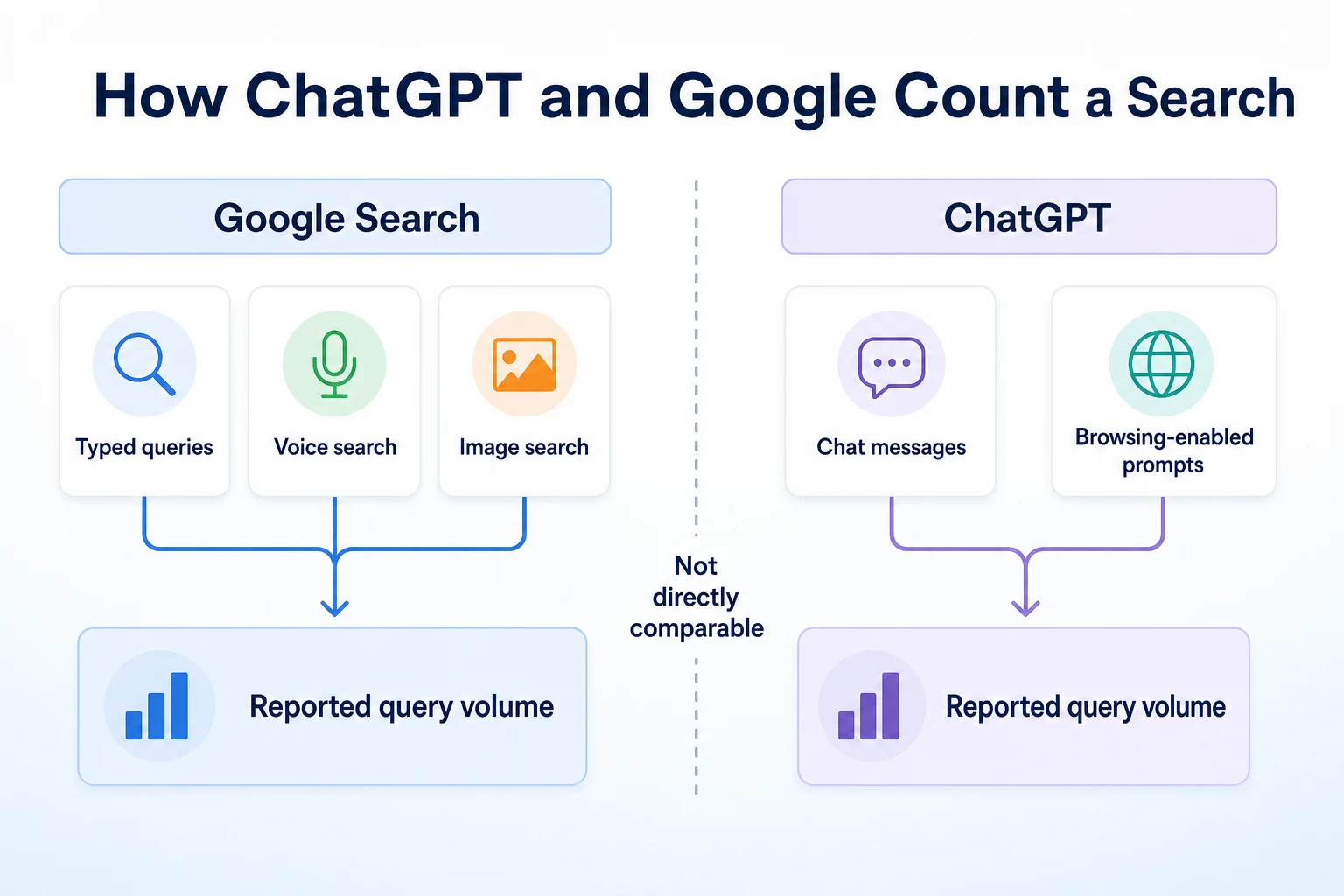
ChatGPT is primarily a chat interface. A person can ask it a factual question, request a summary, have it draft an email, or ask it to browse the web for current information. Only some of those interactions involve ChatGPT actually reaching out to search the web for an answer. OpenAI's reported figure likely includes messages where its browsing or search tool is triggered, which is a narrower slice of total ChatGPT usage, but OpenAI hasn't published the exact criteria it used to decide which messages counted toward the 20% figure.
What counts as a Google search
Google's search volume, as Google itself describes its own product, spans typed queries, voice searches, image searches and queries that trigger things like Google Business Profile listings or shopping results. It's a single, well-established category that Google has reported on in various forms for years, even though Google doesn't publish an exact, current total query count either. The point isn't that Google's number is perfectly known. It's that Google's definition of a search has stayed fairly consistent over time, while ChatGPT's "search-related" activity is a newer category that OpenAI is still defining as it goes.
Why the definitions don't line up
A Google search and a ChatGPT message that happens to trigger a web lookup aren't the same unit of behavior. One is a deliberate act of typing a query into a search box with the expectation of a list of results. The other might be a single step inside a longer conversation, where the person never thought of themselves as "searching" at all. Treating the two totals as directly comparable assumes they measure the same thing, and neither company has confirmed that they do.
Aspect | ChatGPT's likely measurement | Google's likely measurement |
|---|---|---|
What triggers a count | A chat message that activates browsing or a search tool | Any typed, spoken or image-based query submitted to Search |
Consistency of the category over time | New and still being defined by OpenAI | Established and consistent for many years |
Public detail on methodology | Not published in full | Not published in full, but the category itself is well understood |
User intent behind the action | Often one step inside a broader conversation | Usually a deliberate, standalone search act |
Our explainer on how search engines actually work covers the mechanics behind a traditional search in more detail, which is useful background for seeing exactly where a chat-based query diverges from it.
Why a Volume Comparison Isn't the Same as Market Share
Even if the two numbers measured the same thing, a ratio between them still wouldn't amount to a verified market-share figure. That requires a level of independent confirmation that neither company has provided here.
A self-reported figure, not an audited one
The 20% figure came from OpenAI, about OpenAI's own product. No independent research firm, regulator or third-party analytics provider has published a verification of that number. That doesn't make it false. It means it should be read the way any company's self-reported statistic should be read: as a claim about its own performance, not as a neutral measurement of the market as a whole.
Google's own volume isn't fully public either
The other half of the comparison has the same problem. Google doesn't publish a precise, current total for its own global search query volume, so OpenAI's ratio is being built against a figure that is itself an estimate rather than a confirmed baseline. Two uncertain numbers divided against each other don't produce a certain answer. They produce a plausible-sounding ratio that's worth noting, not treating as settled fact.
Where ChatGPT and Google Actually Diverge by Query Type
The more useful question for a small business isn't the overall ratio. It's which kinds of questions people are actually taking to each tool, because that's what determines whether your content needs to show up in one place, the other, or both.
Queries that still favor Google
Navigational searches, where someone wants a specific website or page, still point people toward a traditional search box. Local searches, like finding a nearby business with current hours and directions, also lean heavily on Google, partly because of how closely Google Search is tied to Google Maps and Google Business Profile listings. Anything transactional, where a person wants to click through and complete an action right away, tends to follow the same pattern.
Queries that favor ChatGPT
Research questions, comparisons between options, and requests for an explained answer are more likely to go through a chat interface, where the person wants a synthesized response rather than a list of links to sort through themselves. A question like "what's the difference between X and Y" fits that pattern more naturally than a question like "where can I buy X near me."
Query type | More likely used on | Why |
|---|---|---|
Finding a specific website | Navigational intent fits a search box with a direct result | |
Finding a nearby business | Tied closely to Maps and Business Profile listings | |
Comparing two products or services | ChatGPT | A synthesized answer saves reading several pages separately |
Asking for an explanation of a concept | ChatGPT | The person wants a direct answer, not a list of sources to read |
Completing a purchase or booking | Transactional intent usually ends with clicking through to a site |
Our guides on how to get mentioned in ChatGPT and on how to track ChatGPT traffic go further into both sides of this: how to write content that fits the way AI assistants answer research questions, and how to actually see whether any of that traffic is reaching your site.
What This Means for SEO and Organic Traffic
For most small business websites, the honest answer is that this headline changes less day to day than it sounds like it should. The numbers in Google Search Console tell a more immediate story than a ratio reported by OpenAI.
Google still sends the most clicks
For the large majority of small business sites, Google Search remains the dominant source of organic traffic by a wide margin. A 20% ratio in overall query volume doesn't translate into AI assistants sending anywhere close to that share of a typical website's visits. If your Search Console data shows Google as the source of most of your clicks today, that's unlikely to have changed because of one company's self-reported figure.
What an AI referral looks like instead
When an AI assistant does send a visitor to your site, it tends to look different from a typical Google click. There's often no referral data at all, or it shows up labeled vaguely as direct traffic, which makes it easy to miss if you're only glancing at a top-line traffic number. If you've noticed total organic numbers moving in a way you can't explain, our guide on diagnosing an organic traffic drop walks through how to tell whether a change is coming from Google itself or from somewhere else entirely.
How Brand Discovery Changes When AI Assistants Answer Directly
A ranking in a list of ten blue links and a mention inside a single written answer aren't the same kind of visibility. They ask different things of your content, and they reward different kinds of businesses.
Being cited vs being ranked
Ranking well on Google means your page earns a position among several other options, and the person searching decides for themselves which link to click. Being cited by an AI assistant means your business gets named, sometimes alongside competitors and sometimes alone, inside an answer the person didn't have to click through to read. That's a narrower outcome. There's no page two to fall back to if you're not mentioned, and no guarantee that being cited once means being cited again for a similar question later.
It also changes what "visibility" means in practice. A Google ranking is something you can check directly in Search Console, with real numbers attached. A citation inside an AI assistant's answer is harder to observe, and there's no equivalent dashboard that reliably tells a business owner how often this is happening or why.
What you can influence, and what you can't
You can influence whether your content is clear, specific and easy for a crawler to read. You can make sure your business details, like services, location and pricing, are stated plainly rather than buried in a page designed mainly to look good. You can't control which sources an AI assistant chooses to cite for a given question, and no one, including OpenAI, has published a formula that guarantees a mention. Our piece on how AI assistants decide which businesses to recommend goes further into what's documented about this and what isn't, which is worth reading before assuming any specific tactic will get you cited.
The practical takeaway is modest but useful: write the kind of clear, well-structured content that's easier for any reader, human or machine, to understand correctly. That doesn't buy a guaranteed mention. It removes some of the reasons a system might skip over your page in favor of one that's easier to parse.
A Worked Example: Two Shoppers, Two Search Habits
This example is illustrative, not a record of a real search session.
Imagine two people looking for the same thing: a pair of running shoes for flat feet. One opens Google. The other opens ChatGPT. Neither one is wrong to do what they did, and both might end up buying from the same store.
Step | Google search path | ChatGPT search path |
|---|---|---|
1 | Types "best running shoes for flat feet" into the search box | Asks "what running shoes are good for flat feet" in a chat message |
2 | Sees a page of results, including articles, retailer pages and maybe an AI Overview | Gets a written answer naming a few shoe types or brands, built from sources it browsed |
3 | Clicks into two or three articles to compare opinions | Sees one or two sources cited alongside the answer, if citations are shown |
4 | Clicks through to a retailer's product page to check price and reviews | Sometimes clicks a cited source, sometimes just acts on the summarized answer directly |
5 | Buys from the retailer whose page answered their questions clearly | Buys from whichever brand was named, if they decide to click through at all |
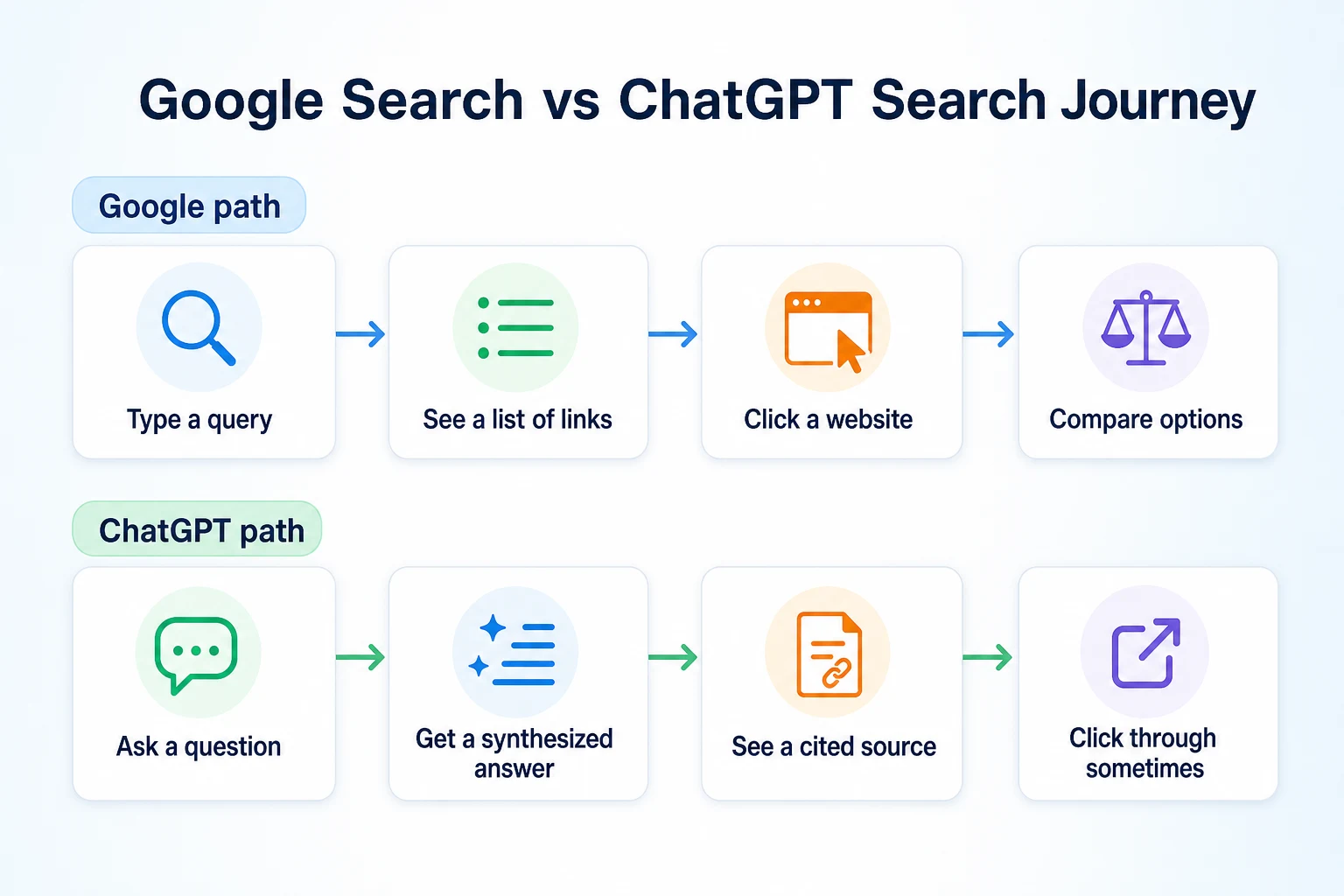
These figures are illustrative.
Notice where a business's content actually has to work in each path. On Google, it needs to earn a click among several competing pages, then hold the visitor's attention once they land. On ChatGPT, it needs to be clear enough, and specific enough, that it gets pulled into the answer in the first place, because there may be no second chance to win the click later in the conversation. Both paths reward content that answers the question plainly. Neither rewards a page that's vague about what it actually sells.
A 30-Day Plan to Prepare Your Site for Google and AI Search
None of this calls for rebuilding a website around a single ratio from a single announcement. A month is enough time to check the fundamentals that matter for Google and for AI assistants at the same time, without treating either one as the only priority.
Week | Task | Why it matters |
|---|---|---|
1 | Run a technical check of your site, including crawlability, page speed and whether key pages are indexed | Both Google and AI crawlers need to be able to reach and read your pages before anything else matters |
2 | Review your most important pages for clear, direct answers to the questions customers actually ask | Vague pages are harder for both a human skimming results and an AI assistant summarizing an answer |
3 | Check whether AI crawlers can actually access your site, and confirm what your robots.txt file allows | A blocked or misconfigured crawler can't read your content, no matter how well it's written |
4 | Review Google Search Console for current click and impression trends, and note anything unusual in direct or unattributed traffic | This is the most reliable way to see what's actually changing on your own site, rather than reacting to an industry-wide claim |
None of these four tasks assumes AI search is replacing Google, or that Google is standing still either. They're the same fundamentals worth checking regardless of which headline prompted the review.
Common Mistakes When Reacting to AI Search Growth Claims
A headline like this tends to produce the same handful of overreactions, and most of them cost more than they fix.
Mistake | Why it backfires | Better move |
|---|---|---|
Dropping proven SEO work to chase "AI SEO" instead | Google still sends the large majority of organic traffic to most small business sites, so abandoning that work removes a reliable channel for an unproven one | Keep improving the pages that already rank, and treat AI visibility as an addition, not a replacement |
Treating the 20% figure as a confirmed market-share statistic | It's a self-reported number compared against an estimate, not an audited measurement of the search market | Read it as one company's claim about its own growth, worth noting but not worth building a strategy around |
Buying into vague "AI SEO" services with no clear deliverable | No one, including OpenAI, has published a formula that guarantees a citation in an AI assistant's answer | Prioritize clear, specific content and a technically sound site, which helps regardless of which tool is reading it |
Ignoring AI referral traffic because the numbers look small | Small volume today doesn't mean the channel stays small, and it's still worth knowing where it's coming from | Check Search Console and your analytics periodically for unattributed or direct traffic that might be AI referrals |
Assuming every visitor behaves the way they do on Google | A ChatGPT answer can satisfy a question without a click at all, which looks like nothing happened even when your content was used | Judge AI visibility by whether your business gets named accurately, not only by click counts |
Where RepGet fits
RepGet has no connection to OpenAI, ChatGPT or Google's search infrastructure, and it doesn't produce or verify statistics about either company's query volume. What it works on is narrower and more concrete: the website behind whichever channel sends someone to it.
A page that's technically sound and clearly written is easier for Googlebot to crawl and rank, and it's also easier for an AI crawler to read and summarize correctly. RepGet's website auditing looks at exactly that layer: whether pages load properly, whether content is organized clearly, and whether there's anything blocking a crawler, human reader, or AI assistant from understanding what a page is actually about. Its keyword research, content planning, article writing and publishing work on the same foundation, building pages that answer real questions plainly rather than vaguely.
If you want to check whether search engines and AI crawlers can actually reach and read your site today, RepGet's free website audit crawls the site and gives it a 0 to 100 SEO score, with technical and content issues worth fixing listed out. No account or credit card required. The free AI Crawler Checker tests specifically whether bots like GPTBot can access your pages, which is a separate and useful check from a general SEO audit.
RepGet doesn't measure how often a business gets cited inside a ChatGPT answer, doesn't track OpenAI's reported query volume, and doesn't guarantee a Google ranking, a Maps position, or a mention in any AI assistant's response. What it can do is make sure the website underneath all of that is ready to be read correctly, by whichever tool a customer happens to be using.
The bottom line
OpenAI's November 2026 claim that ChatGPT's search volume reached roughly 20% of Google's is a real announcement worth knowing about, but it isn't a verified market-share figure. The two companies count a "search" differently, neither number is independently audited, and a ratio built from two uncertain figures doesn't settle how people are actually finding businesses.
What matters more for a small business is simpler and already visible in your own data: how much traffic Google still sends you, whether your content answers real customer questions plainly, and whether your site is technically open to both search crawlers and AI crawlers. Those are the things worth checking this month, regardless of whether the next headline says 20%, 10% or something higher.
Find out what your website needs first
Run a free website audit with RepGet to see what your site needs to work well for Google and AI assistants alike. No account or credit card required.
FAQ
Is ChatGPT search really 20% of Google's volume?
OpenAI said so in November 2026, but it's a self-reported figure compared against an estimate of Google's volume, not an independently audited statistic. It's worth noting, not treating as a confirmed market-share number.
How does OpenAI measure ChatGPT search queries?
OpenAI hasn't published the exact criteria it used. It likely counts chat messages where ChatGPT's browsing or search tool is triggered, which is narrower than every message sent to ChatGPT overall.
Will ChatGPT replace Google search?
Nothing currently documented suggests that. Navigational, local and transactional searches still lean heavily toward Google, while research and comparison questions are more likely to go through a chat interface like ChatGPT.
Does ChatGPT's search growth affect my website's SEO?
For most small business sites, Google still sends the large majority of organic traffic. Writing clear, specific content that's easy to crawl helps with both Google rankings and AI assistant citations at the same time.
How can I tell if ChatGPT is sending traffic to my site?
AI referrals often show up as direct or unattributed traffic in analytics, rather than a labeled referral source. Checking Search Console and your analytics regularly is the most reliable way to spot a pattern.
What's the difference between a Google search and a ChatGPT search?
A Google search returns a list of links for the person to choose from. A ChatGPT search produces a synthesized written answer, sometimes with cited sources, which the person may or may not click through to read.
Should small businesses optimize for ChatGPT instead of Google?
No. Google still accounts for far more search volume and traffic for most sites. The better approach is improving content clarity and site structure in ways that help both Google rankings and AI assistant visibility together.
How do I get my business mentioned in ChatGPT answers?
No one, including OpenAI, has published a guaranteed method. Writing clear, specific, well-structured content about what your business actually offers removes common reasons an AI assistant might skip over your page.