

How to Get Mentioned in ChatGPT: A Business Guide
Short answer
To improve your chances of being mentioned in ChatGPT, make your website accessible to OpenAI's search crawler, clearly explain what your business offers, and build accurate references on relevant third-party websites. Publish useful answers to customer questions and monitor whether ChatGPT mentions your brand. There is no guaranteed placement or fixed ChatGPT ranking.
Ask ChatGPT to recommend an office cleaning company in Manchester, and it may give you a shortlist of businesses.
Your company might appear. Or it might be missing entirely, even if you have a working website and years of experience.
There is no submission form that guarantees your business will appear in organic ChatGPT recommendations. And unlike traditional Google search results, there isn't a fixed first-page ranking you can work toward.
What you can do is make your business easier to discover, easier to understand, and easier to verify.
That involves your website, the information published about your company elsewhere, and the way you measure whether anything is improving.
Here is a practical process you can follow.
How ChatGPT finds businesses to recommend
ChatGPT does not use a single, publicly accessible directory of approved businesses.
Depending on the question and the features involved, an answer may draw on the model's existing knowledge, retrieve current information from the web, or use relevant search and data providers.
When ChatGPT searches the web, it can return an answer supported by links to sources.
This creates an important distinction between three outcomes.
Outcome | What it means |
|---|---|
Brand mention | ChatGPT names your business in its answer |
Citation | ChatGPT links to a page on your website as a source |
Website referral | Someone clicks a link and visits your website |
These are not interchangeable.
Imagine ChatGPT answering a question about office cleaning costs.
It might cite an article on your website without recommending your company as a cleaning provider.
Or it might name your company among several providers without linking directly to your website.
Both can be useful, but they represent different kinds of visibility.
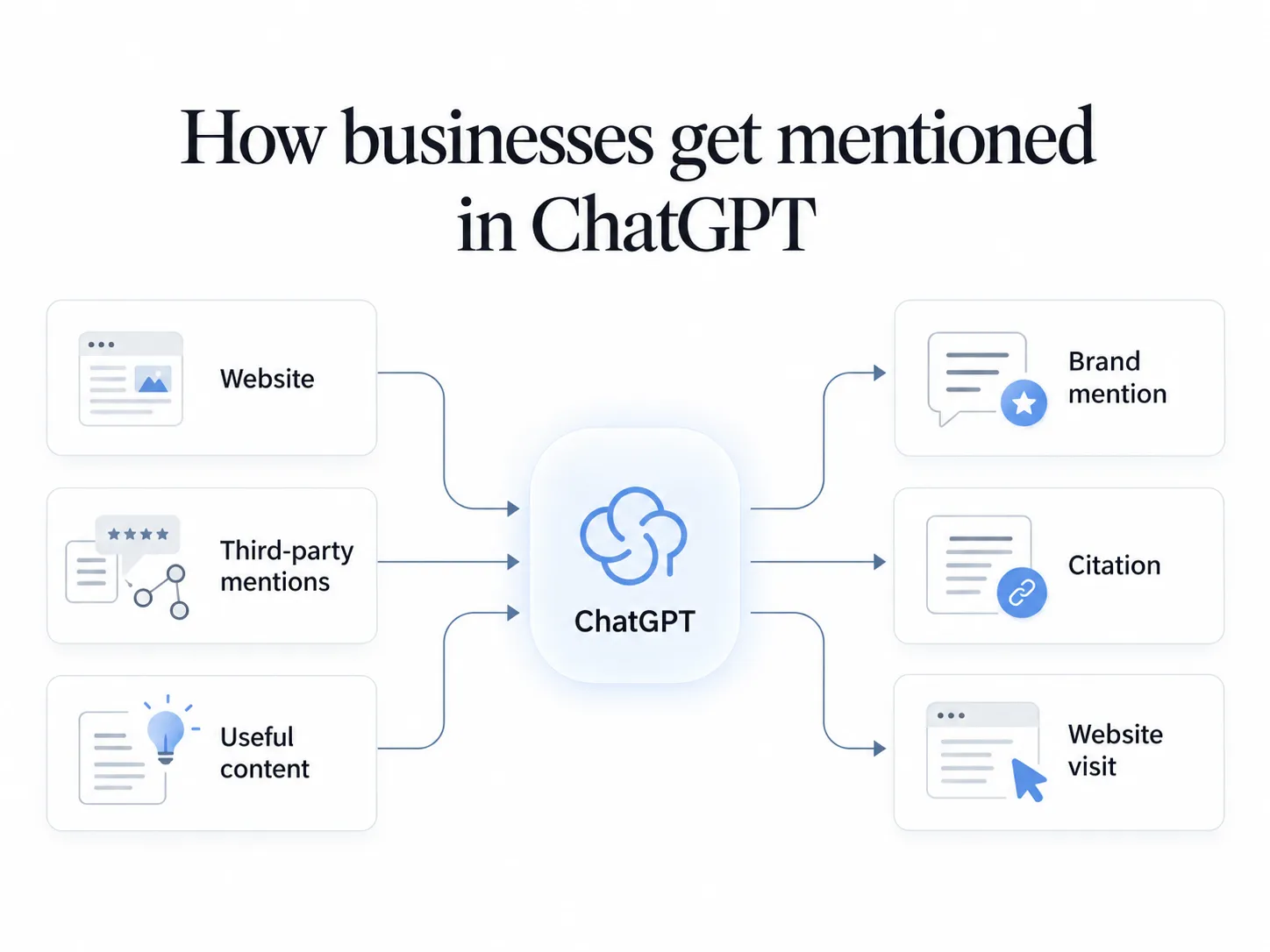
A 2026 Semrush study of AI citations and brand mentions found that citations frequently appear without the corresponding brand being named in the answer.
For businesses, the objective should therefore be broader than collecting links.
You want potential customers to encounter accurate information about your business when they ask relevant questions.
The first step is making sure ChatGPT can access that information.
Check whether ChatGPT can access your website
This is one of the few technical checks you can perform immediately.
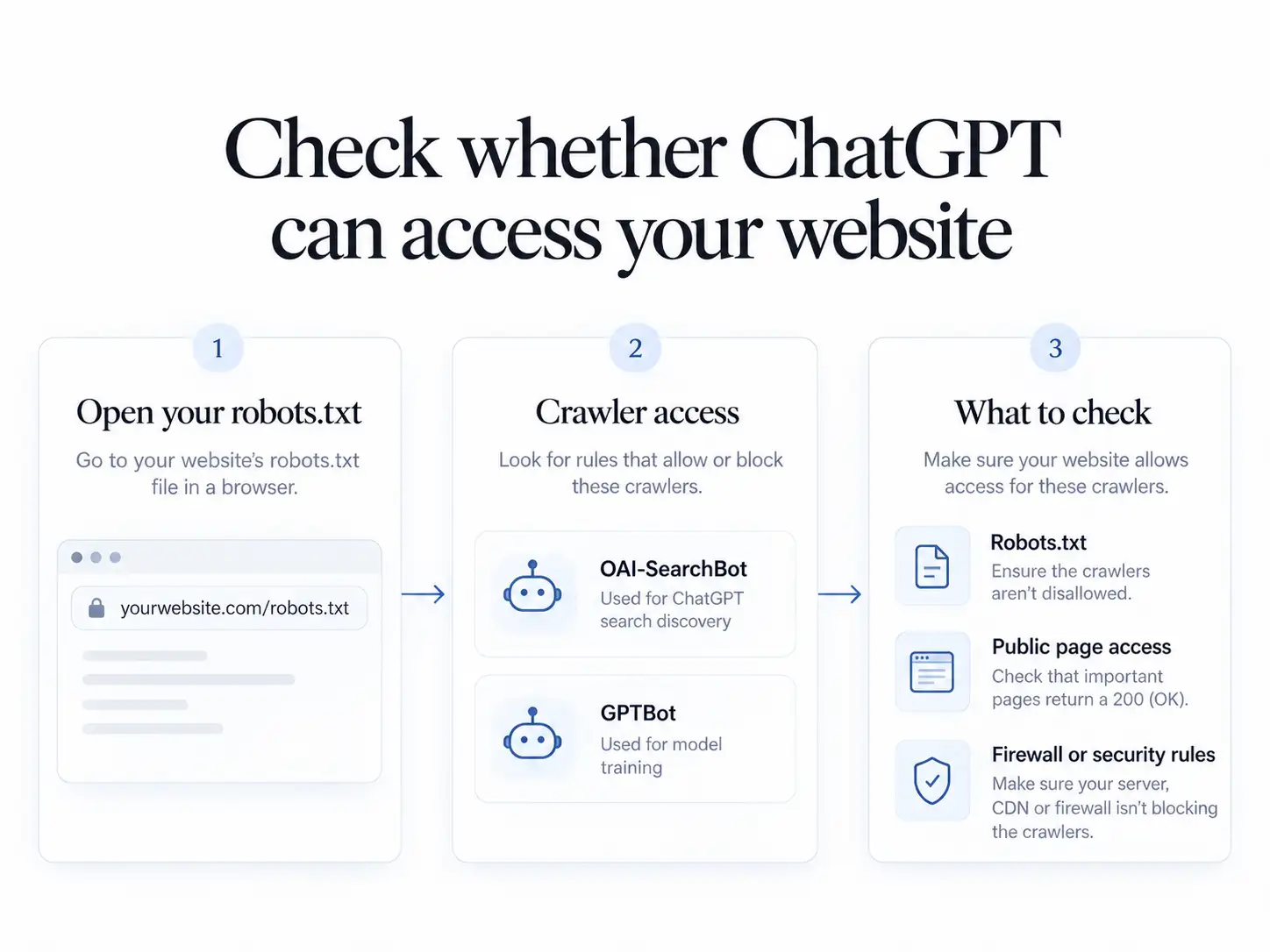
OpenAI uses a crawler called OAI-SearchBot to help discover and surface websites in ChatGPT search.
Website owners can control crawler access through a file called robots.txt.
You can view yours by adding /robots.txt to your domain.
For example:
https://yourwebsite.com/robots.txt
Look for rules affecting OAI-SearchBot.
A sitewide block that applies to this crawler may prevent its pages from being used in ChatGPT search answers, although some navigational links may still appear through other discovery mechanisms.
OpenAI's official crawler documentation recommends allowing OAI-SearchBot when you want your public content to be discoverable through ChatGPT search.
OAI-SearchBot and GPTBot are not the same
This distinction is easy to miss.
OAI-SearchBot is used for ChatGPT search discovery.
GPTBot is used to crawl content that may be used to train OpenAI's foundation models.
A website can allow OAI-SearchBot while blocking GPTBot.
You do not need to permit model-training crawls simply to make your pages eligible for ChatGPT search discovery.
OpenAI documents these controls separately.
Check your site in practice
Start with three checks.
Check crawler permissions. Read your robots.txt rules and confirm OAI-SearchBot is permitted to access the pages you want discovered.
Check the actual page. Make sure important information is publicly accessible without logging in or completing a form.
Check your security settings. Some firewalls, hosting rules, and security services can block crawler requests even when robots.txt allows them.
If you are unsure how your site is configured, use the free RepGet AI Crawler Checker. It checks published robots.txt permissions for OAI-SearchBot and other AI crawlers.
The checker is a useful first step, although it does not replace checking server logs or firewall behavior when you suspect a crawler is being blocked.
Fixing access problems makes your content eligible for discovery. It does not guarantee that ChatGPT will recommend your business.
Make it immediately clear what your business does
A surprisingly common website problem is that the business description sounds impressive but says very little.
Consider a homepage that opens with:
Transforming experiences through innovation, passion, and excellence.
A visitor might eventually work out what the business sells.
An AI system trying to answer a specific question has the same problem: there is very little concrete information in that statement.
Now compare it with:
Acme Clean provides scheduled office cleaning for small and medium-sized businesses in Manchester, including evening cleaning and one-off deep cleans.
The second description identifies the service, customer, location, and relevant capabilities.
It is easier to understand.
The example is fictional, but the principle applies to almost any company.
Your website should clearly explain:
What you sell or provide.
Who your service is intended for.
Which locations you serve, if relevant.
What distinguishes your offering.
How customers can contact you or make a purchase.
That information should appear naturally in your homepage, service pages, and About page.
Avoid describing every service with the same vague marketing language.
A business offering wedding photography, commercial filming, and social media production should explain those services individually instead of relying on one broad description.
Keep important details consistent
Check how your company is described across your website and other public profiles.
Does the business name appear consistently?
Are locations, services, opening hours, and contact details accurate?
Do old profiles still describe products you stopped selling?
You cannot control every source that an AI assistant encounters, but you can correct the information you publish and maintain.
Consistency reduces contradictions that might otherwise confuse customers or systems gathering information about your company.
If you want to understand the broader reasoning behind AI recommendations, read our earlier guide on how AI assistants decide which businesses to recommend.
Build credible mentions beyond your own website
Your website is an important source of information about your business.
But it is also written by you.
A company describing itself as the best provider in its industry is not independent evidence that customers should choose it.
Third-party information can provide additional context.
This might include legitimate customer reviews, professional directories, industry publications, business partners, independent comparisons, or articles that reference your expertise.
The quality and relevance of those references matter.
What the research suggests
Ahrefs analyzed 75,000 brands to examine relationships between online brand signals and visibility in AI search experiences.
Its research found that branded web mentions correlated with AI visibility, with reported correlations of approximately 0.66 to 0.71 across the systems studied.
YouTube mentions also showed a strong correlation.
The findings are interesting, but they do not establish that obtaining a certain number of mentions will cause ChatGPT to recommend a business.
Larger, better-known brands may naturally receive more coverage and appear more often in recommendations for many reasons.
You can examine the Ahrefs research and methodology directly.
For a small business, the practical lesson is to invest in being accurately represented on relevant websites, rather than manufacturing mentions.
Where to start
If you operate locally, review your legitimate business profiles and industry listings.
If you sell software, make sure your product information is current on appropriate review and comparison platforms.
If you offer professional services, look for opportunities to contribute expertise to industry publications or share useful work that others may reference.
Customer reviews can also help establish context, provided they are genuine.
Avoid purchasing fake reviews, creating fabricated recommendations, or placing promotional comments in communities while pretending to be an independent customer.
Those tactics undermine trust, regardless of whether they temporarily increase the number of times your brand appears online.
A smaller collection of credible, relevant references is a better foundation than hundreds of artificial mentions.
Publish answers to questions your customers actually ask
A business website needs more than a homepage and a contact form.
People often ask ChatGPT for advice before they know which company to choose.
For example:
How much does commercial office cleaning cost?
Should a small office use daily or weekly cleaning?
What should I ask before hiring a cleaning company?
A business with useful, accurate information about these subjects gives readers something valuable to discover.
It also creates material that a search-enabled assistant may be able to retrieve and cite.
The important word is useful.
Publishing fifty articles that repeat the same general advice does not give customers fifty different reasons to trust you.
Start with three types of content
Service information
Explain what your company actually offers, what is included, and which customers it serves.
Decision-making guides
Help customers compare realistic options, understand pricing, and identify questions worth asking before buying.
Evidence from your own work
Publish detailed examples, original observations, product demonstrations, or case studies when you have genuine material to share.
A software company could explain a real product workflow.
A hotel could publish accurate information about its rooms, facilities, location, and booking conditions.
A production studio could explain how a project is planned and what affects the creative process.
These details are difficult for an unrelated publisher to reproduce accurately.
They also give your website a reason to exist beyond attracting traffic.
Make the important answer easy to find
You don't need to fill every article with artificial questions or repeat the same phrase in every heading.
Write a clear title.
Answer the main question early.
Explain the details in a logical order.
Use tables when they genuinely improve comparisons, and keep factual information current.
If a price or product feature changes, update the page itself rather than simply changing its publication date.
These are sound editorial practices for readers and search engines alike.
There is no special writing format that guarantees ChatGPT will cite your content.
Check whether ChatGPT already mentions your business
Before making more changes, establish a baseline.
Open ChatGPT and test the kinds of questions potential customers might ask.
Avoid using only prompts that contain your business name.
For example, asking "What is Acme Clean?" tests whether ChatGPT can describe a known company.
It does not tell you whether the business appears when someone asks for office cleaning recommendations without knowing its name.
Those are very different situations.
A practical set of test prompts
For a hypothetical commercial cleaning business in Manchester, you could use the following:
Type | Example prompt |
|---|---|
Local recommendation | Which companies provide office cleaning for small businesses in Manchester? |
Specific customer need | Can you recommend commercial cleaners in Manchester for a 20-person office? |
Service requirement | Which Manchester office cleaning companies offer evening appointments? |
Buying comparison | What should I compare when choosing an office cleaning provider in Manchester? |
Pricing research | How much does commercial office cleaning cost in Manchester, and which providers explain their pricing? |
Branded accuracy check | What services does Acme Clean offer in Manchester? |
The company and prompts are illustrative, not reported test results.
The first five questions can help investigate unbranded discovery.
The last question checks whether the model describes the business accurately when you identify it directly.
Don't combine those results into one visibility score.
Record what actually happens
For each relevant prompt, note whether:
Your business is mentioned by name.
A page from your website is cited.
Competitors appear instead.
The answer contains outdated or incorrect information.
The response provides a useful link to your website.
Keep the test conditions as consistent as practical.
Use the same wording, language, and relevant location. Record whether web search was used and which model or product configuration was tested.
Repeat the checks across multiple sessions and dates.
ChatGPT responses can vary, so a single missing mention should not be treated as a permanent ranking failure.
Likewise, appearing once does not establish that the business is consistently recommended.
The goal is to observe patterns rather than celebrate an isolated answer.
What to fix based on your results
This is where monitoring becomes useful.
Different outcomes suggest different next actions.
What you observe | What to investigate next |
|---|---|
Your pages cannot be accessed by OAI-SearchBot | Robots.txt, firewall rules, and page accessibility |
Your website is cited but your brand isn't named | Whether the relevant page clearly identifies your company and its expertise |
ChatGPT names your company but describes it incorrectly | Outdated website content and third-party business information |
Your brand appears when named directly but not in unbranded recommendations | Whether credible sources connect your business with the service category |
Competitors appear repeatedly while your business is absent | Which sources describe them and whether those sources are relevant to your industry |
Your brand is mentioned but you receive little traffic | Whether users are offered useful links and whether referrals are being measured |
These are diagnostic starting points, not a proven explanation for every AI response.
Consider a company that is mentioned correctly when asked by name but never appears in unbranded recommendations.
Publishing another generic homepage description may not solve the problem.
It could be more useful to improve its service pages, collect accurate customer feedback, or contribute expertise to publications that people in its industry already trust.
Another company might have excellent third-party references but accidentally block OpenAI's search crawler.
Its first priority should be technical access.
The right action depends on the reason your business may be difficult to discover or recommend.
This is why measuring visibility matters more than blindly publishing additional content.
How to measure ChatGPT visibility over time
ChatGPT does not provide website owners with a conventional Search Console equivalent showing every time their business was considered or recommended.
You need to distinguish three measurements.
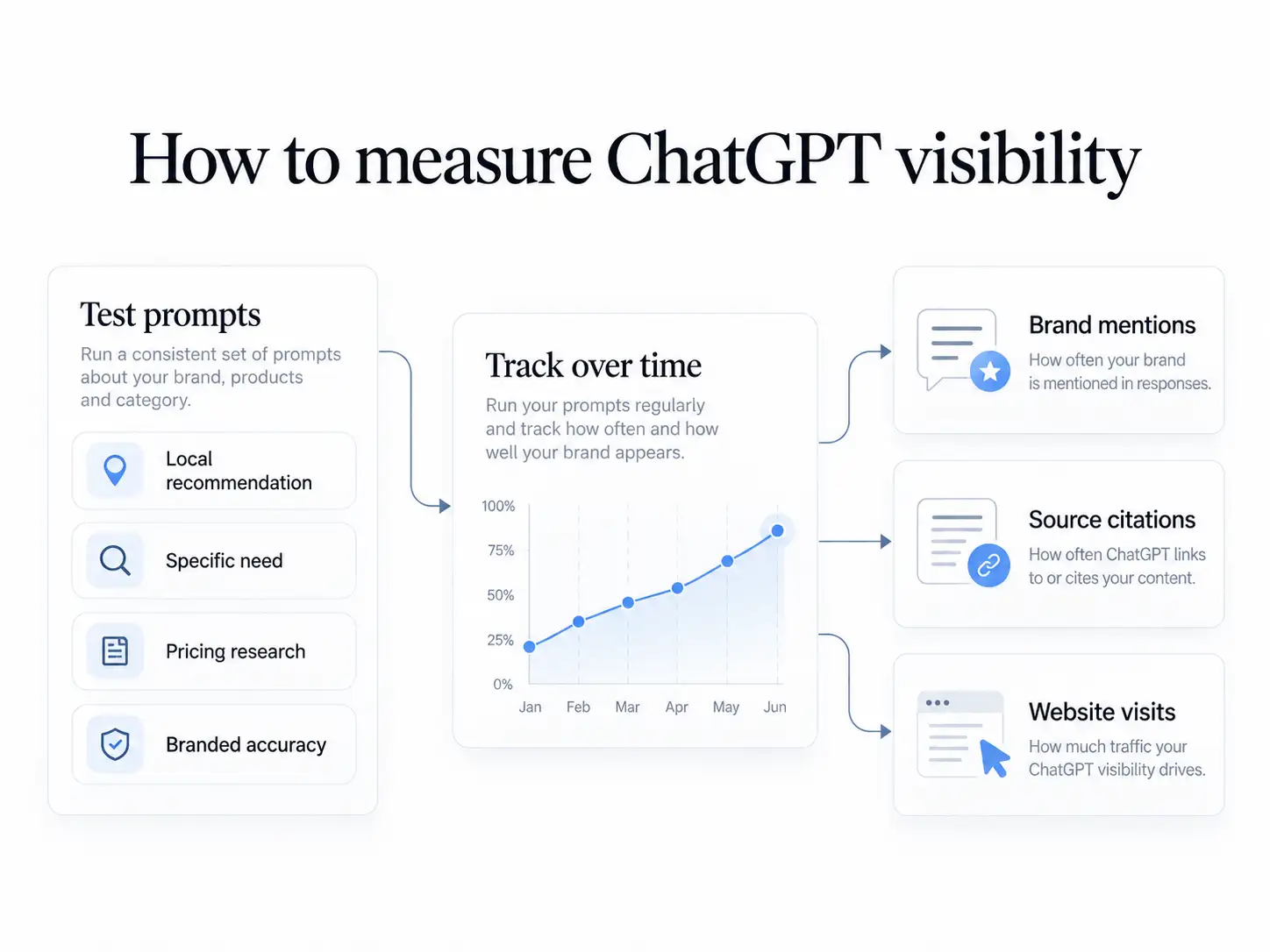
Brand mention frequency
Choose a stable set of relevant prompts and track the proportion of tested responses in which your business is named.
For example, if a business appears in three out of ten monitored answers, its observed mention rate for that sample is 30%.
That is not a universal ChatGPT ranking.
It describes only the prompts, dates, conditions, and responses you tested.
For comparisons over time, use a consistent methodology.
Keep branded queries separate from unbranded queries, and avoid changing the entire prompt set whenever a result disappoints you.
Source citations
Record whether your website appears as a source even when the business itself is not recommended.
An article that helps answer a research question may earn citations without producing an immediate commercial recommendation.
That can still create awareness and referral opportunities.
But citations and brand mentions should be tracked separately.
Website traffic from ChatGPT
OpenAI's publisher guidance explains that links from ChatGPT search results can include the tracking parameter utm_source=chatgpt.com.
That allows website owners to identify associated visits in analytics.
If you use Google Analytics, inspect traffic attributed to ChatGPT and examine what visitors do after arriving.
Do they read another page?
Submit an enquiry?
Start a trial?
Make a purchase?
Not every brand mention produces a website click, and analytics cannot capture every instance in which an AI answer influences a purchasing decision.
Still, referral visits and conversions are more concrete business outcomes than counting mentions alone.
A useful report should separate all three: mentions, citations, and actual visits.
A practical 30-day plan
You don't need to rebuild your entire marketing strategy to begin improving your visibility.
Start with work you can inspect and maintain.
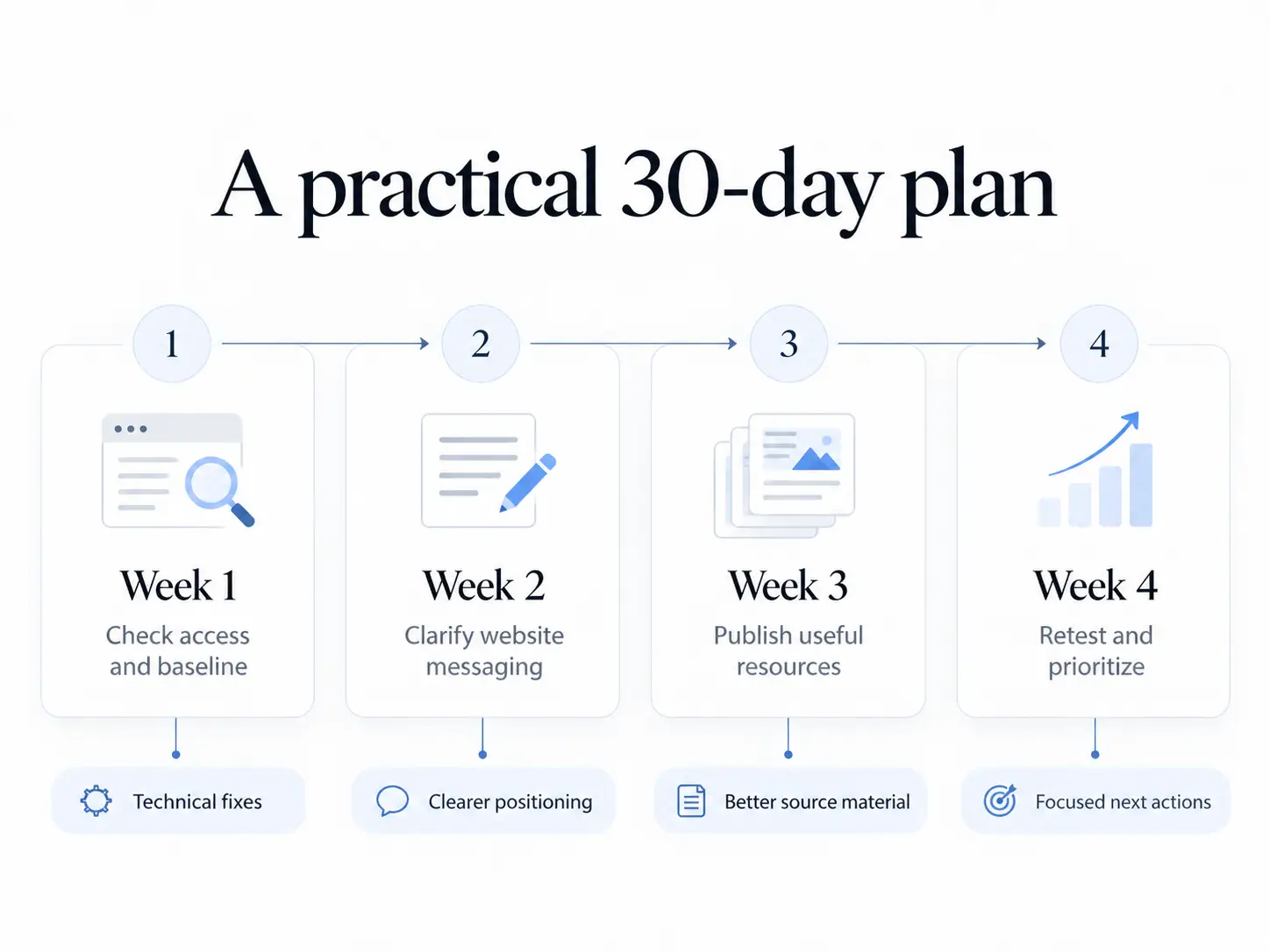
Period | What to do | What you should have afterward |
|---|---|---|
Week 1 | Check crawler access, audit your website, and establish a baseline using relevant prompts | A list of technical issues and initial visibility observations |
Week 2 | Improve homepage and service descriptions, correct inaccurate public profiles | Clearer and more consistent business information |
Week 3 | Publish or improve two genuinely useful customer-focused resources and pursue relevant editorial opportunities | Better source material and legitimate external references |
Week 4 | Repeat the same prompt tests, review citations and referral traffic, and prioritize the next changes | A comparison with the baseline and a focused improvement plan |
This is a process schedule, not a promise that mentions will improve within thirty days.
Some changes may be discovered quickly. Others take longer, and some may have no measurable effect.
The purpose is to learn where the gaps are and address them systematically.
If your website also needs more consistent content production, our guide to AI SEO automation explains which recurring tasks can be automated safely.
What doesn't work: Common ChatGPT visibility mistakes
AI search has created an industry of supposed shortcuts.
Some advice sounds technical enough to be convincing, even when the underlying claims are unsupported.
Buying guaranteed ChatGPT recommendations
No SEO provider can legitimately guarantee that your business will appear in a particular organic ChatGPT recommendation.
Sponsored advertising is a separate product experience from organic recommendations. Purchasing advertising does not guarantee a place in an independent answer.
Be skeptical of anyone selling permanent AI rankings.
Publishing hundreds of nearly identical pages
Creating one page for every possible way someone might phrase a question is not a reliable visibility strategy.
It can also produce a poor experience for actual customers.
A well-developed article that answers several related questions may be more useful than multiple thin pages with almost identical information.
Treating llms.txt as a guaranteed solution
You may encounter suggestions to create an llms.txt file.
Such files can be useful for certain documentation or experimental workflows, but OpenAI does not identify an llms.txt file as a requirement for appearing in ChatGPT search.
It should not replace accessible HTML pages, correct crawler permissions, and accurate public information.
Manufacturing endorsements
Fake customer reviews, fabricated comparisons, purchased praise, and misleading community comments are not a credible way to build visibility.
Even if artificial mentions appear online, they create reputational and compliance risks.
Focus on giving independent publishers and customers real reasons to discuss your business.
Where RepGet fits
For small businesses, the challenge is often keeping track of all the work.
You need to inspect website accessibility, identify technical problems, develop useful content, and monitor whether your brand appears in AI-generated answers.
RepGet brings website auditing, SEO content automation, publishing, and AI visibility monitoring into one workflow.
Its free website check provides a starting point for identifying technical and visibility issues.
For ongoing monitoring, RepGet also advertises tracking across ChatGPT, Claude, Gemini, and Perplexity.
These tools can help organize the process and identify changes worth investigating.
They cannot guarantee recommendations, and their measurements should be interpreted within the prompts and systems being monitored.
The bottom line
Getting mentioned in ChatGPT isn't about finding a secret keyword formula.
Your business needs to be understandable, publicly accessible, and supported by accurate information that others can verify.
Start by checking whether ChatGPT can access your website.
Explain your services clearly.
Publish useful information that demonstrates actual expertise.
Build credible references beyond your own pages.
Then measure what happens when potential customers ask relevant questions.
The objective isn't to appear in every AI answer. It's to become a credible option when someone is genuinely looking for what your business provides.
See whether your website is ready for AI search
Before investing in more content, check whether your website has technical or visibility problems that deserve attention.
Run a free SEO and AI visibility audit with RepGet to identify issues worth investigating and get a clearer starting point.
No account or credit card is required.
FAQ
Can I submit my business directly to ChatGPT?
There is no general submission form that guarantees inclusion in organic ChatGPT recommendations. OpenAI states that publicly accessible websites can appear in ChatGPT search. Making your website crawlable and maintaining accurate public information can support discovery.
Does my website need to rank on Google first?
Not necessarily. Google visibility and ChatGPT visibility are different measurements. Strong search performance may help your content be discovered through search providers, but there is no requirement to hold a particular Google ranking before your business can be mentioned in ChatGPT.
Does blocking GPTBot prevent my website from appearing in ChatGPT search?
Not by itself. OpenAI separates GPTBot, which is associated with potential model-training content, from OAI-SearchBot, which is used for ChatGPT search discovery. You can allow the search crawler while blocking the training crawler.
How long does it take to get mentioned in ChatGPT?
There is no reliable universal timeframe. Discovery, retrieval, source availability, model behavior, and the strength of your public business information can all affect results. Some changes may be reflected sooner than others, and no mention is guaranteed.
Do backlinks help businesses get mentioned in ChatGPT?
Relevant third-party references can contribute to a company's public presence, but backlink quantity alone does not establish AI visibility. Research suggests associations between brand mentions and AI visibility, not a guaranteed causal relationship. Prioritize genuine editorial references over artificial link schemes.
How can I check whether ChatGPT recommends my competitors?
Use the same unbranded prompts you would use to test your own visibility. Record which competitors are mentioned, which sources are cited, and how those results change across repeated tests. Avoid treating one response as a permanent ranking.