

Pinterest Programmatic Deals: What Brands Should Know
Short answer
On October 26, 2026, Pinterest opened Programmatic Deals, letting more advertisers buy its display and video ad inventory through demand-side platforms (DSPs) instead of only Pinterest's own ad manager. This widens eligibility beyond existing Pinterest ad accounts and connects Pinterest inventory to DSPs advertisers may already use elsewhere. Full buyer eligibility and DSP partner details are still rolling out.
A home goods brand's marketing manager opens an email from her Pinterest account rep.
It mentions something called Programmatic Deals, and a demand-side platform she's never used to buy Pinterest inventory before is suddenly listed as an option.
She's spent years running Pinterest campaigns the normal way, picking budgets and audiences inside Pinterest's own ad manager.
Now she's being told she can buy some of that same inventory somewhere else entirely, through a tool her media buying team already uses for other platforms.
She's not sure yet whether that's an opportunity worth exploring or just a new option to ignore.
That's the question behind Pinterest Programmatic Deals, a change Pinterest announced on October 26, 2026. Here's what Pinterest has actually said about it, how it differs from the Pinterest advertising most small businesses already know, and what's worth checking before you decide whether it matters for your brand.
What Pinterest Announced on October 26
On October 26, 2026, Pinterest announced it was opening Programmatic Deals to a wider set of advertisers, letting more buyers purchase Pinterest's display and video advertising inventory through demand-side platforms rather than only through Pinterest's own ad manager. Pinterest described this as extending access that had previously been more limited, connecting its inventory to buying tools advertisers may already use for campaigns running on other platforms.
The announcement in brief
Pinterest's announcement centered on three things: wider eligibility for buying Pinterest inventory programmatically, continued access to display and video ad formats through that route, and partnerships with demand-side platforms that handle the actual buying on an advertiser's behalf. Pinterest hasn't published a full technical breakdown of how its ad exchange or bidding infrastructure works behind this change, so most of what's known comes from how Pinterest describes the buyer experience rather than the mechanics underneath it.
Why Pinterest is opening programmatic access now
Pinterest hasn't published a detailed explanation of the timing beyond presenting this as part of ongoing work to grow its advertising business. It fits a pattern worth noticing, though: platforms that want more ad revenue tend to make their inventory easier to buy through the tools advertisers already use, rather than requiring every buyer to learn a separate, platform-specific system first. Widening programmatic access is one way to do that without changing how Pinterest's self-serve ad manager works for advertisers who prefer it.
What Programmatic Advertising Means on Pinterest
The phrase "programmatic advertising" gets used loosely, so it's worth being precise about what it actually means before deciding whether this change applies to your business.
Programmatic buying, plainly
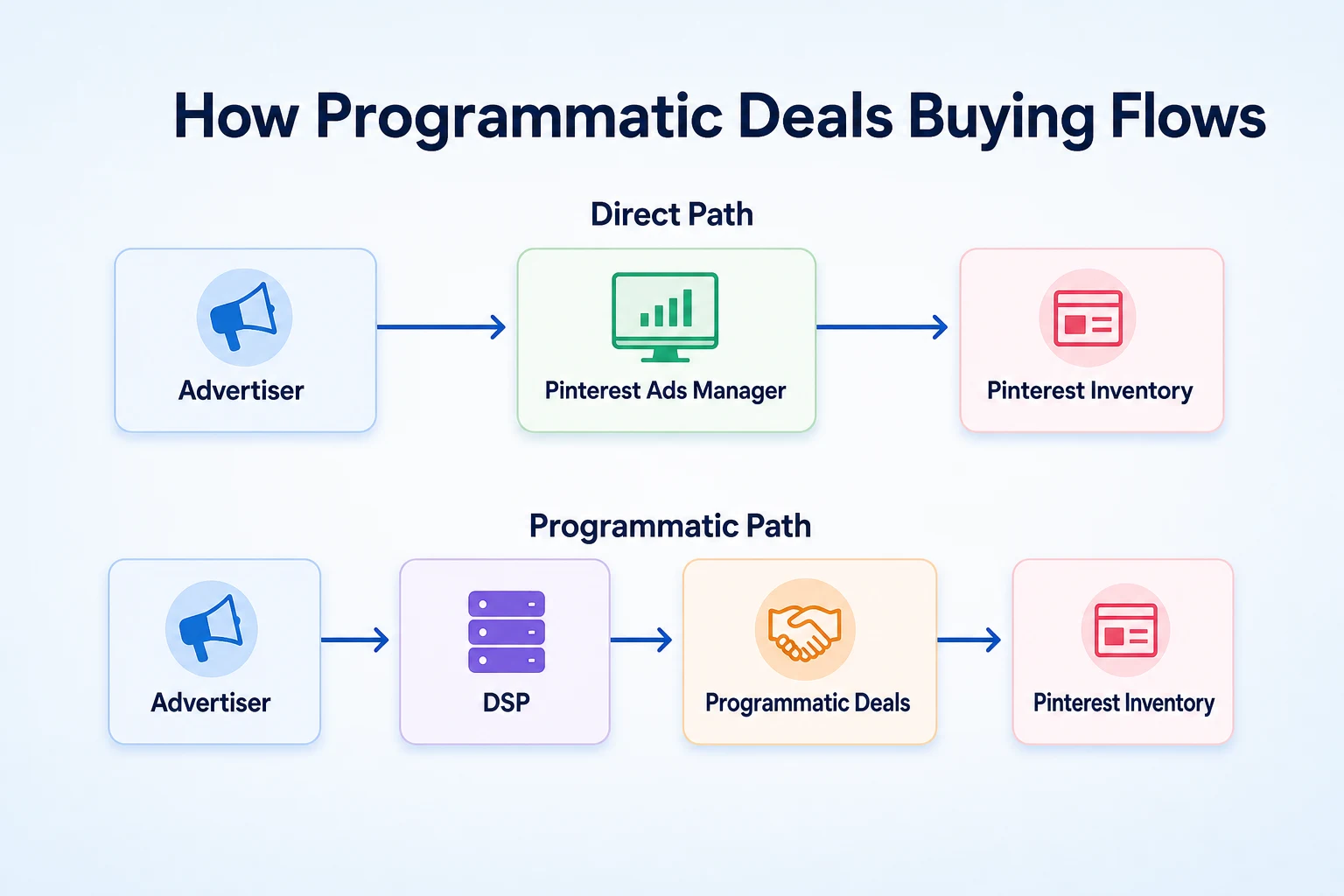
Programmatic advertising means buying ad space through automated systems and software, rather than a person manually selecting placements inside a single platform's own tool. A demand-side platform, usually shortened to DSP, is the software a buyer uses to bid on and purchase that ad space, often across many publishers and platforms at once rather than just one. When Pinterest opens its inventory to programmatic buyers, it means a business (or more often, its agency or media buying team) can purchase Pinterest ad space through a DSP alongside other publishers it's already buying from, instead of logging into Pinterest's ad manager separately.
Where Pinterest Ads Manager still fits
Pinterest hasn't described Programmatic Deals as a replacement for its existing ads manager, and nothing in the announcement suggests self-serve campaigns are going away. For a small business running its own Pinterest ads directly, with a hands-on view of budgets, audiences and creative, Ads Manager remains the straightforward option it's always been. Programmatic Deals is aimed at a different kind of buyer: one already running media buys through a DSP across several platforms, who wants Pinterest inventory available in that same workflow rather than as a separate system to manage.
Aspect | Pinterest Ads Manager | Programmatic Deals |
|---|---|---|
Where you buy | Directly inside Pinterest's own advertising tool | Through a demand-side platform connected to Pinterest's inventory |
Who it suits | A business managing its own Pinterest campaigns directly | A business or agency already buying media programmatically across platforms |
Setup required | A Pinterest advertising account | Access to a DSP that supports Pinterest inventory, plus eligibility |
Reporting | Pinterest's own campaign dashboards | Typically through the DSP's reporting, alongside other platforms bought the same way |
Display and Video Inventory Available Through Programmatic Deals
Pinterest's announcement specified that the inventory available through Programmatic Deals includes display and video ad formats, which is worth unpacking a little, since those two formats aren't identical in how they show up on Pinterest.
Display ad inventory
Display inventory generally covers static or lightly animated visual ad placements, the kind of ad a business might already run through Pinterest's own tools in the form of a Promoted Pin. Pinterest hasn't published a detailed list of every specific placement type included under Programmatic Deals, so it's not yet clear whether every display format available through self-serve buying is also available through this programmatic route, or whether the programmatic inventory is a narrower subset.
Video ad inventory
Video inventory covers Pinterest's video ad placements, which have become a larger part of how brands show products and ideas on the platform over the past several years. As with display, Pinterest hasn't confirmed every detail of which video formats and placements are included in Programmatic Deals specifically, so a business considering this route should expect to confirm the exact format list with a DSP partner or Pinterest directly rather than assuming full parity with self-serve video options.
DSP Partnerships: How Pinterest Inventory Connects to Buyers
None of this works without a demand-side platform actually connected to Pinterest's inventory on the other end, which is the part of the announcement that determines whether a given business can act on this at all.
What Pinterest has said about its DSP partners
Pinterest described Programmatic Deals as working through partnerships with demand-side platforms that connect to its ad inventory, allowing buyers using those platforms to purchase Pinterest display and video placements as part of their regular programmatic buying. Pinterest's announcement didn't name every DSP involved in detail, so the practical first step for any business curious about this is checking directly with whichever DSP it already uses, or plans to use, to confirm Pinterest inventory is actually available through that specific platform.
What's still unconfirmed about DSP access
Pinterest hasn't published a complete, named list of every DSP partner included at launch, nor has it detailed whether all partner DSPs offer the same inventory, the same formats, or the same eligibility requirements. It also hasn't said whether additional DSP partnerships are expected to be added over time or whether the current set is considered final for now. Given that gap, a business shouldn't assume its current DSP, if it uses one, automatically has Pinterest access just because Programmatic Deals exists. That's a question worth asking directly rather than assuming either way.
Who Can Buy: Eligible Advertisers and Availability
The word "more" in Pinterest's announcement is doing a lot of work, and it's worth looking closely at who actually qualifies before assuming your business is included.
Advertiser eligibility
Pinterest described Programmatic Deals as opening to a wider set of advertisers than before, without publishing a full, specific list of the account types, spend thresholds or business categories that qualify. What's clear is the direction: access that used to be more limited is now reaching more buyers. What's not clear is whether a small business running its first Pinterest campaign through a DSP qualifies the same way an established enterprise advertiser does, or whether there's a practical floor, such as a minimum spend commitment, that makes this more realistic for larger budgets. Pinterest hasn't addressed that distinction directly in its announcement.
Rollout timing and regions
Pinterest hasn't published a complete rollout schedule showing which regions or markets get access first, or whether every eligible advertiser gains access at the same time. Feature rollouts like this one are often staged, reaching some accounts, DSPs or regions before others, and Pinterest's announcement doesn't rule that pattern out here. A business that doesn't see Pinterest inventory available through its DSP yet shouldn't assume something is broken. It may simply be waiting for the rollout to reach it.
Question | What's confirmed | What's still unclear |
|---|---|---|
When did this launch? | October 26, 2026 | Full timeline for reaching every eligible advertiser |
Who qualifies? | A wider set of advertisers than before, per Pinterest's announcement | Specific account types, spend thresholds or categories required |
Is access region-limited at launch? | Not addressed directly | Whether every region sees access at the same time |
Is there a minimum spend? | Not addressed directly | Whether a practical budget floor exists in practice |
Programmatic Deals vs Traditional Pinterest Advertising
Once the mechanics are clear, the real question for most businesses is simpler: does this change how you should actually buy Pinterest ads, or not.
Control and targeting differences
Buying directly through Pinterest's ad manager gives an advertiser a direct view of the platform's own targeting options, built specifically around Pinterest's audience and interest data. Buying programmatically through a DSP usually means working within that DSP's own targeting and reporting setup, which may or may not expose every Pinterest-specific targeting option the same way. Pinterest hasn't published a detailed comparison of targeting parity between the two routes, so a business considering a programmatic test should ask its DSP directly what targeting controls are actually available, rather than assuming they match Ads Manager feature for feature.
Who each approach tends to suit
A business running Pinterest as one of several platforms, managed through a single DSP by an internal media buying team or an agency, is the clearer fit for Programmatic Deals. A business running Pinterest as its own campaign, managed hands-on inside Pinterest's tools without a broader programmatic buying setup already in place, has less obvious reason to add a DSP into the mix just for this. Neither approach is better in general. The right one depends on how a business already buys its other media, not on anything specific to Pinterest.
Factor | Traditional Pinterest Ads Manager | Programmatic Deals |
|---|---|---|
Setup effort | Lower, if you already have a Pinterest ad account | Higher, requires DSP access and confirmed eligibility |
Fits an existing multi-platform buy | Less naturally, since it's a separate system | More naturally, if the DSP already handles other platforms |
Targeting transparency | Full view of Pinterest's own targeting tools | Depends on what the DSP exposes |
Best suited to | A business managing Pinterest campaigns directly | A business or agency already buying programmatically elsewhere |
What This Means for Product Discovery and E-commerce Visibility
Pinterest has long positioned itself around discovery rather than pure social interaction, and it's worth being specific about where a change like this actually touches that, and where it doesn't.
Where programmatic inventory fits into product discovery
Wider programmatic access doesn't change what a Pinterest user sees when they search or browse. It changes who can buy the ad space that sits inside that experience, and through what tool. For an e-commerce brand, that mostly matters as a buying efficiency question: if your media team already manages product ads across several platforms through one DSP, having Pinterest available in that same workflow could simplify how display and video budgets get allocated across channels. It's a similar shift to what's happened elsewhere as AI and automated buying tools reshape how ads get placed and discovered; our look at Google AI Mode checkout covers a related change in how shopping and discovery surfaces are evolving, and our piece on Meta AI ads covers how another major platform has been expanding automated buying and targeting for advertisers in a comparable way.
What doesn't change for organic Pinterest visibility
Programmatic Deals is entirely about paid advertising inventory. Pinterest hasn't described any connection between this change and how Pins, boards or product listings rank or surface organically, outside of paid placements. A business whose products show up in Pinterest search and recommendations through strong Pin descriptions, keywords and consistent posting shouldn't expect that side of things to shift because of who's buying ad space differently. Organic discovery and paid programmatic buying remain two separate levers, and this announcement only moves one of them.
A Worked Example: Evaluating Programmatic Deals for a Small Retailer
This example is illustrative, not a record of a real business's decision.
Imagine a small home goods retailer that currently runs Pinterest ads directly through Ads Manager, alongside a separate DSP its agency uses for display ads on other sites. The marketing manager weighs whether switching some Pinterest spend into that same DSP, through Programmatic Deals, is worth exploring.
Consideration | Traditional self-serve ads | Programmatic Deals test |
|---|---|---|
Who manages the campaign | The in-house marketing manager, directly inside Pinterest | The agency, through its existing DSP |
Reporting location | Pinterest's own dashboard | The DSP's dashboard, alongside other platforms |
Setup time | Already in place | Requires confirming eligibility and DSP access first |
Format access | Full range of Pinterest's self-serve formats | Display and video, pending confirmation of exact formats |
These figures are illustrative.
Looking at it this way, the decision isn't really about which option performs better in the abstract. It's about whether the retailer's existing setup, an agency already running a DSP for other channels, makes it worth asking that DSP a direct question: can it buy Pinterest inventory yet, and if so, what does that actually include.
A 30-Day Plan to Decide If Programmatic Deals Fit Your Business
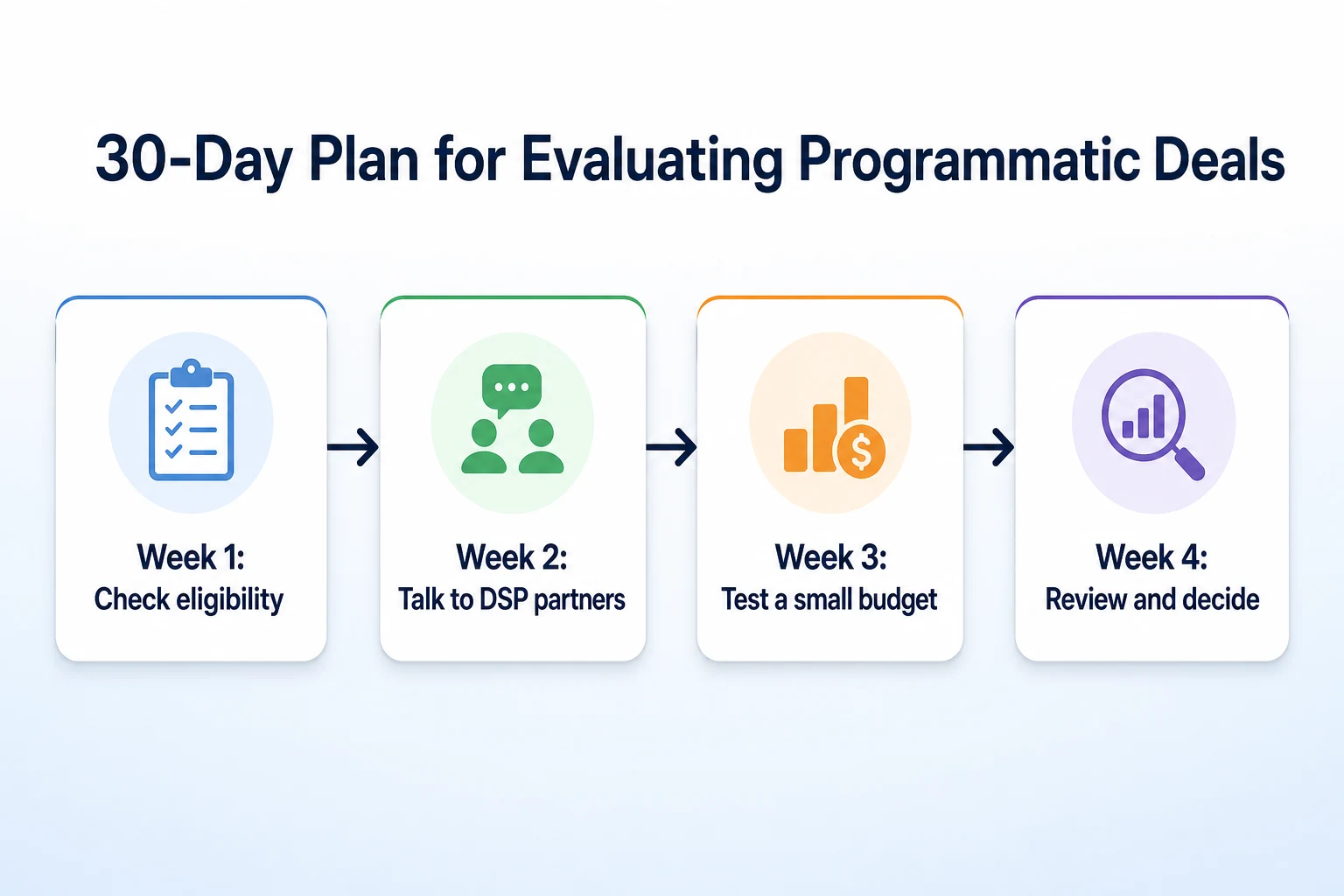
A month is enough time to find out whether Programmatic Deals is worth a real test, without committing a full campaign budget before you know the answer.
Week | Task | Why it matters |
|---|---|---|
1 | Check eligibility with your Pinterest account rep or business account | Pinterest hasn't published a full eligibility list, so confirming it directly avoids wasted effort later |
2 | Ask your DSP, or an agency partner's DSP, whether it connects to Pinterest inventory | Not every DSP partner is named in Pinterest's announcement, so this has to be confirmed case by case |
3 | Run a small test budget through the programmatic route alongside your existing Pinterest campaigns | A small test shows how targeting, formats and reporting actually behave before a larger commitment |
4 | Review the test against your usual Ads Manager campaigns and decide whether to continue | Comparing the two routes side by side is the only way to know if the added setup is worth it for your business |
Common Mistakes to Avoid When Considering Programmatic Pinterest Ads
A new buying option tends to invite the same handful of mistakes, especially in the first few weeks after it's announced.
Mistake | Why it backfires | Better move |
|---|---|---|
Assuming your current DSP already has Pinterest access | Pinterest hasn't published a full list of connected DSP partners, so this isn't a safe assumption | Ask your DSP directly whether Pinterest inventory is available through it yet |
Moving an entire Pinterest budget into a programmatic test at once | Format parity, targeting options and eligibility details are all still unconfirmed in places | Start with a small budget alongside your existing campaigns, not instead of them |
Dropping Ads Manager campaigns because programmatic sounds more advanced | Pinterest hasn't described Programmatic Deals as a replacement for self-serve advertising | Keep running Ads Manager campaigns if they already work for your business |
Expecting programmatic access to change organic product discovery | This announcement is about paid inventory only, not how Pins or listings rank organically | Keep working on Pin descriptions and keywords as a separate, ongoing effort |
Chasing this option without an existing programmatic buying setup | A business with no DSP relationship gains little from adding one just for Pinterest | Weigh whether your business already buys media programmatically elsewhere first |
Where RepGet fits
RepGet has no connection to Pinterest advertising, Programmatic Deals, or any demand-side platform. It doesn't buy ad inventory, manage ad accounts, or touch anything inside Pinterest's tools or a DSP's dashboard.
What RepGet works on is the layer a Pinterest ad eventually points to. A display or video ad, bought directly or programmatically, still sends someone to a product page, a category page or a blog post on your own website. If that page loads slowly, has a thin description, or is missing basic SEO fundamentals, the ad spend behind it is working harder than it needs to. RepGet's website auditing, keyword research, content planning, article writing and publishing work on exactly that part: making sure the pages a Pinterest campaign sends traffic to are technically sound and clearly described, whatever buying route brought the visitor there.
If a business wants to check its site before testing a new ad channel or buying route, RepGet's free website audit crawls the site and gives it a 0 to 100 SEO score, flagging technical and content issues worth fixing first. No account or credit card required. RepGet's free SEO tools cover related checks, like whether a product page's tags and descriptions are actually doing their job once a visitor clicks through.
RepGet doesn't manage Pinterest ads, doesn't connect to a DSP, and doesn't guarantee that any ad spend, programmatic or otherwise, will translate into rankings, traffic or sales. What it can do is make sure the website behind a Pinterest campaign is ready for the people it sends there.
The bottom line
Pinterest's October 26 announcement opens its display and video inventory to a wider set of advertisers through demand-side platforms, which is a real, documented change in who can buy Pinterest ad space and how. It doesn't replace Ads Manager, and it doesn't touch organic Pin visibility or product discovery outside of paid placements.
What's still unclear is exactly which advertisers qualify, which DSPs are connected at launch, and how closely programmatic inventory matches what's available through self-serve buying. Until Pinterest publishes more on those points, the sensible move is the same one that applies to any new ad buying option: confirm eligibility directly, test with a small budget before committing more, and keep whatever's already working in Ads Manager running while you find out.
Find out what your website needs first
Run a free website audit with RepGet to see what your site needs before sending more Pinterest ad traffic its way, programmatic or not. No account or credit card required.
FAQ
What is Pinterest Programmatic Deals?
Pinterest Programmatic Deals is a change announced on October 26, 2026 that lets more advertisers buy Pinterest's display and video ad inventory through demand-side platforms instead of only through Pinterest's own ad manager.
How do I buy Pinterest ads through a DSP?
You'd need a demand-side platform that has a partnership connecting it to Pinterest's inventory. Pinterest hasn't named every partner DSP, so check directly with your DSP or agency whether Pinterest access is included.
Is Pinterest Programmatic Deals available to all advertisers?
Pinterest described the update as opening access to a wider set of advertisers, but it hasn't published a full list of eligibility requirements, so not every account is guaranteed access yet.
What's the difference between programmatic and direct Pinterest advertising?
Direct advertising means buying inside Pinterest's own Ads Manager. Programmatic buying means purchasing the same kind of inventory through a demand-side platform, often alongside ads bought on other publishers.
Which DSPs can buy Pinterest inventory through Programmatic Deals?
Pinterest hasn't published a complete, named list of its DSP partners. The most reliable way to find out is asking your own DSP or agency whether it currently connects to Pinterest's inventory.
Does programmatic advertising on Pinterest help with product discovery?
Programmatic Deals only affects paid ad inventory. Pinterest hasn't described any link between this change and how Pins or product listings rank organically in search and recommendations.
Do I need a minimum budget to use Pinterest Programmatic Deals?
Pinterest hasn't published a stated minimum spend for Programmatic Deals. Any practical budget floor would likely come from the DSP you use rather than from Pinterest directly, so it's worth confirming with that partner.
When did Pinterest open Programmatic Deals to more advertisers?
Pinterest announced the wider rollout of Programmatic Deals on October 26, 2026, extending access to its display and video inventory beyond the more limited set of buyers it had before.