

Google AI Mode Checkout: What Small Retailers Need to Know
Short answer
On November 4, 2026, Google expanded AI-powered checkout to Canada, letting eligible shoppers buy products directly inside Gemini and AI Mode through the Universal Commerce Protocol. Only participating retailers are included, and Google hasn't named every one. For merchants, the real question is whether product data is structured well enough to be found and bought this way.
A Canadian home goods seller notices a strange new referrer in her site's analytics this week.
A sale came through, but the shopper never landed on her checkout page.
The order shows up as paid, the product feed confirms the item, and the only trace of how it happened is a line that reads "AI Mode."
She didn't build anything for this. Nobody on her team set it up.
That's Google AI Mode checkout, a feature Google expanded to Canada on November 4, 2026, and it changes something small business owners have taken for granted for years: that a customer has to visit a website to buy from it. Here's what Google has actually said about how it works, who qualifies, and what a merchant should check before more of these orders start showing up.
What Google Announced on November 4
On November 4, 2026, Google announced that AI-powered shopping checkout, previously available in a more limited form, is expanding to Canada inside both Gemini and AI Mode in Search. The announcement described eligible shoppers being able to complete a purchase from a participating retailer without leaving the Gemini or AI Mode interface.
This sits inside a broader push Google has been making to turn its AI products from answer engines into places where a task, including a purchase, can be finished start to finish.
The announcement in brief
Google's announcement named three pieces: the Canada expansion itself, the retailers involved (without listing every one by name), and the technical layer behind it, which Google calls the Universal Commerce Protocol. Google described the feature as letting a shopper ask about a product, see relevant options, and pay for one, all inside the same conversation or search session.
Google hasn't published a count of how many retailers are live at launch, and it hasn't said whether every Gemini or AI Mode user in Canada sees the option at the same time.
Why this builds on Google's existing AI Mode shopping features
AI Mode has carried shopping-related features for a while, including product comparisons and links out to retailer sites. What's new here isn't that AI Mode can talk about products. It's that it can now hand off a transaction and have it complete without the shopper opening a separate tab.
That's a meaningful step past showing products toward actually selling them, and it's worth treating as a distinct feature rather than an extension of search results a merchant can ignore until it reaches their own market.
How Checkout Works Inside Gemini and AI Mode
Google's description of the shopper-facing flow is fairly simple, even if the technical work behind it isn't.
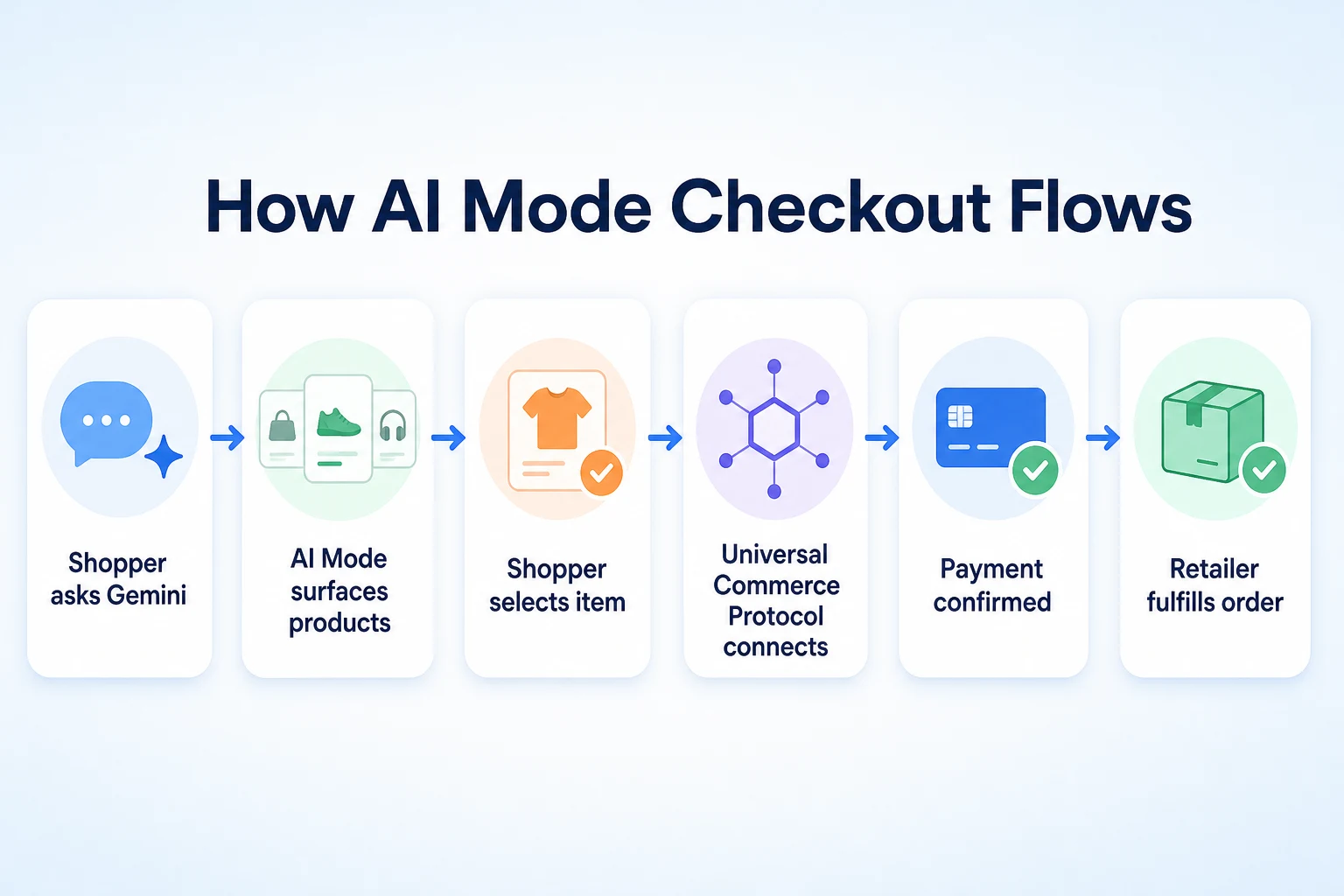
From a product question to a completed order
A shopper asks Gemini or AI Mode a question about a product, something like finding a specific item or comparing a few options. AI Mode surfaces products that match, drawing on retailer data the way AI Mode already does for shopping-related queries. The shopper picks an item, and if that retailer participates in the checkout feature, Google has described the option to complete the purchase right there, without being redirected to the retailer's own site first.
Once a payment method is confirmed, the order is placed with the retailer, who fulfills it the normal way: packing, shipping and any customer service that follows.
What the shopper sees and confirms before paying
Google's description emphasizes that the shopper still sees the price, the retailer, and the details of what they're buying before confirming payment, rather than the AI system completing the purchase on its own judgment. That distinction matters. This is closer to a faster checkout than to an AI system shopping unsupervised on someone's behalf.
Google hasn't published a full account of what happens if an order needs to be changed or canceled shortly after it's placed, so a merchant's normal return and support process still needs to be ready to handle an order that arrived through this path, the same as any other.
The Universal Commerce Protocol, Explained
The checkout experience is the visible part. Underneath it sits something Google calls the Universal Commerce Protocol, and understanding what that is matters more for a merchant than the shopper-facing flow does.
What the protocol standardizes
Google has described the Universal Commerce Protocol as a shared way for AI systems and retailers to exchange the information a transaction needs: product details, pricing, availability and payment confirmation, in a consistent format rather than a one-off connection built separately for each retailer. That's similar in spirit to how structured product data already gives search a consistent way to read price, availability and reviews from a product page, except this protocol is built for completing a transaction, not just describing one.
Google hasn't published the full technical specification of the protocol in consumer-facing terms, so most small merchants won't interact with it directly. It's typically something a retailer's ecommerce platform or payment provider implements on their behalf.
Why a shared protocol matters more than a single integration
A protocol that multiple retailers and platforms can adopt is different from Google building a custom connection to one store at a time. It suggests Google intends this to scale across many retailers and, eventually, potentially other AI systems, rather than remaining a narrow pilot with a handful of hand-picked partners.
For a merchant, the practical takeaway isn't to learn the protocol's technical details. It's to know that participation likely runs through whichever ecommerce platform or payment system the business already uses, which is where the "are we eligible" question actually gets answered.
Who's Eligible: Shoppers, Retailers and Regions
Not every shopper, retailer or country has access to this yet, and Google has been fairly specific about some of those limits while leaving others open.
Shopper requirements
Google's announcement describes the feature as available to eligible shoppers in Canada using Gemini or AI Mode. Google hasn't published a full list of account requirements beyond location, such as whether a specific Google account type or a saved payment method is needed before the checkout option appears during a shopping conversation.
Retailer requirements
On the retailer side, Google has described this as limited to participating retailers, meaning a business needs to have adopted the Universal Commerce Protocol, typically through its ecommerce platform or a partner, before its products can be bought this way. Google hasn't published a public directory listing every participating retailer, so a merchant's best source of truth is their own ecommerce platform or payment provider, not a general search.
Why Canada and not everywhere yet
Google hasn't published a stated reason for choosing Canada as this expansion's focus, beyond presenting it as part of a gradual rollout. Previous AI Mode features have followed a similar pattern: a limited market or group of users first, then a wider expansion once Google has more to go on. Google hasn't published a timeline for when AI Mode checkout might reach other countries.
Factor | What's required | What's still unclear |
|---|---|---|
Shopper location | Shopper must be in Canada using Gemini or AI Mode | Whether this depends on account settings or device location, or both |
Shopper account setup | Not fully detailed by Google | Whether a specific account type or saved payment method is required |
Retailer participation | Retailer must have adopted the Universal Commerce Protocol | The full list of participating retailers at launch |
Payment method | Confirmed before the order is placed, per Google's description | Which payment providers or methods are supported at launch |
These figures reflect what Google has stated publicly as of this announcement and may change as the rollout continues.
What This Means for Canadian E-commerce
Setting aside the technical mechanics, the bigger shift for a merchant is simpler to state: a sale can now happen without a shopper ever visiting the business's own site.
A shorter path from discovery to purchase
Until now, even a shopper who found a product through an AI assistant still had to click through to a retailer's site, find the item again, and go through that site's own checkout. AI Mode checkout removes that middle step for participating retailers. The shopper asks, sees the product, and pays, all inside Gemini or AI Mode.
That's a shorter funnel than almost anything ecommerce has worked with before. It's also one a merchant doesn't control the look or feel of. The product page a shopper might have browsed, with its photos, reviews and related items, isn't necessarily part of what they see before buying. Our piece on the Google AI Overviews links update covers a related pattern: Google surfacing an answer, or in this case a transaction, closer to the source, with less of the surrounding context a business built reaching the shopper directly.
What stays with the retailer, and what moves to Google
A retailer still owns the product, the price, the fulfillment and the customer relationship once an order is placed. Google's description of the feature puts the retailer in the position of fulfilling an order the same way they would from any other sales channel.
What shifts is the part of the experience the business used to control fully: the moment of discovery and the decision to buy. A product photo, description or review that doesn't read well to an AI system has less chance of being surfaced in the first place, regardless of how polished the business's own site looks once a shopper arrives there. That's a different kind of competition than ranking in regular search results, and it's one a merchant can't opt out of just by not participating, since AI Mode may still describe or compare their products even without full checkout integration.
What This Means for SEO and AI Product Discovery
None of this replaces the fundamentals of getting found, but it does change what a product page needs to communicate, and to whom.
How an AI system reads a product page
An AI system choosing products to surface in response to a shopper's question draws on structured data and readable product information, similar in principle to how it works when deciding what to mention in a text answer. Clear pricing, accurate availability, a plain description of what the product is and does, and reviews that are actually visible in the page's text all make it easier for a system to represent a product correctly. Our guide to how AI assistants decide which businesses to recommend covers this from a broader angle, and the same logic applies here: a system can't choose a product it can't read clearly.
Google's own documentation on product structured data remains the baseline for this. If that markup is missing, outdated, or doesn't match what's actually on the page, it's a reasonable thing to assume an AI system is working with weaker information than it should be, whether that affects AI Mode checkout specifically or not.
Why this isn't a replacement for ranking in regular search
It's worth being direct about what AI Mode checkout doesn't change. A business still needs to show up in regular search results, still needs a working site that loads quickly and describes its products well, and still benefits from the kind of visibility that doesn't depend on being a participating retailer in one specific feature. Our piece on how to get mentioned in ChatGPT makes a similar point about a different assistant: being readable and accurately described matters regardless of which AI system is doing the reading, and no single feature from one company is worth rebuilding a whole SEO approach around.
A Worked Example: One Retailer's First Week With AI Checkout
This example is illustrative, not a record of a real retailer's results.
Imagine a small Canadian kitchenware store that hears about AI Mode checkout from a customer who mentions buying something
She hears about AI Mode checkout from a customer who mentions buying something through it while chatting with Gemini, and decides to spend a week finding out whether her own store even qualifies.
Day | Task | What they found |
|---|---|---|
Monday | Checked with their ecommerce platform about Universal Commerce Protocol support | The platform confirmed it was working on adoption but hadn't enabled it for every merchant yet |
Tuesday | Reviewed their product feed for missing prices and out of date stock counts | Two products still listed as in stock had actually sold out weeks earlier |
Wednesday | Checked product pages for structured data using Google's documentation as a reference | Most pages had basic product markup, but a handful of newer listings were missing it entirely |
Thursday | Searched for their own products inside AI Mode | A couple of items appeared in comparisons, but no checkout option showed up yet |
Friday | Asked their payment provider directly whether AI Mode checkout was part of their roadmap | Got a general yes, with no firm date attached |
Nothing about that week got them live on AI Mode checkout. What it did was clear up where the actual blockers were, which turned out to be more about data accuracy and platform support than anything the store itself needed to build from scratch.
A 20-Minute Checklist to Check Your Own Eligibility and Readiness
Most small merchants don't need to wait for a formal invitation to start getting ready. The groundwork here overlaps heavily with normal product page maintenance.
Step | Task | Why it matters |
|---|---|---|
1 | Ask your ecommerce platform or payment provider whether they support the Universal Commerce Protocol | Participation typically runs through that layer, not something a merchant sets up alone |
2 | Check your product feed for accurate pricing and stock levels | An AI system surfacing an out of date price or an out of stock item creates a bad experience before a sale even happens |
3 | Confirm structured data is present and correct on your product pages | It's the format Google's documentation describes for communicating price, availability and reviews clearly |
4 | Search for your own products inside AI Mode and Gemini | Shows what a shopper sees today, checkout option or not |
5 | Check Search Console for any referral traffic tagged as coming from AI Mode | Early signal of whether shoppers are already discovering products this way, even without checkout |
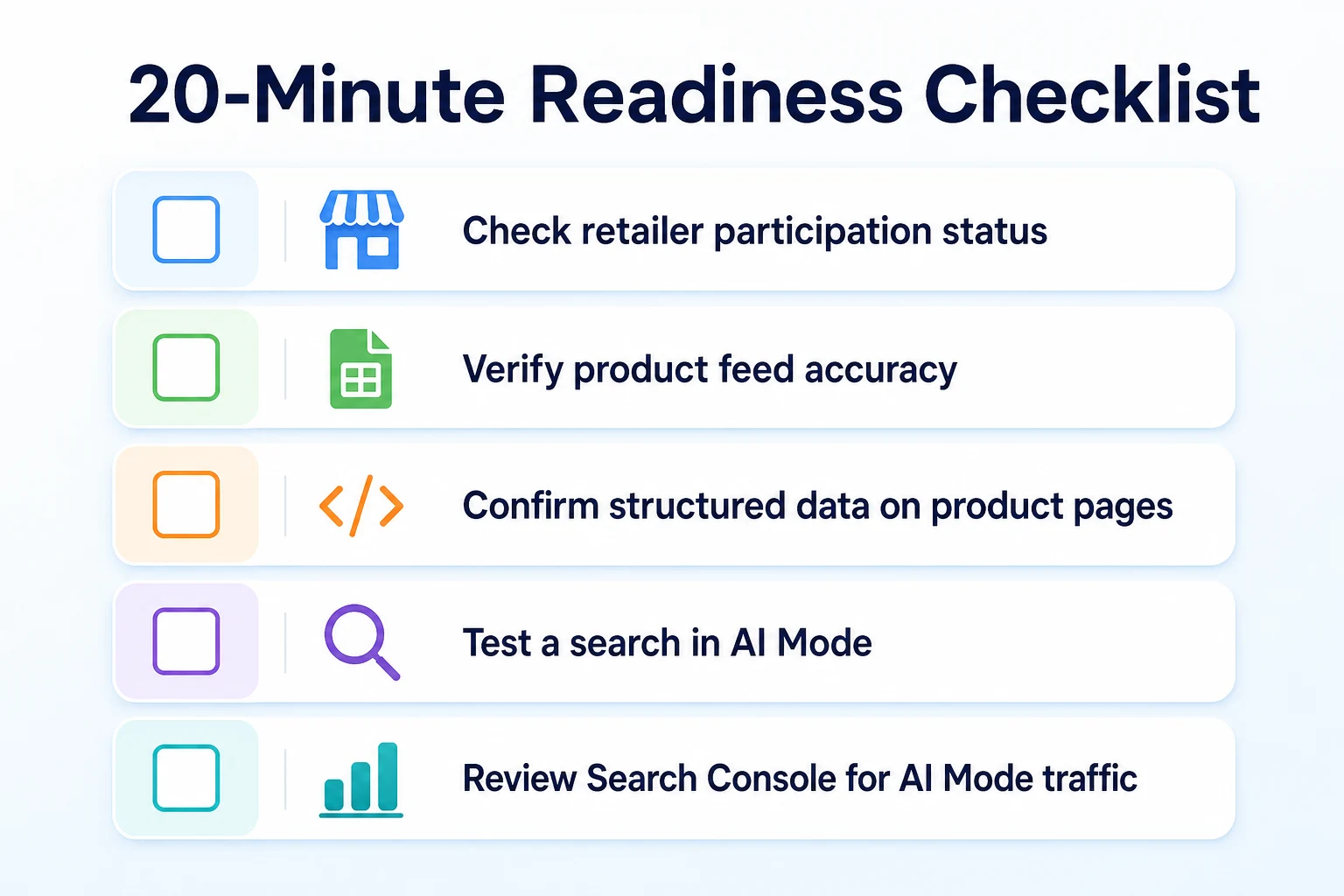
RepGet's free website audit covers the product and technical checks in that list, and the free Meta Tag Checker is a quick way to confirm what tags a page is actually serving before assuming the markup is correct.
Common Mistakes Merchants Make With AI Shopping Features
A new feature like this tends to invite a few predictable mistakes, mostly from assuming more than Google has actually confirmed.
Mistake | Why it backfires | Better move |
|---|---|---|
Assuming your store is eligible without checking | Participation depends on your platform or payment provider adopting the protocol, not just wanting in | Ask your platform directly rather than guessing from the announcement alone |
Letting product feed data go stale | An AI system repeating a wrong price or an out of stock item damages trust before a sale happens | Review the feed on a regular schedule, not just once after reading about this feature |
Treating AI checkout as a replacement for your own site's checkout | Most shoppers, in Canada and everywhere else, still buy directly through a retailer's own site | Keep your existing checkout working well instead of deprioritizing it |
Ignoring structured data because it feels technical | Weak product markup limits how well any AI system, not just this one, can represent a product accurately | Treat it as ongoing maintenance, the same as keeping prices and stock counts current |
What Google Hasn't Said Yet
It's worth separating what Google has actually confirmed from what's left for a merchant to assume, since the two blur easily in coverage of a new feature.
What's confirmed
Google confirmed the November 4, 2026 expansion to Canada, the involvement of Gemini and AI Mode, the existence of the Universal Commerce Protocol as the technical layer behind it, and that only participating retailers are included.
What's still unclear
Google hasn't published a full list of participating retailers, a timeline for expanding beyond Canada, whether there are fees tied to transactions completed this way, or how returns and disputes are handled when a purchase happens entirely inside Gemini or AI Mode rather than on a retailer's own site.
Question | What's confirmed | What's still unclear |
|---|---|---|
Where is it available? | Canada, as of November 4, 2026 | When or whether it expands to other countries |
Who can sell through it? | Participating retailers using the Universal Commerce Protocol | The full list of retailers live at launch |
Are there fees? | Not addressed in the announcement | Whether transaction fees apply, and to whom |
How are returns handled? | Not addressed in detail | Whether a return goes through Google, the retailer, or both |
Until Google publishes more detail on these points, a merchant's safest approach is to treat eligibility and participation as something to confirm through their own platform, not something to assume from the announcement alone.
Where RepGet fits
RepGet has no role in Google AI Mode checkout or the Universal Commerce Protocol. It doesn't process payments, it isn't a participating retailer platform, and nothing about this feature runs through RepGet.
What RepGet does is work on the product pages and site content that sit underneath all of this, whether a shopper buys through a retailer's own checkout or through an AI assistant. A product page with a vague description, missing structured data, or an out of date price is a weaker candidate for being surfaced accurately by any AI system, checkout feature or not. RepGet's website auditing, keyword research, content planning and article writing work on exactly that layer: making sure product and category pages describe what they're selling clearly enough for both a shopper and a system reading on a shopper's behalf.
If a merchant wants to know where their own site stands before chasing eligibility for a feature still rolling out, RepGet's free website audit crawls the site and gives it a 0 to 100 SEO score, flagging technical and content issues worth fixing first. No account or credit card required. RepGet's free SEO tools cover related checks, like whether a product page's tags and descriptions are actually serving the information an AI system or a shopper would need.
RepGet doesn't manage product feeds, doesn't integrate with the Universal Commerce Protocol, and doesn't guarantee a store will become a participating retailer or appear in AI Mode results. What it can do is help make sure the content behind a product is accurate and readable before worrying about which checkout feature eventually reaches it.
The bottom line
Google's November 4 expansion of AI Mode checkout to Canada is a real, documented step toward letting a purchase finish entirely inside Gemini or AI Mode, through retailers that have adopted the Universal Commerce Protocol. For now, it's limited to Canada, limited to participating retailers, and missing a lot of the detail a merchant would want before relying on it: no public retailer list, no stated fees, no clear return process specific to this path.
None of that is a reason to ignore it. A merchant's product data, pricing accuracy and structured data matter regardless of whether checkout happens on their own site or inside an AI assistant, and the groundwork for one supports the other. Checking with an ecommerce platform or payment provider about Universal Commerce Protocol support, cleaning up a product feed, and confirming structured data is accurate are useful this week whether or not a store ends up eligible anytime soon.
Find out what your website needs first
Run a free website audit with RepGet to see what your product pages and site need before more shoppers discover you through an AI assistant. No account or credit card required.
FAQ
What is Google AI Mode checkout?
It's a feature Google expanded to Canada on November 4, 2026, letting eligible shoppers complete a purchase from a participating retailer directly inside Gemini or AI Mode, without visiting the retailer's own checkout page.
Can I actually buy products directly through Gemini?
Yes, if you're an eligible shopper in Canada and the retailer participates in the feature, Google has described being able to select a product and pay without leaving Gemini or AI Mode.
Is AI Mode checkout available outside Canada yet?
Not according to Google's announcement. Google hasn't published a timeline for expanding AI Mode checkout to other countries beyond this Canada launch.
What is the Universal Commerce Protocol?
It's the technical layer Google has described as standardizing how AI systems and retailers exchange product, pricing and payment information needed to complete a transaction inside an AI assistant.
How do I know if my store is a participating retailer?
Google hasn't published a public directory of participating retailers, so the most reliable way to check is asking your ecommerce platform or payment provider directly about Universal Commerce Protocol support.
Does AI Mode checkout replace my online store's own checkout page?
No. Most shoppers still buy through a retailer's own site, and Google's feature works alongside existing checkout rather than replacing it, so a working checkout on your own site still matters.
How does AI Mode checkout affect my SEO?
It doesn't change core SEO fundamentals, but it raises the value of accurate, readable product data and structured data, since an AI system relies on that information to surface and describe products correctly.
Do I need special structured data for Google's AI shopping features?
Google hasn't published checkout-specific structured data requirements, but keeping existing product structured data, like price, availability and reviews, accurate and current is a reasonable baseline to maintain.