

Google AI Overviews Links Update: What It Means for SEO
Short answer
On October 15, 2026, Google said it is showing more links and clearer source attribution inside AI Overviews and AI Mode. Google hasn't published click-through or traffic figures tied to the change. The practical response is to check Search Console for AI-related impressions, keep your site crawlable to Google's AI features, and write content that answers questions directly enough to be worth citing.
A shop owner checks Google Search Console on a quiet Tuesday morning.
There's a new cluster of impressions that wasn't there last month.
No new blog post went up. No campaign launched. Nothing on the site changed at all.
Around the same time, Google confirmed it had changed how AI Overviews and AI Mode show links to websites.
That's the Google AI Overviews links update, announced on October 15, 2026. Here's what Google actually said, what it could mean for your site's traffic and citations, and three practical things worth checking this week.
What Google changed on October 15, 2026
On October 15, 2026, Google said it is showing more links and clearer source attribution inside AI Overviews and AI Mode. This is a change to how an existing feature presents sources, not a new product and not a change to how regular Google Search results are ranked or displayed.
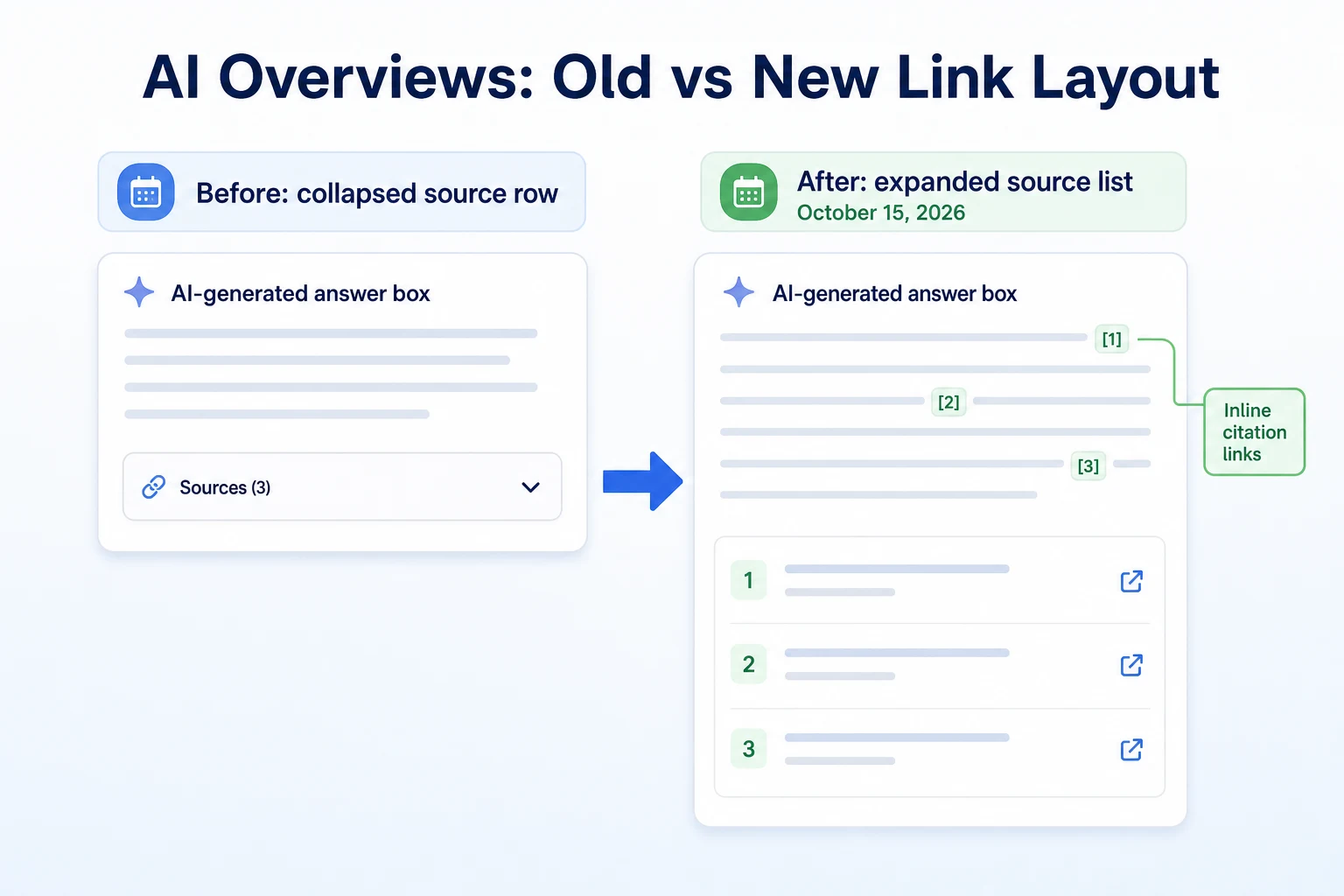
What the new link presentation looks like
Before this update, AI Overviews typically showed a small, collapsed row of source links sitting below or beside the generated summary. A reader had to click or expand that row to see where the information came from. Google said the new presentation shows more of those links by default, placed closer to the parts of the answer they support, rather than grouped into one collapsed carousel at the end.
Why Google says it made the change
Google framed the update as a way to make it clearer where an AI-generated answer's information comes from, and to make it easier for someone reading an AI Overview to click through to the original source if they want more detail. That's consistent with how Google has talked about AI features in Search generally: as a layer that sits on top of its index and is meant to point people back to the web, not replace it. Google hasn't described this as a response to any specific complaint or metric. It's described as a presentation change aimed at making sources more visible.
How source attribution is different now
The structural change is straightforward to describe, even if its effects are not yet clear. Instead of a single, small block of source links that a reader might skip past entirely, the update expands that block and moves individual links nearer to the specific sentence or claim they back up.
In practice, that means a summary covering several points might now show a distinct link next to each point, rather than one shared list of sources at the bottom covering the whole answer. Google has described this as happening within both AI Overviews, which appear above traditional search results, and AI Mode, which generates a fuller conversational response on its own page.
What hasn't changed, as far as Google has said, is the underlying process AI Overviews and AI Mode use to select which pages to draw from and cite in the first place. The update is about how those sources are shown once chosen, not about a new method for choosing them.
What this could mean for SEO and citations
It's worth being precise here, because it's easy to read a change like this and assume more than Google has actually confirmed.
What Google has actually confirmed
Google has confirmed that AI Overviews and AI Mode now display more links to sources, and that those links sit closer to the specific claims they support. That's the extent of what's been officially stated. Google hasn't published a new ranking factor tied to this update, hasn't said it changed which pages get selected as sources, and hasn't announced a new way for a site to request or improve its chances of being cited.
What's still a prediction, not a fact
Whether more visible links lead to more people actually clicking through to a given website is not something Google has stated either way. It's reasonable to expect that a more visible, more specific link could be easier to notice and click than one buried in a collapsed row, but reasonable isn't the same as confirmed. The same applies to any claim that a website will get more recognition or more frequent citations in AI Overviews because of this update. That's a plausible effect, not a documented one. Our piece on how AI assistants decide which businesses to recommend covers the same gap between what's documented and what's assumed, and the same caution applies here: nobody outside Google, including RepGet, can say with certainty how this update changes which sites get cited or how often.
What this could mean for website traffic
The most honest answer is that nobody can say yet, including Google. Google hasn't published click-through data for AI Overviews or AI Mode, before or after this update, and it hasn't committed to releasing figures showing how traffic from these features compares to traffic from a traditional search result.
What can be said is that more visible, more specifically placed links are a reasonable candidate for slightly different click behavior than a collapsed source list, simply because a visible link in context is easier to notice than one tucked away. Whether that translates into more clicks, fewer clicks, or no meaningful change for a particular site is likely to depend on the query, the topic, and how AI Overviews are choosing to answer that query in the first place, none of which this update directly addresses.
It's also worth remembering that AI Overviews and AI Mode are one part of how people find a website through Google. A change to how their links are displayed doesn't affect how a page performs in traditional search results, local results, or any other part of Search that doesn't involve an AI-generated summary. Any traffic change tied to this update is likely to show up, if it shows up at all, as a shift within the portion of traffic that was already coming from AI features, not as a change to a site's overall search visibility.
A quick way to check if AI Overviews already sends you traffic
Search Console doesn't label a click or an impression as coming from AI Overviews or AI Mode specifically. Google hasn't built a separate filter for that yet. But there are a few signs worth checking before assuming the update has or hasn't touched your site.
Imagine a small bakery that wants to know whether its recipe and ingredient pages are showing up in AI-generated answers. The owner opens the Performance report in Search Console, filters to the last 28 days, and compares it against the same period a month earlier. A jump in impressions with little or no change in average position can be a sign that a page is being pulled into a summary rather than shown as a normal blue link, since AI Overviews can generate an impression without the page moving up or down in traditional rankings. This example is illustrative, not a guarantee of what any one site will see.
Report | What to filter or search for | What it tells you |
|---|---|---|
Performance: Search results | Compare impressions and clicks over the last 28 days against the prior period | Whether impressions are rising faster than clicks, which can point to more AI summary appearances |
Performance: Queries | Sort by impressions and look for question-style or conversational queries | Whether the kind of query AI Overviews tends to answer is already finding your pages |
Performance: Pages | Check which pages gained impressions without a matching rise in clicks | Which pages might be getting cited or shown inside a summary rather than clicked directly |
None of this proves a page was used as a source in an AI Overview. Google hasn't given site owners a direct way to confirm that. It's a pattern worth watching rather than a confirmed signal, and it's the same kind of gap covered in our guide to Google Search Console impressions but no clicks, which walks through other reasons a page might gain visibility without gaining visits.
Three practical actions for website owners this week
None of these actions depend on knowing exactly how Google's selection process works. They're things worth doing regardless of whether this specific update changes anything for your site.
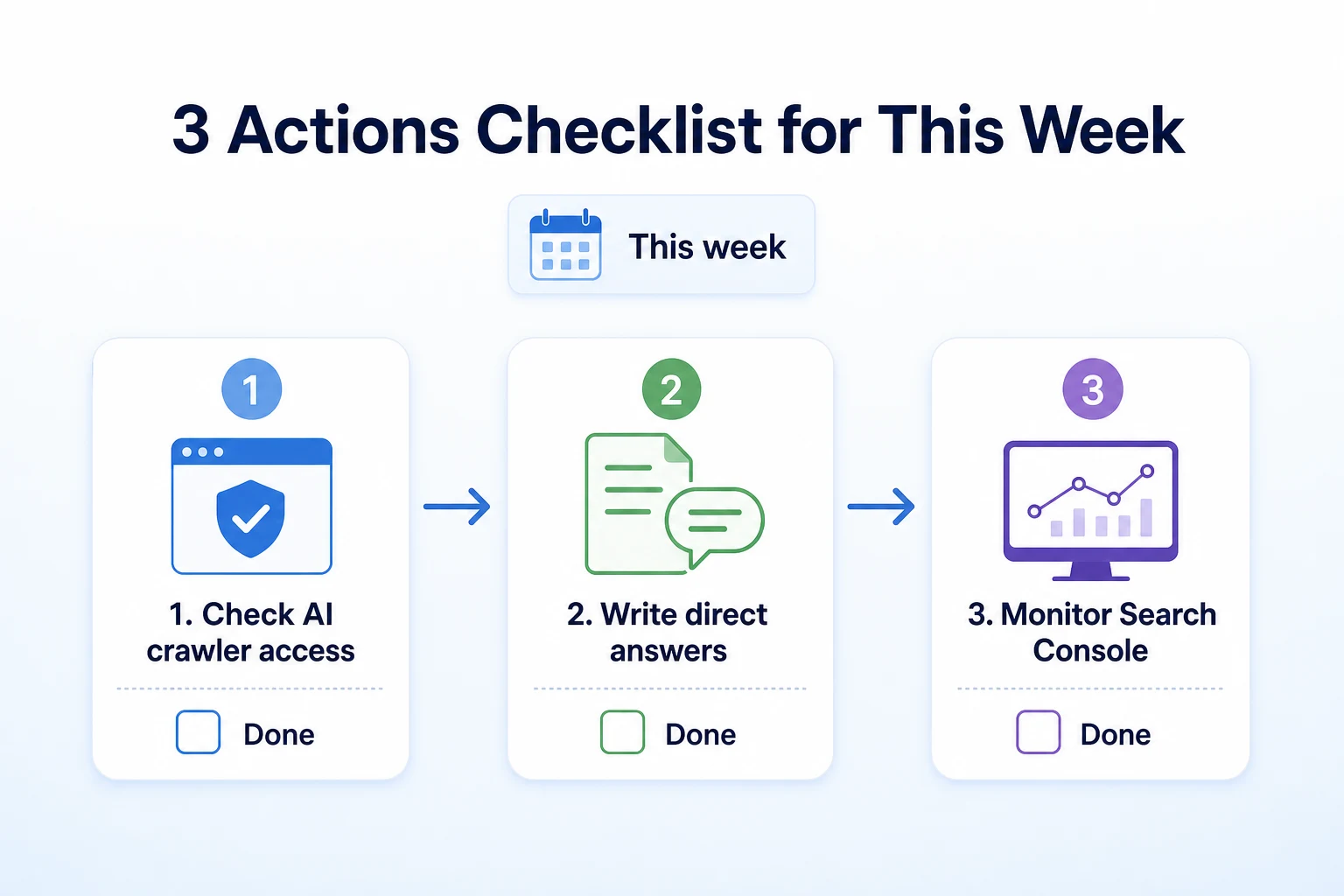
1. Confirm AI crawlers can reach your site
If Google's AI features can't crawl a page, they can't cite it, no matter how the links are displayed once a source is chosen. A quick way to check this is to run your site through RepGet's free AI Crawler Checker, which tests whether bots like Google's crawlers can actually access your pages. This takes a few minutes and tells you whether a blocked robots.txt rule or a server setting is quietly keeping your content out of consideration before anything about citations or links even matters.
2. Make your content easy to cite
An AI Overview pulls from pages that answer a question clearly enough to summarize. A page that buries its main point under several paragraphs of introduction, or that answers a question only implicitly, is harder to extract a clean citation from than one that states the answer plainly near the top. This doesn't require rewriting an entire site. It means checking your most important pages for a clear, direct answer early on, and using RepGet's free LLM HTML Visibility Checker to see how much of that text is actually readable by an AI system in the first place, rather than hidden inside scripts or formatting it can't parse.
3. Track AI-driven impressions over time
A single week of data won't tell you much, since normal fluctuation in Search Console can look similar to a real shift. Set a recurring reminder to check the Performance report monthly, using the comparison approach described above, and keep a simple record of impressions and clicks for your key pages. Over two or three months, that record will tell you more about whether this update changed anything for your site than any single day's numbers can.
Common mistakes to avoid after this update
A handful of reactions to an update like this tend to cause more harm than the update itself.
Mistake | Why it backfires | Better move |
|---|---|---|
Blocking AI crawlers out of caution | Removes any chance of being cited at all, even though the update didn't change how crawling works | Check crawler access first, and only block what you've deliberately decided to keep out |
Rewriting an entire site based on one announcement | Spends time and budget reacting to a presentation change Google hasn't tied to any ranking or selection factor | Make targeted improvements to key pages and watch Search Console before committing to a full rewrite |
Assuming a traffic drop is caused by this update | Overlooks other common causes, like a technical issue or a seasonal change in demand | Rule out other explanations first, the way a broader organic traffic drop diagnosis would |
Waiting for Google to publish exact numbers before doing anything | Delays basic, low-risk checks that are worth doing regardless of what Google eventually discloses | Run the crawler and content checks now, since they help even if this update turns out to matter little |
The pattern underneath most of these mistakes is the same one that shows up after almost every Google announcement: treating a presentation change as proof of a bigger shift than Google has actually confirmed, in either direction.
What Google hasn't said yet
It's worth listing plainly what Google has not confirmed, since most of the overreach around an update like this comes from filling in the gaps with assumptions.
Google hasn't published click-through or traffic figures for AI Overviews or AI Mode, either before or after October 15, 2026. It hasn't said what share of searches now trigger an AI Overview, and it hasn't broken down how that share differs by topic, industry or region. Anyone citing a specific percentage for how much traffic AI Overviews send to websites is going further than Google's own documentation supports.
Google also hasn't published a rollout schedule describing which countries, languages or site types see the new link presentation first. Its general documentation on AI features in Search explains how AI Overviews and AI Mode work at a high level, but it doesn't include a formula for which sources get linked more often, or a guarantee that a given page will appear as a source at all. There's no confirmed answer to whether the update changes how often a small business site, specifically, gets cited compared to a large publisher.
None of that means the update isn't real or isn't worth a look. It means the honest position is to treat it as a documented change to presentation, not a documented change to outcomes, until Google says otherwise.
Where RepGet fits
RepGet doesn't control what Google's AI Overviews or AI Mode choose to link to, and it can't make a page appear as a cited source. Nothing about that selection process runs through RepGet, and no tool anywhere can promise it will.
What RepGet can help with is the groundwork that sits underneath any chance of being cited at all. Its free AI Crawler Checker and LLM HTML Visibility Checker both check real, specific things: whether crawlers can reach your pages, and how much of your text is actually readable by an AI system once they're there. Those are the two most basic conditions for showing up anywhere in an AI-generated answer, regardless of how the links around that answer are displayed.
Beyond that, RepGet's content planning and article writing can help build pages that answer a question directly and clearly, the kind of structure this article described as easier to cite. Anything RepGet writes can stay as a draft for a business to review before it's published. For a broader check of a site's technical and content health, RepGet's free website audit crawls the site and gives it a 0 to 100 SEO score, flagging issues worth fixing whether a visitor arrives through a traditional search result or an AI-generated summary. No account or credit card required. RepGet doesn't guarantee a ranking, a citation, or a mention in AI Overviews or AI Mode, and no honest tool can.
The bottom line
Google confirmed a real, dated change on October 15, 2026: AI Overviews and AI Mode now show more links to sources, placed closer to the specific claims they support. That's a presentation change to an existing feature, not a new ranking factor and not a change to how sources get selected in the first place.
What hasn't been confirmed is just as important. Google hasn't published click-through data, a rollout schedule, or a formula for which sites get cited more often because of this update. Any claim about more traffic, more citations or better visibility tied directly to this change is a prediction, not a documented fact. The useful response isn't to rewrite a site overnight or block AI crawlers out of caution. It's to confirm your pages are reachable, make your key answers easy to find and cite, and watch Search Console over the next month or two rather than the next day.
Find out what your website needs first
Run a free website audit with RepGet to see what your own site needs before assuming this update has changed anything for you. No account or credit card required.
FAQ
What did Google change in AI Overviews on October 15, 2026?
Google said it now shows more links to sources inside AI Overviews and AI Mode, placed closer to the specific claims they support, rather than grouped into one small, collapsed row of links.
Will AI Overviews send more traffic to my website now?
Google hasn't published click-through data for this update, so there's no confirmed answer. More visible links are a reasonable candidate for different click behavior, but that's a prediction, not a documented fact.
How do I know if AI Overviews is already linking to my site?
Search Console doesn't label a click as coming from AI Overviews specifically. Checking the Performance report for pages with rising impressions but flat clicks is a useful, though not conclusive, signal to watch.
Does the October 2026 update affect AI Mode as well as AI Overviews?
Yes. Google described the change as applying to both AI Overviews, which appear above traditional results, and AI Mode, which generates a fuller conversational response on its own page.
What should a small business do about the Google AI Overviews links update?
Confirm AI crawlers can reach your site, make your key pages answer questions clearly near the top, and track Search Console impressions over the next month or two rather than reacting to a single day's numbers.
Can I stop Google's AI Overviews from using my website's content?
This update didn't change how sources are selected or crawled, so existing crawler controls still apply. Blocking Google's crawlers out of caution removes any chance of being cited, not just by AI Overviews.
Is this update the same as a change to regular Google Search results?
No. Google described this as a change to how AI Overviews and AI Mode present source links, not a change to how traditional search results are ranked or displayed.
Has Google published any traffic or click data for this update?
No. Google hasn't released click-through or traffic figures for AI Overviews or AI Mode, either before or after the October 15, 2026 announcement.