

Meta AI Ads: Should Your Small Business Use Them?
Short answer
Meta's AI ad tools can write ad copy, generate image variations, and test them automatically across Facebook and Instagram, saving time on setup. They don't affect your organic Google rankings or how AI assistants describe your business, since those run on separate systems. Worth trying if you already run paid ads and want less manual work; it won't replace organic SEO or guarantee results.
A gift shop owner logs into Meta Ads Manager to boost a post.
A new button offers to generate ad creative and targeting automatically with AI.
There's no real explanation of what it changes, just a toggle and a vague promise of better performance.
The owner isn't sure if turning it on will save time or just hand control of the budget to a system nobody at the shop understands.
Meta AI ads cover a handful of features bundled under that pitch: automated campaign setup, AI-generated copy and images, and targeting that expands beyond what you specify. Here's what each one actually does, when it's worth testing for a small business, and how it relates to the organic SEO work that happens on your own website.
What Meta's AI Ad Tools Actually Are
"Meta AI ads" isn't one feature. It's a set of tools that sit inside Meta's ad platform, and the pitch rarely separates them out.
Advantage+ campaigns and automated budget allocation
Advantage+ is Meta's name for a campaign setup that automates decisions a person used to make manually: which placements to use across Facebook and Instagram, how to split budget between them, and how aggressively to spend as the campaign learns. Instead of building separate ad sets for each audience or placement, you give the system a goal and a budget, and it adjusts delivery on its own as data comes in.
AI-generated ad copy and image variations
A separate piece generates text and image variations from what you upload. Give it a product photo and a short description, and it can produce several headlines, body text options, and sometimes cropped or edited versions of the image to test against each other. The system then shows different combinations to see which perform better, without you manually building each version.
Automated audience expansion beyond your targeting
Even when you set a specific audience, interests, age range, location, the automated targeting underneath Advantage+ campaigns can expand delivery beyond that audience if the system predicts a better result elsewhere. You can still provide signals, like a customer list or an audience you believe fits, but the system treats that as a starting point rather than a strict boundary.
How Meta AI Ads Differ From Organic SEO Work
These tools sit entirely inside paid social media. That's a different kind of visibility from the organic search results this blog usually covers, and the difference matters for how you plan a budget around either one.
Where each one shows up
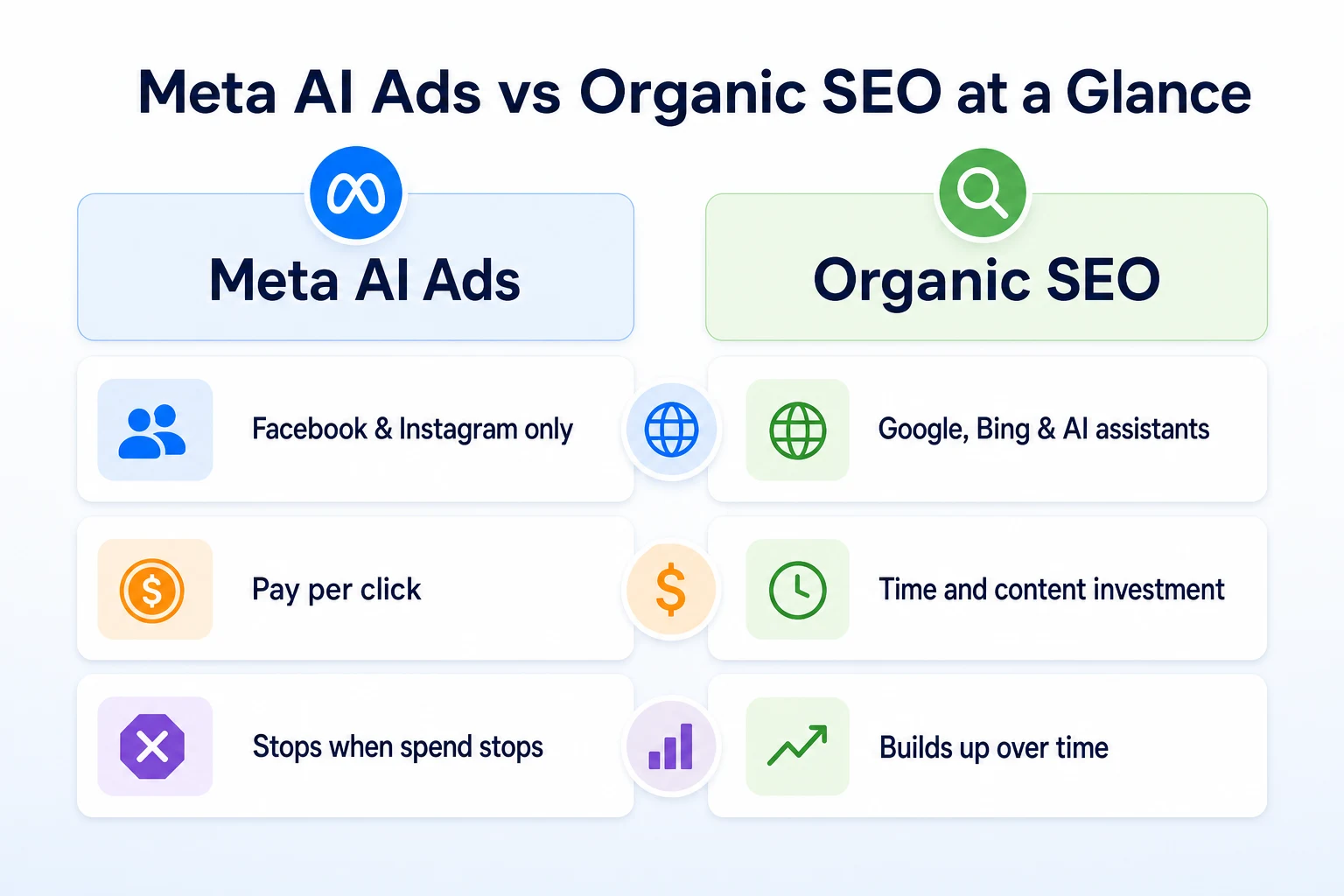
Meta AI ads appear on Facebook and Instagram, to people Meta's system decides are worth showing them to, for as long as you're paying for that placement. Organic SEO work shows up in Google, Bing, and increasingly in AI assistant answers, based on what your own site says and how well search systems can read it. Our comparison of Google Search ads vs SEO covers the same underlying trade-off on a different platform.
What happens when you stop
Paid reach stops the moment spending stops. An ad campaign that was bringing in clicks yesterday brings in nothing tomorrow if the budget runs out, regardless of how well it was performing. Organic SEO work behaves differently. A well-built page can keep showing up in search results months or years after it was published, with no ongoing spend required to keep it there, though it still needs occasional updates to stay accurate and relevant.
Why they draw from different budgets and skills
Meta ads are a line item: a daily or monthly spend that scales directly with how much reach you want. Organic SEO is mostly time and content work: writing pages, fixing technical issues, keeping listings current, which a small business can often do without an ongoing cash outlay, though it takes longer to show results. Our guide to local SEO for small businesses covers what that organic side actually involves for a business serving a specific area.
Factor | Meta AI ads | Organic SEO |
|---|---|---|
Where it shows up | Facebook and Instagram only | Google, Bing, and AI assistant answers |
Cost pattern | Pay per click or impression, ongoing | Time and content investment, mostly upfront |
Time to see results | Often within days | Usually weeks to months |
What happens if you stop | Reach stops almost immediately | Pages can keep showing up without ongoing spend |
What the 'AI' Part Changes, and What It Doesn't Guarantee
The automation in these tools genuinely speeds up a process that used to take a person hours. It's worth being clear about what that speed does and doesn't buy you.
Faster variations, not better ones by default
Generating ten headline options in seconds instead of writing ten by hand is a real time saver. It doesn't mean any of those ten headlines are actually good. The system is working from whatever product description or image you gave it, and a vague input produces vague output just as easily as a good one produces something usable. Automation here replaces drafting time, not judgment.
No connection to Google rankings or AI assistant answers
Meta's ad systems and Google's search systems are entirely separate. Running Meta AI ads, however well they perform, has no documented effect on where your site ranks in Google, and no documented effect on whether an AI assistant mentions your business when someone asks it a question. Those outcomes depend on your website's own content and technical setup, not on what's happening inside a Facebook ad account. Our guide to AI SEO automation covers what automation can and can't reasonably be expected to do on the organic side, which is a useful comparison if a vendor is blurring the two.
What Meta AI Ads Need From You to Work
None of these tools start from nothing. Each one needs a few inputs from your business before it has anything useful to work with.
Creative assets to start from
The AI creative tools generate variations, they don't invent your product from scratch. You still need decent product photos or video, and a clear, accurate description of what you're selling. Thin or blurry source material produces thin or blurry ad variations, no matter how many the system generates.
Tracking setup for conversions
Automated targeting and budget allocation learn from results, which means they need a working way to measure those results. That usually means Meta's pixel or a conversions API set up correctly on your website, tracking the actual purchases, bookings, or form submissions an ad leads to. Without that, the system is optimizing toward clicks or engagement instead of the outcome you actually care about.
A budget large enough to let testing happen
Automated systems need some minimum level of spend and data before their decisions start to reflect anything meaningful. A handful of dollars a day across many variations rarely generates enough signal for the system to tell a good option from a bad one. A smaller number of variations with a budget that can actually run for a week or two tends to produce a clearer answer than spreading very little money across everything the tool can generate.
When It's Worth Testing Meta AI Ads for a Small Business
There's no single right answer for every business here, and anyone who tells you otherwise is selling something. The honest answer depends on a few things you already know about your own setup.
Signs it's worth testing
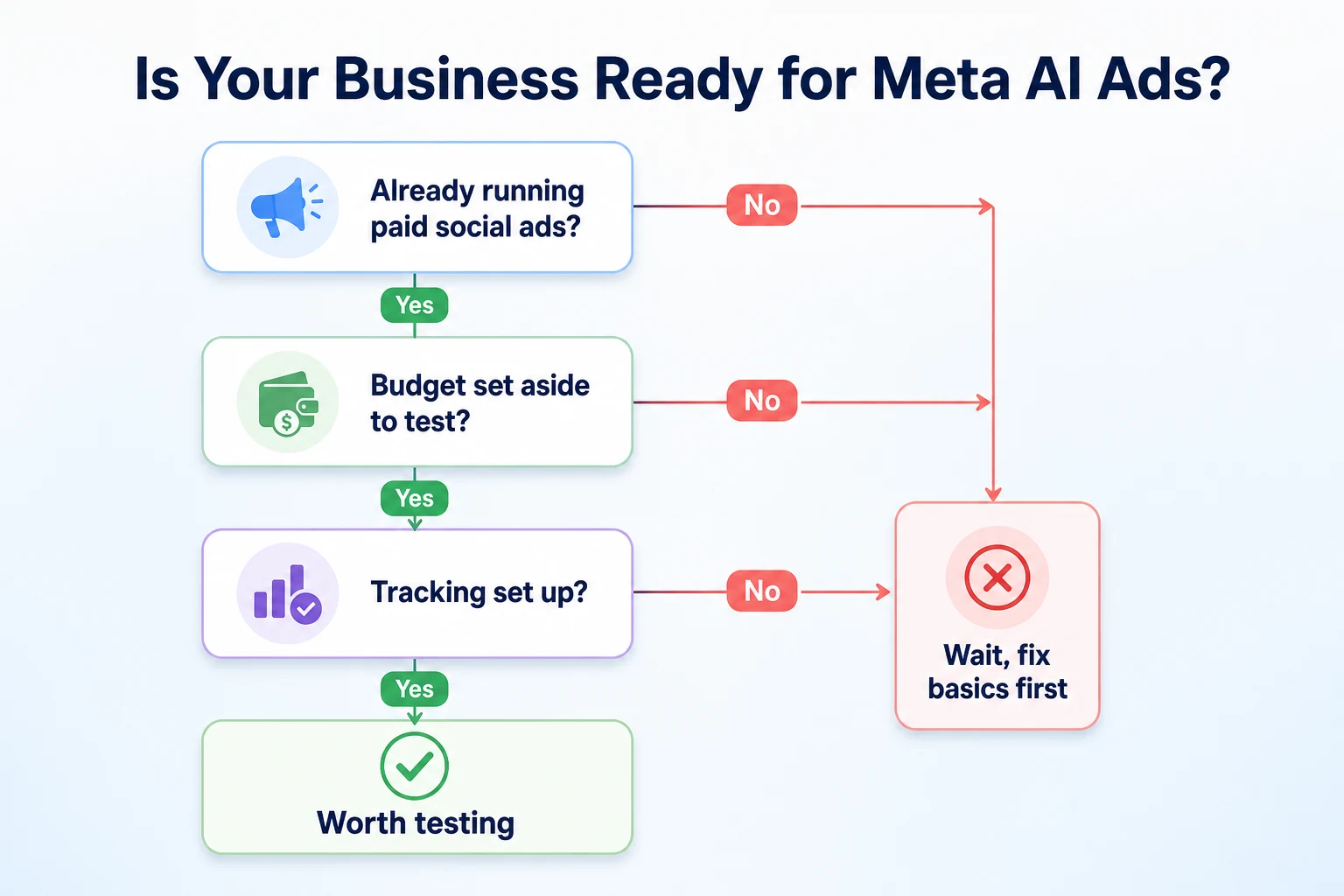
Advantage+ and AI creative tend to pay off fastest for a business that's already running manual Facebook or Instagram ads and finding the setup time tedious. If you already know roughly what works, a decent product photo, a customer base Meta can learn from, an existing conversions pixel, automation mostly removes busywork rather than guessing for you.
It's also worth testing when you have a budget set aside specifically for the test, separate from money you need for anything else, and when your website is actually ready to convert a visitor who clicks through: a clear price, a working contact form or checkout, and a page that loads properly on a phone.
Signs your time is better spent elsewhere first
If you've never run a paid ad before and have no tracking set up, turning on full automation on day one means the system is optimizing against very little real signal. A smaller, manually built test often teaches you more at this stage than handing everything to Advantage+ immediately.
It's also a sign to wait if your website itself isn't ready. Sending paid clicks to a page that's slow, confusing, or missing basic information wastes the ad spend regardless of how good the targeting is. Our guide on what to fix first on a website that gets no traffic covers the kind of groundwork that needs to happen before paid traffic can do much good.
Situation | Worth testing | Wait first |
|---|---|---|
Ad experience | Already running manual Facebook or Instagram ads | Never run a paid ad before |
Budget | Set aside specifically for the test | Coming out of money needed elsewhere |
Tracking | Pixel or conversions API already set up | No tracking in place yet |
Website readiness | Clear pricing, working checkout or form, loads fine on mobile | Slow, confusing, or missing basic information |
What to Review Before You Let AI Generate and Target Automatically
Automation doesn't mean hands off entirely. A few checks before launch catch most of the problems that show up later as wasted spend or an awkward ad.
Reviewing generated copy and images before they go live
Read every headline and body text variation the system produces before approving the campaign. These tools occasionally misstate a price, invent a claim about a product that isn't accurate, or crop an image in a way that cuts off something important, like a phone number on a flyer graphic.
It's worth treating the first batch of generated creative the same way you'd treat a draft from a new employee: useful as a starting point, not something to publish unread. A generated headline that overstates what you offer can create a real problem with a customer who shows up expecting it.
Setting exclusions and a budget cap
Before letting the automated targeting expand beyond your set audience, add any exclusions that matter: a location you don't serve, an age range that isn't relevant, or a customer list you'd rather not re-target with a cold offer. The system treats your input as a signal, not a strict rule, so it's worth checking in on the breakdown periodically rather than assuming it stays within the lines you set.
Set a daily or campaign budget cap before launch, even on a modest test. Automated systems are built to spend what they're given as efficiently as they can manage, which still means a cap protects you from the system spending faster than expected while it's learning.
A Worked Example: A Month of Advantage+ With AI Creative
Imagine a small home goods retailer runs a one-month Advantage+ campaign with AI-generated creative, mainly to see if the automation is worth keeping over their old manual setup. This example is illustrative.
Metric | Manual campaign (previous month) | Advantage+ with AI creative (this month) |
|---|---|---|
Cost per click | $0.62 | $0.51 |
Conversions (purchases) | 34 | 41 |
Organic search traffic | No change observed | No change observed |
Google ranking for main product pages | Unchanged | Unchanged |
These figures are illustrative.
The retailer sees a lower cost per click and more conversions, which is a reasonable outcome for the time saved not building each variation by hand. Organic traffic and Google rankings for the same product pages stay exactly where they were, because nothing about running a Facebook ad campaign touches either one. That's the expected result, not a disappointing one.
Common Mistakes Small Businesses Make With Meta AI Ads
A handful of habits turn a reasonable test into wasted budget, and most show up in the first few weeks of using these tools.
Expecting the ads to help Google rankings is the first, and it comes up often enough to repeat plainly: Meta's ad systems and Google's search systems are separate, and spending on one has no documented effect on the other. A business that cuts back on organic work, like the kind covered in our SEO tips for small business sites, because the ad budget is running, is trading a long-term asset for a short-term one without realizing it.
Publishing AI-generated copy without reading it is the second. A generated headline that misstates a price or a feature doesn't just hurt that ad, it can create a real disagreement with a customer who clicked expecting something slightly different.
Running full automation with no budget cap is the third. A test meant to cost $200 can run past that quickly if nobody set a limit before launch, especially while the system is still learning what converts.
Dropping organic content work entirely because ads are running rounds out the list. Paid reach disappears the moment spending stops. A business that leans entirely on ads during a slow month, then needs the budget back for something else, finds itself with no fallback if organic work was neglected in the meantime.
Expecting ad spend to move organic Google rankings.
Approving AI-generated headlines or images without reading them first.
Letting automated targeting run with no budget cap set.
Cutting organic content work because a paid campaign is active.
How Meta Ads and Organic SEO Can Work Together
None of this means the two should be treated as competitors for the same budget line. Run them alongside each other and each one can make the other slightly more useful.
Using what ads reveal about customer language
A Meta ad campaign generates something organic work often lacks: a fast read on which words actually get a click. If one AI-generated headline about a product's durability consistently outperforms one about its price, that's a real signal about what your customers care about, not just a guess.
That signal is worth feeding back into your website. A phrase that wins in an ad is worth testing as a heading or a bullet point on the matching product or service page, since it suggests the same language might also help a visitor arriving from a search result decide to stay and read further.
Why the landing page still needs its own SEO work
An ad can get someone to click. It can't fix what happens after they land. If the page a Meta ad sends traffic to is slow to load, missing basic details, or hard to read on a phone, the ad spend is paying to deliver visitors to a page that loses them anyway.
The same page also needs to stand on its own for organic search, since paid clicks and organic clicks usually land in the same place. Our guide to service page SEO covers what a page needs to convert a visitor regardless of where they arrived from, and a technical SEO audit covers the loading and structural issues that quietly undercut both kinds of traffic at once.
A 30-Day Plan to Test Meta AI Ads Properly
A month is long enough to see whether Advantage+ and AI creative are worth keeping, without committing a season's budget to find out.
Week | Focus | Tasks |
|---|---|---|
1 | Set up tracking and budget | Confirm the pixel or conversions API is firing correctly, set a daily budget cap, and gather decent product photos and accurate descriptions to feed the creative tools |
2 | Launch a small reviewed test | Turn on Advantage+ with a limited set of AI-generated variations, reading every headline and image before approving them, and confirm exclusions are set correctly |
3 | Monitor and exclude poor placements | Check the audience and placement breakdown, exclude anything irrelevant, and note which headline or image variations are actually converting |
4 | Compare results and decide | Compare cost per click and conversions against your previous manual campaign, check that organic traffic and rankings are unaffected as expected, and decide whether to continue, adjust, or stop |
This plan isn't built to catch a change in your Google rankings, because there isn't one to find. It's built to answer a narrower question: did the automation save time or money over running the campaign by hand. Keeping organic content work moving during the same month, along the lines in our SEO content calendar guide, means the ad test doesn't come at the cost of the slower work that keeps paying off after the test ends.
Where RepGet fits
RepGet doesn't manage Meta ad accounts, write ad creative, or touch ad spend in any way, and nothing about this article changes whether a business decides to test Advantage+. What it can do is make sure the website those ads point to, and the organic side of your search presence, is in reasonable shape before or alongside any ad budget.
RepGet's free website audit crawls a site and gives it a 0 to 100 SEO score, flagging technical and content issues worth fixing, including the kind of slow-loading or thin landing pages that waste paid clicks regardless of how well the targeting performed. No account or credit card required.
Beyond the audit, RepGet brings keyword research, content planning, article writing, publishing and search performance reporting from Google Search Console into one workflow, along with a set of free SEO tools for checking specific technical details on your own. That's useful for building out the organic side this article has described as separate from, and complementary to, anything happening in a Meta ad account. RepGet doesn't guarantee a ranking, a Maps position, an ad result, or a traffic number from any tool, paid or organic.
The bottom line
Meta's AI ad tools can generate copy and image variations quickly, automate budget allocation across placements, and expand targeting beyond what you'd set manually. For a business already running paid social with a budget and tracking in place, that automation genuinely saves setup time and can perform well.
What it doesn't do is touch your organic Google rankings or how an AI assistant describes your business, since those depend entirely on your website's own content and technical setup, not on what's happening inside a Facebook ad account. The two are worth running together, not instead of each other, and a weak landing page undercuts either one regardless of how good the ad targeting was.
If you're weighing an ad budget against organic work, start by finding out which one your site actually needs first.
Find out what your website needs first
Before testing Meta AI ads or anything else, see what your site actually needs. Run a free website audit with RepGet to check whether your landing pages are ready to convert the traffic you're about to pay for. No account or credit card required.
FAQ
What are Meta's AI ad tools?
They're a set of features inside Meta Ads Manager, including Advantage+ campaigns that automate budget and placement, plus tools that generate ad copy and image variations from what you upload.
Does Meta Advantage+ actually work for small businesses?
It can save setup time for a business already running manual Facebook or Instagram ads with tracking in place. It works less well as a first attempt at advertising with no prior data to learn from.
Do Meta ads help my Google rankings?
No. Meta's ad systems and Google's search systems are separate, and running ads on Facebook or Instagram has no documented effect on where your site ranks in Google search results.
How much do Meta AI ads typically cost to test?
There's no fixed figure, since cost depends on your industry and competition. Set a daily budget cap before launch and run it for at least a week or two so the system has enough data to learn from.
Can I turn off Meta's automated targeting if I don't like it?
Yes. You can set exclusions for locations, age ranges, or audiences you don't want included, though the automated system treats your input as a signal rather than a strict rule, so check it periodically.
Is AI-generated ad copy from Meta any good on its own?
It varies. The tool generates variations quickly from what you upload, but a vague product description produces vague copy just as easily, so every variation needs a human read before it goes live.
Should a small business spend on ads or SEO first?
It depends on whether your website is ready to convert a visitor. If the site is slow, confusing, or missing basic information, fixing that first makes any ad spend, Meta or otherwise, work harder.