

Google Search Ads vs SEO: Where to Spend Your Budget First
Short answer
Google Search Ads bring visitors within hours but stop the moment you stop paying, while SEO takes months to build but can keep bringing visitors without ongoing ad spend. A small business with an urgent need or a short runway usually gets more from ads first; one with time to invest and a smaller budget usually gets more lasting value from starting with SEO, and most eventually use both.
A small business owner has a few hundred dollars to spend this month.
One advisor says to run Google Search Ads today. Another says to invest that money in SEO and be patient.
Both are giving reasonable advice. They're just answering different questions.
The real question isn't which channel is better in general. It's which one makes sense for this business, this budget and this timeline.
Here's how Google Search Ads and SEO actually compare on cost, speed and durability, so you can decide where your next dollar does the most good.
What Google Search Ads and SEO Actually Are
Before comparing cost and speed, it helps to be clear about what each one actually is, since the terms get used loosely.
How Google Search Ads work
Google Search Ads are paid listings that appear when someone searches a term you've chosen to bid on. You set a budget, choose keywords, write an ad, and enter an auction against other businesses bidding on the same terms.
You're charged when someone clicks, not just when the ad is shown. Stop paying, and the ad stops appearing, usually within minutes.
How organic SEO rankings work
SEO is the work of making a page relevant and trustworthy enough that Google ranks it in the unpaid results, without paying for each click. That includes the words on the page, the site's technical setup, and the signals that suggest the page deserves to be shown for a given search.
Nobody pays Google directly for an organic ranking. The cost is the time and work it takes to earn one, which is a different kind of expense than a media budget.
Where each one appears on the results page
Search ads usually appear above or alongside the organic results, clearly labeled as sponsored. Organic listings sit beneath them, earned rather than bought.
A searcher can see both on the same page for the same query, and many do click both, which is part of why the two aren't really competitors so much as two different ways of reaching the same person. Our guide to local SEO for small businesses covers what builds organic visibility for a business that serves a specific area.
How Fast Each One Can Bring Customers
Speed is usually the first thing a small business cares about, and it's also where the two options differ the most.
Google Search Ads: visibility within hours
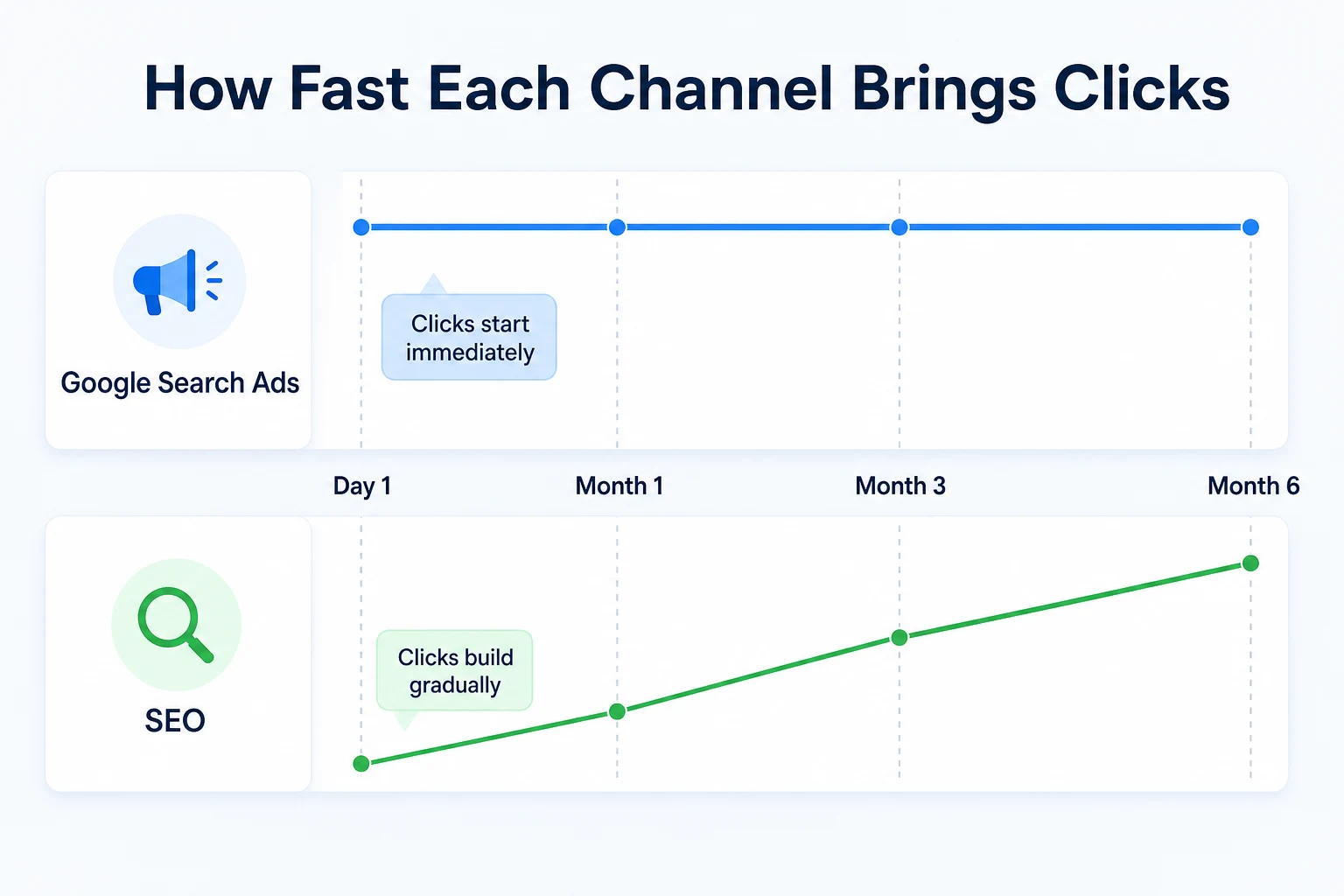
An ad campaign can go live the same day it's set up, and clicks can start arriving within hours of approval. There's no waiting for Google to decide the page deserves to be shown. The auction decides it, on the spot, for every search that matches your keywords.
This is the main reason ads make sense for a business that needs customers soon, not eventually.
SEO: rankings that build over months
Organic rankings don't work that way. A new or updated page typically needs to be crawled, evaluated against the competition, and given time to settle into a position, which commonly takes weeks to months rather than hours.
A business starting SEO this month shouldn't expect meaningful organic traffic this month. The work done now is mostly an investment in where the site stands later in the year.
What Each One Actually Costs
Cost isn't just the dollar amount. It's also what kind of cost it is, and whether it keeps adding up the same way over time.
Cost per click and daily budgets for Google Search Ads
With search ads, cost is direct and immediate. You set a daily or monthly budget, and each click costs something, with the exact amount set by an auction against other advertisers bidding on the same keyword.
More competitive keywords generally cost more per click, which is one reason it's worth checking how contested your target keywords actually are before setting a budget. RepGet's guide to using Google Keyword Planner for free keyword research is a reasonable starting point for seeing what a keyword's competition looks like before you commit spend to it.
What SEO costs when there's no media spend
SEO doesn't have a per-click price tag. Its cost is time: writing pages, fixing technical issues, building the kind of site Google can crawl and trust. A business doing this work itself pays in hours rather than dollars. A business paying someone else to do it pays for that labor instead of for clicks.
Cost type | Google Search Ads | SEO |
|---|---|---|
Upfront cost | Ad spend starts the moment the campaign goes live | Time or labor spent on content and site work, little or no media spend |
Ongoing cost | Every click costs money for as long as the campaign runs | Ongoing content and maintenance work, but no per-click charge |
Cost if you stop | None, but traffic also stops | None, and some traffic can continue for a while |
What Happens When You Stop Paying
This is where the two options diverge the most, and it's often the deciding factor once the first two are understood.
Why ad traffic disappears the day you pause a campaign
Pause a Google Search Ads campaign and the clicks stop almost immediately. There's no leftover visibility carrying forward. The ad simply stops entering the auction, and the traffic it brought goes with it.
This isn't a flaw in how ads work. It's the nature of paying per click: the visibility only exists while the payment does.
Why organic rankings can outlast the work that built them, for a while
Organic rankings behave differently. A page that earned a good position doesn't lose it the moment you stop actively working on it. It can keep bringing visitors for a while, sometimes months, without new spend or new content.
That doesn't mean SEO is maintenance-free. Rankings can slip as competitors publish newer content or as a topic shifts, and a page left untouched for too long eventually falls behind. But the decline is usually gradual, not immediate the way paused ad traffic is.
Scenario | Google Search Ads | SEO |
|---|---|---|
You pause spending | Traffic from ads stops almost immediately | Not applicable, since there's no per-click spend to pause |
You pause content work | No effect, since ad visibility doesn't depend on new content | Rankings can hold for a while, then gradually slip as competitors publish newer pages |
You do nothing at all | No clicks, no cost | Existing rankings may continue bringing some traffic, with no guarantee of how long |
These scenarios are illustrative. Actual results depend on competition, the keyword, and how the site is maintained.
Which Keywords Make Sense for Ads vs SEO
Not every keyword is worth the same approach. Competition changes the math for both channels, and it's worth checking before committing a budget to either one.
When a keyword's difficulty favors ads
Some keywords are expensive to rank for organically because large, established sites already occupy the top organic positions and aren't going anywhere soon. A keyword with high search volume and high commercial intent, the kind someone types right before they buy or book, often falls into this group.
For these, the organic climb can take a long time, and a newer site may be competing against pages with years of built-up authority behind them. Paying for a click at the top of the page can be the faster, more realistic way to appear for that search while SEO work happens in the background.
When a keyword is worth targeting with SEO instead
Other keywords are specific enough, or less contested enough, that a smaller site has a real shot at ranking organically within a reasonable timeframe. These are often longer, more specific phrases tied to a particular service, location or problem, rather than a single broad term everyone is bidding on.
Our guide to finding low-competition keywords that bring customers walks through how to spot these before deciding where to put the work. A keyword with low competition and decent intent behind it is often the better first SEO target, since it's realistic to rank for without years of built-up authority.
A Worked Example: Comparing Two Paths for the Same Business
Imagine a local plumbing company with a $500 monthly budget and a decision to make. This example is illustrative, and the numbers are rounded for simplicity.
One path puts the full $500 into Google Search Ads every month. The other puts it into SEO work instead, paying for a few pages of content and some technical fixes, with no media spend at all.
Month | Ads path | SEO path |
|---|---|---|
Month 1 | Campaign live within days, clicks arrive immediately, but traffic stops the moment spend stops | New pages published, little or no organic traffic yet |
Month 2 | Steady clicks, same cost, same result as month 1 | Pages indexed and being evaluated, traffic still minimal |
Month 3 | Steady clicks continue, cost unchanged | A few pages begin appearing in search results, early traffic trickles in |
Month 6 | Same traffic as month 1, assuming the budget hasn't changed | Several pages ranking, organic traffic growing without extra spend that month |
If spend or work stops | Traffic drops to zero almost immediately | Existing rankings may continue bringing some traffic for a while |
These figures are illustrative. Actual timelines and outcomes depend on the industry, the competition and how consistently the work is done.
Neither path is wrong. The ads path gives this business customers from day one, at a steady, predictable cost. The SEO path gives it very little in the early months, then starts paying off in a way that doesn't disappear the moment the work pauses. Which one fits depends on how soon this business needs the phone to ring.
Signals That Point to Ads First
Some situations make Google Search Ads the more sensible place to start, at least for now.
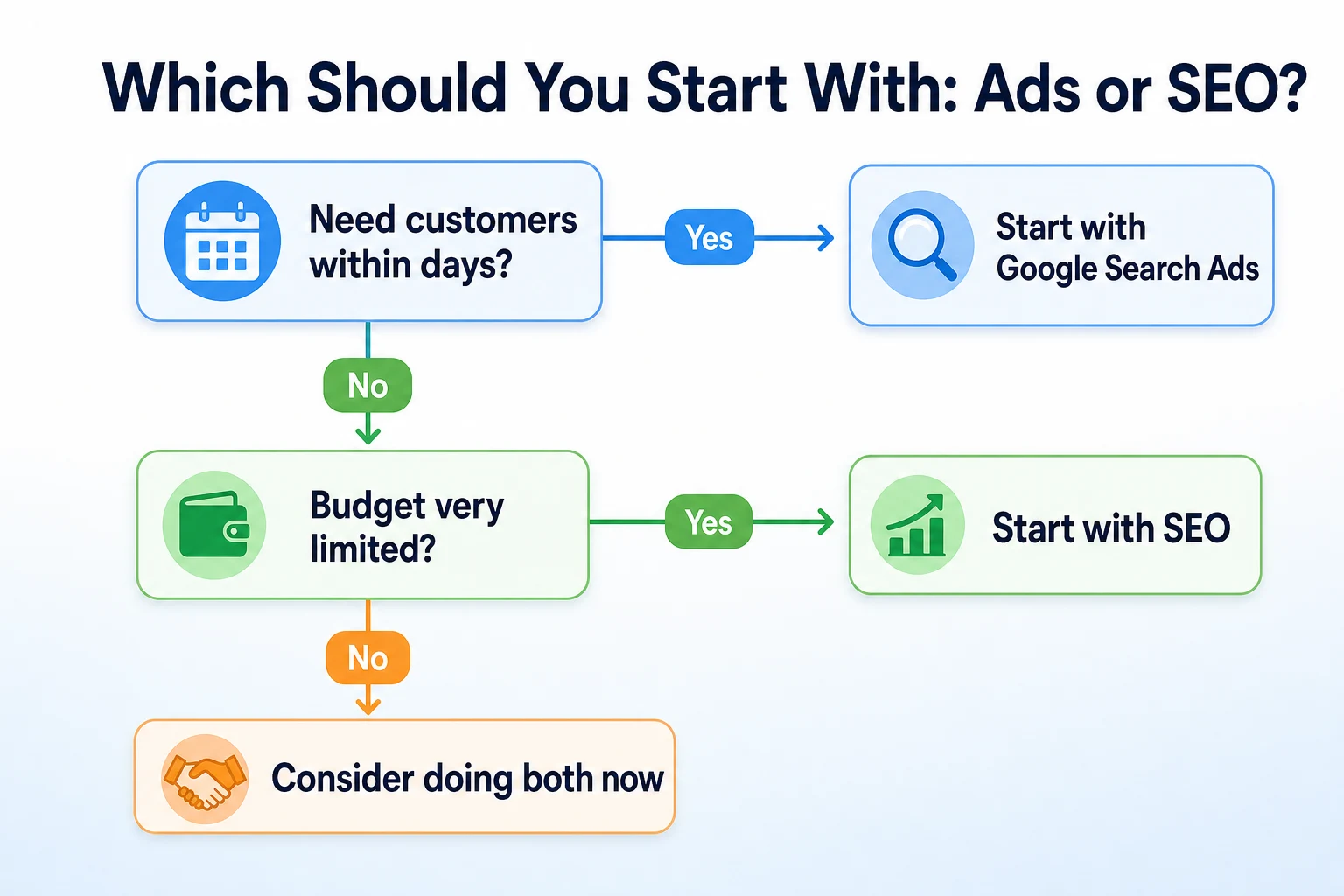
A business that needs customers within days, not months, usually can't wait for organic rankings to build. A seasonal business approaching its busy period, or one that's simply run out of work to do this week, often falls into this category.
A business testing something new, a new service, a new location, or a new offer, can use ads to see whether there's real demand before investing months of SEO work into a page that might not pay off. The ad spend doubles as a quick, honest test.
A business competing in a market where the organic results are dominated by a handful of large, well established sites may find that ranking organically for its most valuable keywords is a long and uncertain road. Buying visibility at the top of the page can make more sense while a longer-term SEO plan develops underneath it.
A business with cash available right now but little time to spend on content or technical work also leans toward ads, since ads require far less ongoing attention once a campaign is set up correctly.
Signals That Point to SEO First
Other situations point the other way, toward building organic visibility before spending on ads.
A business with a longer runway, one that isn't relying on this month's traffic to make rent, can afford to let SEO work build in the background while it keeps doing whatever already brings customers in, referrals, repeat business, word of mouth.
A business with a very limited budget often gets more out of SEO than ads, simply because a small daily ad budget in a competitive market can run out fast without producing enough clicks to matter. That same money spent on a handful of well-targeted pages can keep working long after it's spent.
A site with little or no organic presence yet, one that's never had a dedicated service page or any content built around what customers actually search for, usually has easy wins available. Fixing a missing page or a thin service description tends to move the needle faster than squeezing more out of an ad campaign that's already running close to its limit.
A business whose keywords aren't dominated by national brands or years-old competitors has a realistic shot at ranking without years of built-up authority behind it, which makes the SEO investment more likely to pay off within a reasonable time.
Why Most Businesses Eventually Need Both
Framed as a single either/or choice, this comparison can make it sound like a business has to pick a side and stay there. In practice, most businesses that stick around end up running both at once, just not necessarily starting that way.
Using ads to cover the gap while SEO builds
A common pattern is to run ads for the keywords that matter most right now, while SEO work happens underneath, aimed at the same keywords or ones nearby. The ads bring customers during the months when organic traffic is still close to zero.
This isn't wasted ad spend. It's covering the gap between needing customers today and having rankings that haven't built up yet. Once those rankings exist, the business isn't relying on ads alone to fill that need.
Shifting budget as organic traffic grows
As organic pages start ranking and bringing in visitors on their own, some businesses reduce ad spend on the keywords those pages now cover, and redirect that budget toward keywords that still need paid visibility, or toward further SEO work.
This shift doesn't need to be dramatic or sudden. It's a gradual rebalancing, checked every month or two against what's actually bringing in traffic, rather than a one-time decision made at the start and never revisited.
A 30-Day Plan to Decide and Start
Deciding where to put the next dollar doesn't need to be a long deliberation. A month is enough time to get real information and start acting on it.
Week 1: audit what you have
Before spending anything new, look at what's already on the site. Check which pages exist, which keywords they're realistically positioned for, and whether anything technical is quietly holding the site back. Our SEO audit checklist walks through what to look for on a small business site.
Week 2: test a small ad budget
Run a modest Google Search Ads campaign on your highest-intent keywords, just large enough to see whether clicks convert into actual enquiries. This isn't a long-term commitment. It's a quick way to learn what a click is worth before deciding how much of the budget belongs here permanently.
Weeks 3 and 4: start the SEO work that pays off later
Use what the audit and the ad test turned up to pick a handful of pages to fix or write. Prioritize whichever keywords showed real intent in the ad test but aren't yet well covered by an organic page.
Week | Focus | What to do |
|---|---|---|
Week 1 | Audit | Review existing pages, keywords and technical issues before spending anything new |
Week 2 | Test | Run a small Google Search Ads campaign on high-intent keywords to see what a click is worth |
Week 3 | Plan | Pick the pages most worth writing or fixing, based on what the audit and ad test showed |
Week 4 | Build | Write or fix the chosen pages and fix any technical issues found in week 1 |
By the end of the month, you'll have real numbers on what a click costs you, which pages are worth building, and a short list of SEO work already underway, instead of a decision made on instinct alone.
Common Mistakes When Choosing Between Them
Most of the regret businesses feel about ads or SEO doesn't come from picking the wrong channel. It comes from a handful of avoidable mistakes made while running either one.
Judging SEO after a month is one of the most common. A page that isn't ranking in week four hasn't failed. It's usually still being evaluated, and pulling the plug this early throws away work that was starting to pay off.
Running ads without a landing page built to convert is another. A click that costs money and lands on a vague homepage with no clear next step is a click wasted, regardless of how well the ad itself was written.
Treating the two as permanently separate budgets is a mistake too. A business that never revisits the split, even after SEO starts bringing in traffic, keeps paying for clicks on keywords an organic page could now cover for free.
Chasing the same broad, expensive keyword with both ads and SEO at once, without checking whether it's realistic to rank for organically, can waste the SEO side of the effort for months before anyone notices.
And stopping SEO work the moment ads start performing well is a common reversal. Ads can disappear the day the budget runs out. A business that let its organic pages go stale while ads were working has no safety net left when that budget needs to shrink.
Mistake | Why it hurts | What to do instead |
|---|---|---|
Judging SEO after one month | Rankings usually take longer to settle, so early results understate the eventual payoff | Give new or updated pages a few months before deciding whether they're working |
Running ads with no landing page built to convert | Paid clicks go to waste if the page doesn't give visitors a clear next step | Send ad traffic to a page built around the exact keyword and offer, not the homepage |
Never revisiting the budget split | Keeps paying for clicks on keywords an organic page could now cover for free | Check performance every month or two and shift spend as organic traffic grows |
Letting SEO lapse once ads are working | Leaves no fallback if the ad budget has to shrink later | Keep at least some SEO work going even while ads are performing well |
Where RepGet fits
RepGet works on the SEO side of this decision, not the paid side. It doesn't run or manage Google Search Ads campaigns, and it won't help with keyword bids or ad copy.
What it does help with is the work that builds organic visibility over time. RepGet brings website auditing, keyword research, content planning, article writing, publishing to the business's website, and search performance reporting from Google Search Console into one workflow, so the SEO side of a split budget doesn't fall through the cracks while ads are running.
Its free website audit crawls a site, gives it a 0 to 100 SEO score, and lists technical and content issues worth fixing, which is a reasonable place to start the 30 day plan above before deciding how much budget SEO deserves. Its free SEO tools cover smaller checks along the way, from robots.txt to keyword density, without needing an account.
Articles RepGet writes can stay as drafts for a business to review before they're published, so nothing goes live without someone checking it first. RepGet doesn't guarantee a ranking, a position in Google Maps, or a particular amount of traffic from any of this work, and no honest tool can.
The bottom line
Google Search Ads and SEO aren't competing answers to the same question. They're answers to different questions: one is about speed, the other about durability.
A business that needs customers this month usually gets more from ads first, even if SEO work starts in parallel. A business with more runway and a smaller budget usually gets more lasting value from starting with SEO, since the traffic it builds doesn't disappear the day the spending stops.
Most businesses that stay in this long enough end up doing both, shifting the balance as organic pages start to carry more of the load. The right place to start depends on your timeline, your budget and how competitive your keywords actually are, not on which channel sounds more modern.
Find out what your website needs first
Before putting a budget toward either option, see what your site currently has and where the easy SEO wins might be. Run a free website audit with RepGet to check your site's technical setup alongside its content. No account or credit card required.
FAQ
Is it better to pay for Google Ads or do SEO?
It depends on your timeline and budget. Ads work faster if you need customers soon; SEO costs less in direct spend and can keep bringing traffic after the work is done, though it takes months to build.
How much do Google Search Ads cost per click?
Cost per click is set by an auction and varies by keyword and competition, so there's no fixed price. More competitive, high-intent keywords generally cost more per click than niche or lower-demand ones.
Can I do SEO and Google Ads at the same time?
Yes, and many businesses do. A common approach runs ads on keywords that matter now while SEO work builds organic pages for the same or related keywords in the background.
How long does SEO take to work compared to ads?
Ads can bring clicks within hours of launch. SEO typically takes weeks to months before a new or updated page settles into a meaningful ranking position, if it ranks at all.
Do I need SEO if I'm already running Google Ads?
Ads alone leave you paying for every click indefinitely. SEO gives you a chance at traffic that doesn't disappear the moment you pause spending, which most businesses eventually want alongside ads.
What happens to my traffic if I stop running Google Ads?
Traffic from ads drops to close to zero almost immediately once a campaign is paused, since paid visibility only exists while the spend is active.
Is Google Ads worth it for a small business?
It can be, especially for urgent needs, testing new offers, or competing against established sites in organic results. Whether it's worth it depends on the cost per click and what a click is actually worth to your business.
Which is cheaper, SEO or Google Ads?
SEO has no per-click cost, but it costs time or labor instead. Ads have a clear, immediate dollar cost per click. Which is cheaper overall depends on how long you compare them over.