

Backlink Quality Checklist: 12 Signs of a Good Link
Short answer
A good backlink comes from a relevant, real site with its own traffic, placed naturally in the content with no payment behind it. It uses natural anchor text, sits on a page Google can crawl and index, and comes from a domain that isn't part of a link scheme. No single factor proves quality alone, it's the pattern across relevance, authority and how the link was earned that matters.
A business owner gets an email offering twenty backlinks for a flat fee.
She almost says yes.
Then she notices a competitor with far fewer backlinks sitting above her in Google's results anyway.
She wants to know what actually separates a backlink worth having from one that does nothing at all, or worse.
That's the real question behind any backlink quality checklist. It isn't about how many links point at your site. It's about whether each one is the kind of link search engines treat as a genuine signal, rather than noise or a risk.
Here's a 12-point way to check any backlink, whether it's already pointing at your site or someone's offering to sell you one.
Why Backlink Quality Matters More Than Backlink Count
Most small business owners hear "get more backlinks" long before anyone explains what makes one backlink different from another.
That gap is where the twenty-links-for-a-flat-fee email finds its audience.
What Google's documentation actually says about links
Google's Search Central documentation describes links as a signal it uses to discover pages and to understand how pages relate to one another. It doesn't describe a target number of links to reach, and it doesn't describe link volume on its own as something to chase.
The same documentation warns against link schemes, meaning links created or exchanged specifically to manipulate rankings rather than to point a reader somewhere useful. That warning matters here, because it's the dividing line between a backlink that helps and one that can draw the wrong kind of attention to a site. Our guide to AI backlinks goes further into what's realistic to expect from backlink building generally, and our guide to how Google decides which sites to rank covers where links sit among the other signals Google uses.
Why a high link count can still mean a weak profile
A site can carry hundreds of backlinks and still have a weak profile, if most of those links come from directories nobody reads, from sites in an unrelated industry, or from pages built purely to host outbound links.
A site with a dozen backlinks from relevant, real, well-read pages often does more for its visibility than a site with ten times as many links from thin or unrelated sources. Quality doesn't just sit alongside quantity here. It tends to matter more.
The 12-Point Backlink Quality Checklist at a Glance
Before working through each point in detail, it helps to see all 12 laid out together, so you can score a link quickly before deciding whether to chase it or accept it.
Point | What to check | Quick pass or fail sign |
|---|---|---|
1. Topical relevance | Does the linking page cover a subject related to your business | Pass: a related topic. Fail: no connection at all |
2. Domain authority signals | Does the domain show the usual marks of an established, trusted site | Pass: a known, established presence. Fail: a brand-new or unknown shell site |
3. Real traffic | Does the site appear to have actual visitors and activity | Pass: visible engagement. Fail: no sign anyone reads it |
4. Link attribute | Is the link dofollow, nofollow, sponsored or UGC | Pass: any of these, used honestly. Fail: a paid link with no sponsored tag |
5. Placement on the page | Is it inside the main content or buried in a footer or sidebar | Pass: inside the body content. Fail: a generic footer or sitewide link |
6. Anchor text | Does the clickable text read naturally in the sentence | Pass: natural phrasing. Fail: an exact-match keyword stuffed in |
7. How it was earned | Was it editorial, or paid, exchanged or self-placed | Pass: editorial, unprompted. Fail: paid without disclosure |
8. Content on the linking site | Does the site publish real, original content | Pass: a genuine publication. Fail: a thin site built to host links |
9. Indexed and crawlable | Is the linking page itself indexed and reachable | Pass: indexed and crawlable. Fail: an orphan page blocked from search |
10. Referring domain diversity | Are your links spread across different domains | Pass: many different domains. Fail: most links from one or two sources |
11. Surrounding content | What does the text around the link actually say about you | Pass: accurate, fair context. Fail: misleading or unrelated text |
12. Link neighborhood | What else does this domain link to | Pass: a mix of credible outbound links. Fail: links mostly to low-quality sites |
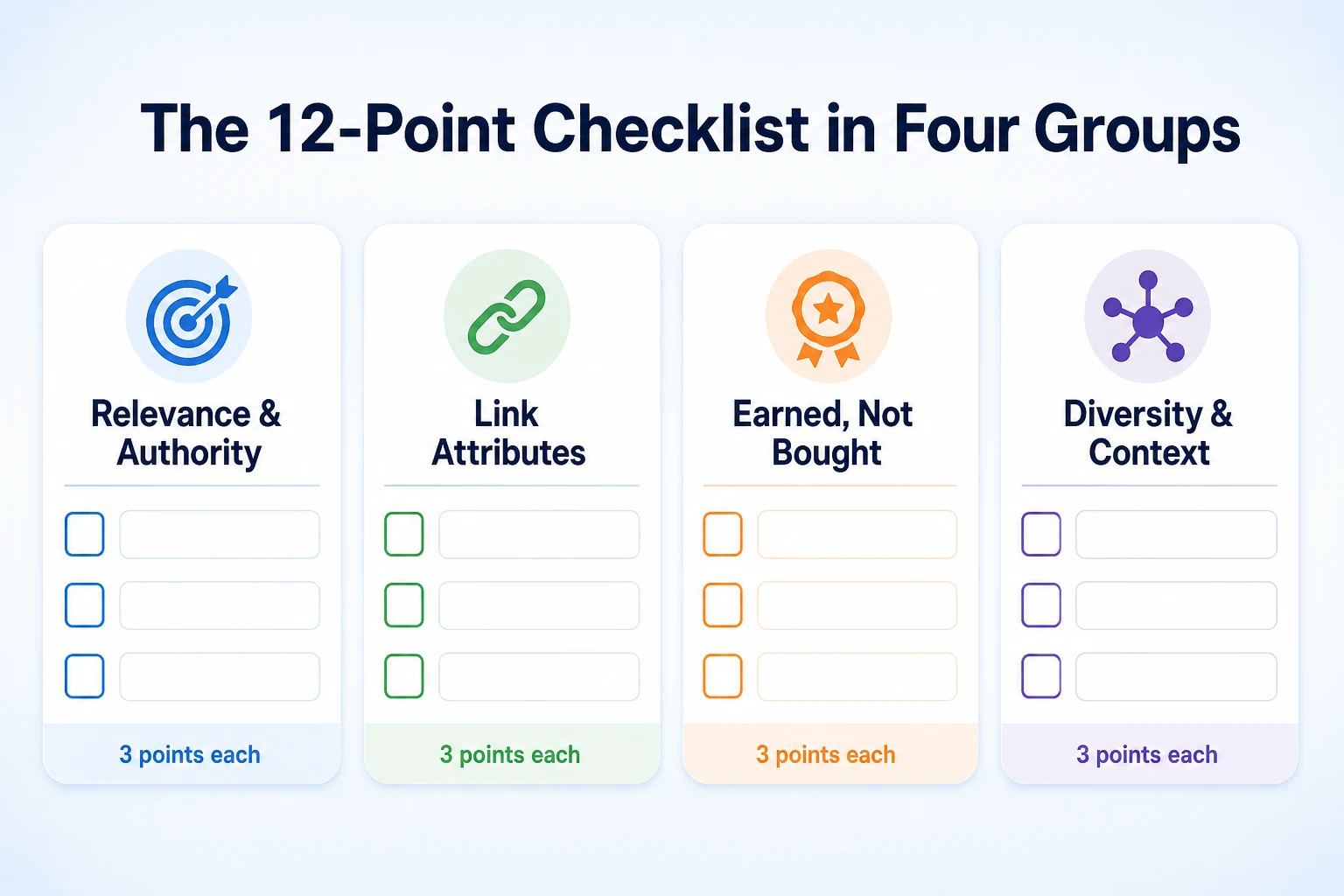
Relevance and Authority: Points 1 to 3
The first three points decide whether a link is even worth evaluating further. A link that fails here rarely gets saved by anything in the rest of the checklist.
Point 1: Is the linking page topically relevant
A backlink from a page about a subject close to your own business carries more weight than one from a page with no connection to what you do. A plumbing company linked from a home maintenance blog makes sense. The same company linked from a page about car insurance doesn't.
Relevance doesn't have to be exact. A local bakery linked from a wedding planning site is relevant even though the two businesses aren't in the same industry, because the topic connects naturally. What to avoid is a link that exists only because it was placed, with nothing about the surrounding page relating to your business at all.
Point 2: Does the domain show real authority signals
A domain doesn't need to be famous to carry weight, but it should show the ordinary marks of an established site: an about page, a real author or business behind it, other pages that look cared for, and a history that goes back further than a few weeks.
A domain registered recently, with thin content and no clear owner, is a weak place for a backlink to come from, no matter how relevant the topic looks on the surface.
Point 3: Does the site have its own real traffic
A site that nobody reads doesn't pass much value along through its links, even if everything else about it looks fine. Signs of real traffic include comments on posts, social shares, a reasonably active publishing schedule, and content that reads like it was written for an actual audience rather than for search engines alone.
You can't measure another site's traffic directly without its own analytics, but these visible signs are a reasonable stand-in when deciding whether a link is worth pursuing.
Link Attributes: Points 4 to 6
Once a site and page pass the relevance and authority check, the next three points look at the link itself: how it's marked, where it sits, and what it says.
Point 4: Dofollow, nofollow, sponsored or UGC
Google's Search Central documentation describes rel="nofollow", rel="sponsored" and rel="ugc" as hints it can use when deciding how much weight to give a link, rather than a sign the link counts for nothing. A nofollow link from a genuine, relevant site can still send real visitors and still represent a fair, honest mention.
What matters more than the attribute itself is honesty. A paid placement marked sponsored is fine. A paid placement with no attribute at all, dressed up as an organic editorial mention, is the kind of thing Google's guidance on link schemes warns against. Our guide to AI search citations vs backlinks covers how these attributes interact with the newer question of whether AI assistants read and repeat the same link at all.
Point 5: Where the link sits on the page
A link placed naturally inside a paragraph, where a reader would actually encounter it while reading, tends to carry more weight than a link sitting in a sitewide footer or a sidebar widget that appears on every page of the site regardless of topic.
Sitewide links are also one of the clearer signs of a link scheme, since they're usually placed once and never touched again, rather than chosen deliberately for a specific piece of content.
Point 6: Anchor text that reads naturally
Anchor text is the clickable words themselves. Natural anchor text reads like a normal part of the sentence: "this local bakery's wedding cake menu" rather than "best wedding cakes near me," repeated identically across dozens of different sites.
Exact-match keyword anchor text, used over and over across many links, is one of the patterns Google's guidance on link schemes flags as manipulative. A link with plain, varied anchor text that simply names the business or describes the page is a safer and more natural sign.
Signs a Link Was Earned, Not Bought: Points 7 to 9
The next three points ask a harder question: did this link happen because someone genuinely wanted to point readers to you, or did it happen because money or a trade changed hands?
Point 7: Editorial links versus paid or exchanged links
An editorial link is one a site added on its own, because it fit the story or the page, with nothing offered in return. A paid link is one bought outright, whether through a direct payment, a
A paid link is one bought outright, whether through a direct payment, a
A paid link is one bought through a direct payment, a guest post arranged specifically to carry a link, or a reciprocal arrangement where two sites agree to link to each other mainly to pass value along rather than to help a reader. Google's guidance on link schemes treats both buying and selling links that pass ranking signals, and excessive reciprocal linking done purely for that purpose, as practices to avoid.
None of this means every paid placement is against the rules. A sponsored post marked honestly with a rel="sponsored" attribute is a disclosed arrangement, not a scheme. The problem is a paid link dressed up as if it happened on its own.
Point 8: Real content on the linking site
A site built to host outbound links, rather than to publish anything a person would actually read, is a weak source no matter how the link itself is marked. Signs of this include pages with almost no original writing, content that reads like it exists only to surround a handful of links, and a publishing pattern that looks automated rather than written by a person.
A genuine publication, even a small one, usually has a recognizable voice, a consistent topic focus, and posts that make sense as something a reader would want.
Point 9: Indexed and crawlable, not an orphan page
A backlink only does anything if the page carrying it is itself indexed and reachable. A link sitting on a page blocked by robots.txt, marked noindex, or orphaned with no other page linking to it, is close to invisible to search engines, regardless of how good everything else about it looks.
It's worth checking this directly rather than assuming it. Our guide to getting a website indexed by Google covers how to confirm a page is actually in Google's index, which is the same basic check worth running on a page that's supposedly linking to you.
Diversity and Context: Points 10 to 12
The last three points step back from any single link and look at the wider pattern a backlink sits inside.
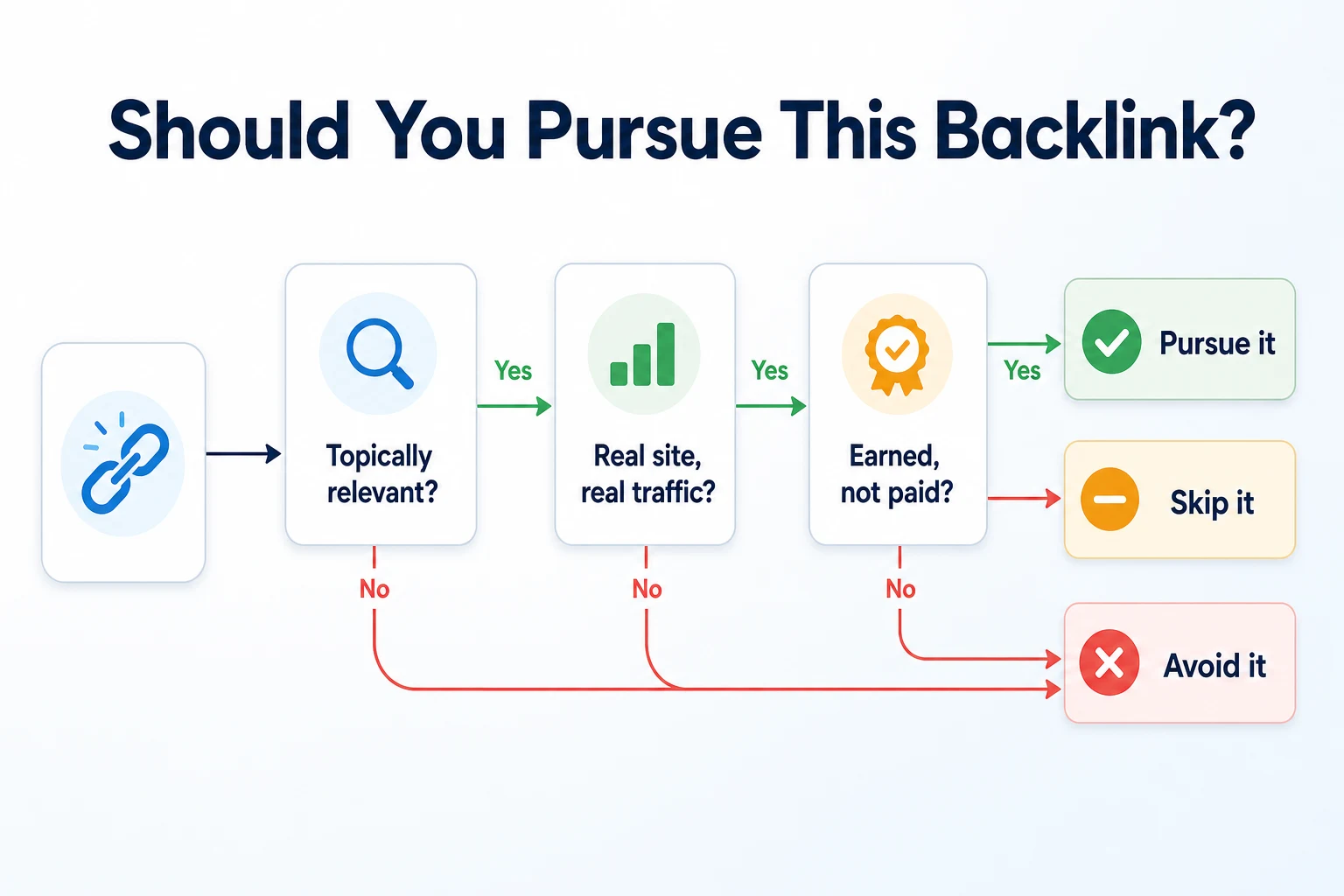
Point 10: A spread of different referring domains
Ten links from ten different domains tend to carry more weight than ten links from the same domain repeated across different pages. A link profile dominated by one or two sources looks less like organic interest and more like a single relationship being leaned on heavily, whether that's a friendly partner, a paid arrangement, or a directory network.
A healthy spread doesn't need to be huge. A handful of different domains, each relevant and each earned on its own terms, is a stronger foundation than dozens of links clustered on two or three sites.
Point 11: What the surrounding content says about you
The sentence or paragraph around a link matters as much as the link itself. A link inside a paragraph that accurately describes your business, your service or your product gives a reader and a search engine a clear, honest signal of what you do.
A link dropped into content that's vague, inaccurate, or only loosely related to your actual business does less for you, even if the link itself is technically sound. It's worth actually reading the page a link sits on, not just confirming the link exists.
Point 12: The site's link neighborhood
What a site links to elsewhere says something about the company a link keeps. A domain that otherwise links out mainly to low-quality, spammy or unrelated sites is a weaker source, even for a page that looks fine on its own.
This one takes a little more digging than the others, since it means looking beyond the single page in question to a handful of other pages on the same site. It's worth the extra few minutes before deciding a link is worth pursuing or keeping.
A Worked Example: Scoring Three Backlinks
Running all 12 points against every single link isn't realistic day to day. But scoring a handful of fictional examples side by side shows how differently two links from the same type of source can turn out.
Backlink | Relevance | Authority | Placement | Overall verdict |
|---|---|---|---|---|
A local news article mentioning a bakery's new opening, link placed in the body text | High, same town, same topic | Established outlet with a real readership | Inside the article body | Strong link, earned editorially |
A general business directory listing, one of thousands of identical entries | Low, no specific connection beyond a category tag | Unclear, thin site with little original content | Sitewide template, same on every listing | Weak, likely does little either way |
A paid guest post on an unrelated blog, exact-match anchor text, no sponsored tag | None, different industry entirely | New domain, thin content around the links | Buried among several other paid links | Risky, resembles a link scheme |
These three backlinks are illustrative.
The news article passes most of the 12 points without much argument. The directory listing isn't dangerous, it's just unlikely to move anything either way. The paid guest post is the one worth actually removing or disavowing if it already exists, since it combines several of the warning signs this checklist is built to catch.
How to Check Your Current Backlinks in Search Console
Before chasing any new backlinks, it's worth knowing what's already pointing at your site, and Google Search Console is the most direct, free place to look.
Reading the Links report
Search Console's Links report, found under the Links section in the left-hand menu, lists the external sites linking to you, the specific pages on your site receiving the most links, and the top linking text used. Clicking into any domain shows the individual pages on that site that link to you, which is where the relevance and placement checks from earlier in this article actually happen.
Working through this list against the 12-point checklist doesn't need to happen all at once. A reasonable approach is to check the domains sending the most links first, since those are doing the most work in either direction.
What Search Console doesn't tell you
Search Console only shows links Google has found and recorded, not every link that exists anywhere on the web, so treat it as a solid baseline rather than a complete count. It also doesn't score link quality for you. It shows you where a link comes from, but deciding whether that source is relevant, authoritative and honestly earned is still a judgment call using the 12 points above.
Our technical SEO audit guide and SEO audit checklist both cover where a backlink review fits alongside the rest of a site's technical health, since a weak link profile is rarely the only thing worth checking at the same time.
Red Flags and Common Mistakes
Most backlink trouble doesn't come from one obviously bad link. It comes from a handful of habits that look harmless at the time and add up to a weak or risky profile.
Buying a bundle of links from an unknown seller because the price looks reasonable, without checking a single one of the 12 points above first.
Trading links with another local business purely so each site can list the other, rather than because either page genuinely helps the other's readers.
Chasing a high link count as a goal in itself, when a dozen strong, relevant links usually do more than a hundred weak ones.
Accepting a guest post with exact-match anchor text repeated across every paragraph, because it was easier than asking for natural phrasing.
Ignoring a sitewide footer link because it's free, without noticing it sits on a domain with no real content of its own.
Treating a backlink offer that promises a fixed number of links per month the same way you'd treat a tool that promises fixed traffic numbers. Our guide to why a website traffic bot hurts your SEO instead of helping covers a related version of this same mistake: paying for a number instead of for something real.
Never checking existing backlinks at all, so a risky link sits unnoticed for years until it draws unwanted attention.
None of these mistakes are unusual, and none of them require a specialist to avoid. They mostly come down to checking before accepting, rather than after.
A 30-Day Plan to Audit and Build Quality Backlinks
Working through an entire backlink profile in one sitting isn't realistic for most small businesses. A month, split into four focused weeks, is enough to get a clear picture and make real progress.
Week | Focus | Tasks |
|---|---|---|
Week 1 | Pull the full list | Export the Links report from Search Console, sort by referring domain, and note the domains sending the most links first |
Week 2 | Score the top domains | Run the 12-point checklist against your 10 to 15 largest referring domains, and flag anything that looks like a link scheme |
Week 3 | Deal with the weak or risky ones | Ask for removal where a link looks paid without disclosure, and leave alone anything that's simply weak but not harmful |
Week 4 | Pursue a handful of new, relevant links | List three to five genuinely relevant sites, and pitch content or a relationship worth linking to, rather than asking for a link directly |
New, relevant links tend to follow naturally from content worth linking to in the first place. Our SEO content calendar guide covers how to plan the kind of pages, guides, local resources, original research, that other sites actually want to reference on their own.
Where RepGet fits
RepGet doesn't buy, sell or place backlinks on your behalf, and it doesn't promise a specific number of links, a ranking position, or a mention in an AI answer. Nobody honestly can promise any of that.
What RepGet does is bring website auditing, keyword research, content planning, article writing, publishing to your website, and search performance reporting from Google Search Console into one workflow. That matters for backlink quality specifically, because the content side of this problem, writing the kind of clear, specific, genuinely useful page that a relevant site would want to reference, is a large part of earning links that pass the 12 points in this checklist. Articles RepGet writes can stay as drafts for your team to review before anything goes live, so you can check a page is actually worth linking to before it's published.
RepGet's free website audit crawls your site and gives it a 0 to 100 SEO score, with the technical and content issues worth fixing listed out, which is a reasonable first step before spending time chasing new links at all. No account or credit card required. RepGet does not replace Google Search Console's own Links report, and it does not replace your own judgment when deciding whether a specific backlink opportunity is worth pursuing.
The bottom line
A backlink quality checklist isn't really about finding one magic signal that proves a link is good. It's about checking a pattern: is the page relevant, does the domain show real authority, is the link honestly earned, and does the context around it actually say something true about your business.
A handful of links that pass most of these 12 points will usually do more for a small business than a pile of links bought cheaply and never checked. The twenty-links-for-a-flat-fee email isn't always a scam in the strict sense, but it's rarely where the strongest links come from either. Checking before accepting, and checking what's already there before chasing anything new, is the habit that actually separates a backlink worth having from one that does nothing at all, or worse.
Find out what your website needs first
Run a free website audit with RepGet to see what your site needs fixed before spending time or money chasing new backlinks. No account or credit card required.
FAQ
What makes a backlink high quality?
A high quality backlink comes from a relevant, real site with genuine traffic, sits inside the main content rather than a footer, uses natural anchor text, and was earned editorially rather than bought or exchanged.
Is a nofollow backlink still worth having?
Yes. Google's documentation treats nofollow as a hint about how much weight to give a link, not proof it counts for nothing, and a nofollow link from a relevant site can still bring real visitors.
How many backlinks does a small business actually need?
There's no fixed number. A dozen relevant, honestly earned links from different domains usually does more than a large pile of weak or unrelated ones.
Can a backlink hurt my SEO instead of helping it?
A single weak link rarely causes harm on its own, but a pattern of paid, undisclosed or scheme-like links is the kind of thing Google's guidance on link schemes warns against.
How do I check if a backlink is from a spammy site?
Look at whether the site has real original content, a visible author or business behind it, some sign of actual readers, and check what else the domain links to elsewhere.
Does anchor text still matter for backlinks?
Yes. Natural anchor text that reads like part of the sentence is a healthier sign than exact-match keywords repeated identically across many different links.
How do I find my current backlinks for free?
Google Search Console's Links report, under the Links section, lists the external sites linking to you and the pages on your site receiving the most links, at no cost.
Are paid backlinks against Google's guidelines?
Buying links specifically to pass ranking signals is covered by Google's guidance on link schemes, though a sponsored placement disclosed honestly with a rel="sponsored" attribute is a different, disclosed arrangement.
Comments
1 shownShare your thoughts about this article.
New to RepGet? Create a free account to join the conversation.
For me, the strongest test is whether a backlink would still be worth having if search engines didn’t exist. It should belong in the article, reach the right audience and give readers a useful reason to click. I’d encourage every business owner to open the actual linking page and read the surrounding content before judging an opportunity by a domain score alone. A backlink should make sense as a recommendation. Dumitru Culiuc, Founder of RepGet