

Website Traffic Bot: Why It Hurts Your SEO Instead of Helping
Short answer
Website traffic bots send automated, non-human visits to a site. Search engines and analytics tools detect patterns like no scrolling, no clicks, and repeated IP ranges. Buying this traffic doesn't improve rankings, since Google doesn't use raw visit counts as a ranking signal, and it can trigger analytics flags or ad account issues. Real growth comes from content, technical SEO, and genuine demand.
An email lands in a small business owner's inbox.
It promises 10,000 visitors a month for fifty dollars.
The pitch is simple: more traffic looks better to Google, looks better to investors, looks better on a dashboard. Maybe it even buys time while the real SEO work catches up.
None of that is true, and the gap between what a website traffic bot promises and what it actually does is worth understanding before anyone spends a dollar on it.
Here's what these services actually sell, how the traffic they send gets caught, and what to do instead if the goal is visitors who can become customers.
What a Website Traffic Bot Actually Is
A website traffic bot is automated software that requests pages on a site to make it look like a visit happened, without a real person behind it.
No one is reading the page, clicking a link, or deciding whether to call the business. A script is sending a request, the server is answering it, and an analytics tool is counting it as a session.
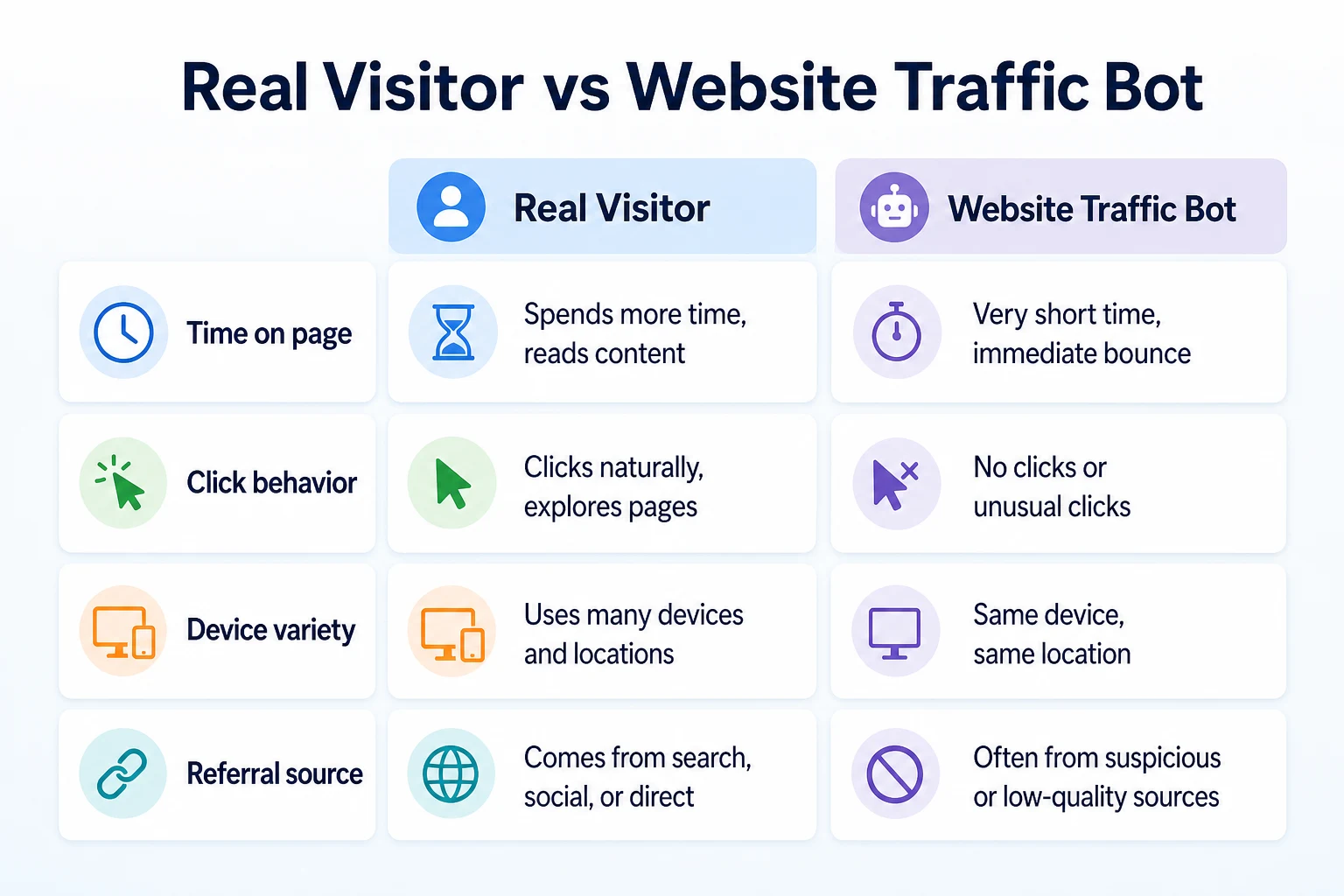
How these services generate visits
Most of these services rely on one of a few methods. Some run networks of automated bots that cycle through a list of URLs on a schedule. Some use click farms, where real devices are paid to open a page briefly and leave. Others route requests through rotating proxies, so the same bot appears to come from thousands of different locations and IP addresses.
The common thread is that the visit exists only to be counted. It wasn't triggered by a search, a referral, or a person who wanted to see the page.
Why the pitch sounds appealing to a small business
The appeal is understandable. A visit counter at zero or close to it feels discouraging, and a service that promises to fill it overnight sounds like a shortcut past months of slow SEO work.
It also plays on a reasonable but mistaken assumption: that search engines reward sites with more visible activity, the same way a busy restaurant looks more appealing than an empty one. Search ranking doesn't work that way, and the next section covers why.
Why Bot Traffic Doesn't Move Your Google Rankings
Even if every bought visit went completely undetected, it still wouldn't change where a page ranks.
What Google documents about ranking signals
Google's own documentation on how Search works describes ranking as based on factors like relevance, the quality and usefulness of content, and whether a page can be crawled and understood, not on raw visit counts reported by a third party.
Google doesn't have access to a site's own analytics numbers unless the business chooses to connect Search Console or another Google product, and even then, that data isn't described as a ranking input. A traffic bot sending visits doesn't give Google anything it uses to rank a page higher.
Why a bigger number alone changes nothing
A higher session count on an analytics dashboard doesn't tell Google anything, because Google isn't reading that dashboard. It's evaluating the page itself: what's written on it, whether it answers the question someone searched, whether the site is technically sound enough to crawl and index properly.
Bot traffic changes none of that. The page is exactly as useful, or as thin, after 10,000 fake visits as it was before them. If it wasn't ranking well on its own merits, it still won't be.
How Bot Traffic Gets Detected
Bot traffic doesn't blend in as well as the services selling it suggest. The patterns it leaves behind are fairly easy for analytics tools, server logs, and ad networks to spot.
Signals in Google Analytics
A sudden, unexplained spike in sessions with no matching spike in a marketing campaign or seasonal event is one of the first things that stands out. So is a flood of visits with near-zero average session duration, no pages per session beyond one, and a bounce rate close to 100 percent across the board.
Signals in server logs
Server logs often tell a more detailed story than analytics dashboards do. A large volume of requests coming from a narrow band of IP addresses, or from data center ranges rather than residential ones, is a common giveaway. So is a visit pattern that repeats identically: same pages, same order, same timing, over and over.
Signals ad networks watch for
Ad networks and affiliate programs run their own fraud detection, since fake clicks cost them money too. They typically look for clicks with no meaningful engagement afterward, clusters of activity from known bot-hosting infrastructure, and conversion rates that don't match any pattern a genuine audience would produce.
Detection signal | What it typically looks like | Where it shows up |
|---|---|---|
Session duration | Large numbers of visits lasting a few seconds or less | Google Analytics engagement reports |
Bounce or exit pattern | Near-total bounce rate, almost no multi-page sessions | Google Analytics behavior reports |
IP concentration | Requests clustered in narrow data center IP ranges | Server access logs |
Timing pattern | Identical request intervals or repeated page sequences | Server access logs |
Click-to-conversion mismatch | High click volume with conversions far below normal range | Ad network fraud reports |
These patterns are illustrative of what detection systems commonly flag. Actual thresholds vary by platform and aren't published in detail.
The Real Damage a Website Traffic Bot Can Do
Bot traffic doesn't just fail to help. It actively creates problems that cost a business time, money, and sometimes accounts it relies on.
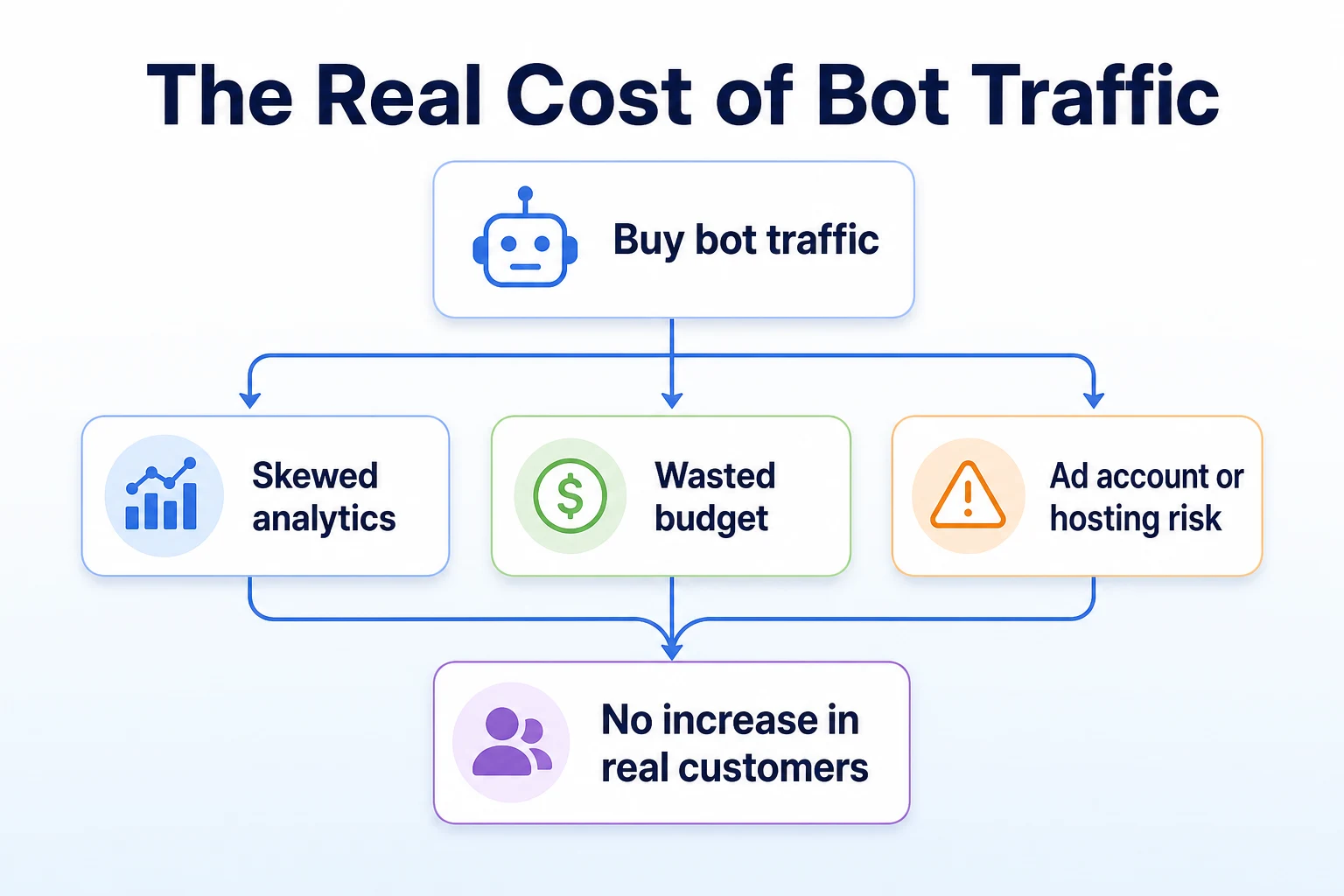
Skewed data that misguides decisions
Once bot traffic mixes into a site's analytics, every report built from that data becomes unreliable. Conversion rate drops because the denominator is inflated with visits that were never going to convert. Bounce rate spikes. Average session duration craters.
A business owner looking at that dashboard might conclude a page is failing when it isn't, or that a real marketing effort underperformed when it actually worked fine. Bad data leads to decisions based on something that never happened.
Hosting, ad account and reputational risk
A sudden flood of automated requests can also strain hosting resources, pushing a site past bandwidth limits or triggering a hosting provider's own automated defenses. Some hosting plans charge extra for traffic overages, which means a business can end up paying twice: once for the bot traffic itself, and again for the hosting bill it inflated.
If that traffic touches an ad account, the risk is more serious. Ad networks that detect fraud patterns tied to a site can suspend accounts connected to it, and getting an account reinstated is rarely quick or guaranteed.
Does Buying Traffic Ever Trigger a Google Penalty?
It's worth separating what's documented from what's assumed, because the two get mixed up a lot in this conversation.
Google's spam policies for Google Search describe practices Google considers manipulative, including things like cloaking, link schemes, and content created mainly to manipulate rankings rather than help a reader. Buying raw traffic from a bot network isn't explicitly named in that documentation as a type of spam action, mostly because it doesn't need to be. It doesn't influence rankings in the first place, so there's nothing for a ranking-focused spam policy to catch.
That doesn't mean there's no risk at all. If bot traffic is routed through click farms or disguised as ad clicks to generate ad revenue or inflate affiliate payouts, that crosses into a different kind of fraud that ad networks and payment processors actively police, separate from anything Google Search does. A business that layers bot traffic onto a monetized site is taking on that risk, not a search ranking risk.
The more realistic consequence isn't a manual action notice. It's the practical damage already covered: wasted money, unreliable analytics, and a possible account suspension on whatever platform the fraud pattern gets noticed on. That's a real cost, even without a documented search penalty attached to it.
A Worked Example: Two Businesses, One Decision
Imagine two small businesses, each with two hundred dollars a month to put toward growing their website traffic. This example is illustrative, and the numbers are rounded for simplicity.
One spends that two hundred dollars on a traffic bot service promising thousands of monthly visits. The other spends the same amount on a handful of hours of SEO work: fixing a technical issue, writing a page around a specific service, and checking that the site can actually be crawled.
Month | Bot traffic path | SEO work path |
|---|---|---|
Month 1 | Session count jumps immediately, analytics show near-zero time on page across the spike | New page published, little or no traffic yet, no change to analytics quality |
Month 2 | Same inflated numbers continue, conversion rate in reports drops because of the added sessions | Page indexed and being evaluated, traffic still minimal but genuine |
Month 3 | Hosting flags unusual request volume, no change in enquiries or sales | Page begins appearing in search results for its target phrase, a trickle of real visits arrives |
Month 6 | Still no change in enquiries, analytics remain unreliable for every report built since month 1 | Several pages ranking, real visitors arriving without new spend that month |
If spend stops | Fake traffic disappears, real traffic was never there to lose | Existing rankings may continue bringing some visitors for a while |
These figures are illustrative. Actual outcomes depend on the industry, the keyword, and how the work is done.
Neither business sees results overnight. But one ends month six with a dashboard full of noise and nothing to show for it, and the other ends month six with a small, durable base of visitors who found the page because it answered something they were actually searching for.
Legitimate Ways to Grow Real Website Traffic
The honest version of this is slower than the fifty-dollar pitch, but it's the only version that produces visitors who can become customers.
Fix what's blocking real visitors first
Before chasing new traffic, it's worth checking whether the site is losing visitors it should already have. A slow page, a broken form, or a confusing navigation menu can quietly turn away people who found the site on their own. Our SEO audit checklist walks through what to check on a small business site before spending anything new.
Build content around what customers search for
Real traffic tends to come from pages that answer a specific question or describe a specific service someone was already looking for. Finding those phrases doesn't require guessing. Our guide to finding low-competition keywords that bring customers covers how to spot search terms a smaller site has a realistic shot at ranking for.
Make sure search engines can actually find your pages
A well-written page still needs to be reachable. For a business serving a specific area, that includes the basics of showing up for nearby searches. Our guide to local SEO for small businesses covers what builds that kind of visibility over time, without any of it depending on inflated visit counts.
How to Tell If Traffic You Already Have Looks Like a Bot
Some owners aren't deciding whether to buy traffic. They've already paid for it, or they've noticed an odd spike and want to know what it actually is. A few checks in free analytics tools answer that without much guesswork.
What to check | Where to look | What a bot pattern often looks like |
|---|---|---|
Average session duration | Engagement report in Google Analytics | Large numbers of sessions lasting a few seconds or less |
Pages per session | Engagement report in Google Analytics | Almost every session views exactly one page |
Geography of visits | Location or demographics report | A spike of visits from countries or regions unrelated to the business |
Traffic source | Acquisition or channel report | A sudden jump attributed to direct traffic or an unfamiliar referral source |
Timing of the spike | Daily or hourly trend view | A sharp jump with no matching campaign, post, or event behind it |
None of these checks on their own prove a visit was fake. A short session can happen from a genuine visitor who found the wrong page and left. What matters is the combination: a spike that arrives all at once, with near-zero engagement, from places and sources that don't match how real customers normally find the site.
A 30-Day Plan to Replace Bought Traffic With Real Visitors
If the fifty-dollar pitch already got clicked, or if an owner just wants a plan instead of a dashboard full of noise, a month is enough time to start over properly.
Week 1: stop and audit
The first step is simple: cancel any traffic bot service that's running, and stop sending it money. Then look at what's actually on the site today. Check which pages exist, whether they load properly, and whether anything technical is quietly keeping real visitors or search engines out.
This is also the week to separate any skewed analytics data from what came before it, so future reports aren't comparing real numbers against inflated ones.
Week 2: fix the technical basics
Before building anything new, confirm the basics are in place. That means checking that pages are actually indexed, that there's no accidental block keeping search engines out, and that the site loads reasonably fast on a phone. Our checklist on getting a website indexed by Google covers the specific steps worth running through here.
A site that's hard for a real visitor or a search engine to use won't hold onto traffic even once it starts arriving, so this step comes before anything about content or keywords.
Weeks 3 and 4: build toward real demand
With the technical basics checked, the last two weeks go toward content built around what customers actually search for. Pick a small number of pages, service descriptions, location pages, or answers to common questions, and write them around a specific phrase rather than a vague topic.
This won't produce a traffic spike. It produces a few pages that can start showing up in search results over the following months, and keep showing up without ongoing payment once they do.
Week | Focus | What to do |
|---|---|---|
Week 1 | Stop and audit | Cancel any bot traffic service and review the site's current pages and technical state |
Week 2 | Technical basics | Confirm pages are indexed, crawlable and load reasonably fast |
Week 3 | Plan content | Pick a short list of pages to write, based on what customers actually search for |
Week 4 | Build | Write or fix the chosen pages and publish them |
Run a free website audit at the start of week 1 to get a baseline before making any changes, so there's something to compare against once the month is over.
Common Mistakes Businesses Make Chasing Traffic Numbers
Most of the regret here isn't about one bad purchase. It's a handful of related mistakes that keep an owner focused on the wrong number.
Treating visit count as a proxy for business health is the most common one. A dashboard showing thousands of sessions can still describe a site that produces zero enquiries, and a lower, honest number tied to real visitors tells a business far more about whether it's working.
Buying traffic to impress an investor, a partner, or a potential buyer is another. Anyone who looks past the top-line number, by checking engagement, conversion rate, or where the traffic actually came from, will see through it quickly, and it tends to damage credibility more than silence would have.
Running bot traffic alongside genuine SEO or ad campaigns without separating the data is a quieter mistake. Once the two are mixed in the same analytics view, it becomes hard to tell which real efforts are working, because every report is diluted by sessions that never should have counted.
Skipping a traffic service's terms, or a hosting provider's terms, before signing up is worth avoiding too. Many hosting plans and ad platforms explicitly prohibit artificially inflated traffic, and finding that out after an account gets flagged is a worse position than reading it beforehand.
Mistake | Why it hurts | What to do instead |
|---|---|---|
Treating visit count as a health metric | A high number can hide a site that produces no real enquiries | Track enquiries, calls or sales alongside traffic, not traffic alone |
Buying traffic to impress others | Anyone checking engagement or source data will likely notice | Share honest numbers, even if they're smaller |
Mixing bot and real traffic in analytics | Makes it impossible to tell which real efforts are working | Keep any bought traffic data separate, or remove it entirely |
Skipping a provider's terms of service | Many hosts and ad platforms prohibit artificial traffic outright | Read the terms before signing up for any traffic service |
Where RepGet fits
RepGet doesn't sell, generate, or manage traffic of any kind, bot or otherwise. If a pitch promises a guaranteed number of visitors, that's not something RepGet does, and it's worth treating any tool that offers it with the same caution covered throughout this article.
What RepGet does is help with the legitimate side of growth. It brings website auditing, keyword research, content planning, article writing, publishing to the business's website, and search performance reporting from Google Search Console into one workflow, so the slower, durable work of building real traffic doesn't require juggling several separate tools.
Its free website audit crawls a site, gives it a 0 to 100 SEO score, and lists technical and content issues worth fixing, which is a reasonable first step before deciding where to put any time or budget. Its free SEO tools cover smaller checks along the way, from crawlability to keyword density, without needing an account.
RepGet doesn't guarantee a ranking, a traffic number, or a particular amount of real visitors from any of this work, and no honest tool can. What it can do is show what a site currently has and where the realistic opportunities sit.
The bottom line
A website traffic bot can't move a ranking, because rankings aren't built from raw visit counts in the first place. What it can do is hand a business unreliable data, wasted spend, and in some cases a suspended ad or hosting account.
The patterns these services produce, near-zero session duration, repeated IP ranges, visits with no matching campaign behind them, are the same patterns analytics tools and ad networks are already built to catch. None of that risk buys a single real customer.
The slower path, fixing what's broken, writing for what customers actually search, and making sure search engines can find the result, doesn't show up as a spike. It shows up gradually, as visitors who found the site because it answered something they needed.
Find out what your website needs first
Before spending on traffic of any kind, see what your site currently has and where the real opportunities are. Run a free website audit with RepGet to check your site's technical setup alongside its content. No account or credit card required.
FAQ
Will buying website traffic increase my Google ranking?
No. Google's ranking systems don't use raw visit counts reported by third-party analytics as a signal, so even undetected bot traffic has no effect on where a page ranks.
Can Google tell if my website traffic is fake?
Google doesn't rely on a site's own analytics data to rank pages, so it isn't evaluating your traffic numbers directly. Detection instead happens in tools like Google Analytics, server logs, and ad networks.
Is buying bot traffic against Google's rules?
Google's documented spam policies don't name bot traffic specifically, mainly because it doesn't influence rankings. The bigger risk sits with hosting providers and ad networks, which often prohibit artificial traffic outright.
What happens if I buy bot traffic for my website?
Expect skewed analytics, wasted money, and possibly hosting or ad account issues if the traffic gets flagged. What you won't get is any change in rankings or real customers.
How can I check if my website traffic is real or fake?
Check session duration, pages per session, and traffic source in Google Analytics. A spike with near-zero engagement from unfamiliar sources or locations is a common bot pattern.
Does bot traffic mess up my Google Analytics numbers?
Yes. It inflates sessions while dragging down conversion rate, time on page, and other engagement metrics, which makes every report built from that data unreliable going forward.
What's a safe way to increase website traffic quickly?
There's no shortcut that's both fast and safe. The realistic path is fixing technical issues, publishing content around what customers search, and confirming search engines can crawl and index the site.
Can bot traffic get my site penalized or banned from Google?
There's no documented Google Search penalty specifically for bot traffic, since it doesn't affect rankings. The more likely consequence is a suspended ad account or hosting plan if the fraud pattern gets flagged elsewhere.