

AI Content Detector: Should You Run Your Blog Posts Through One?
Short answer
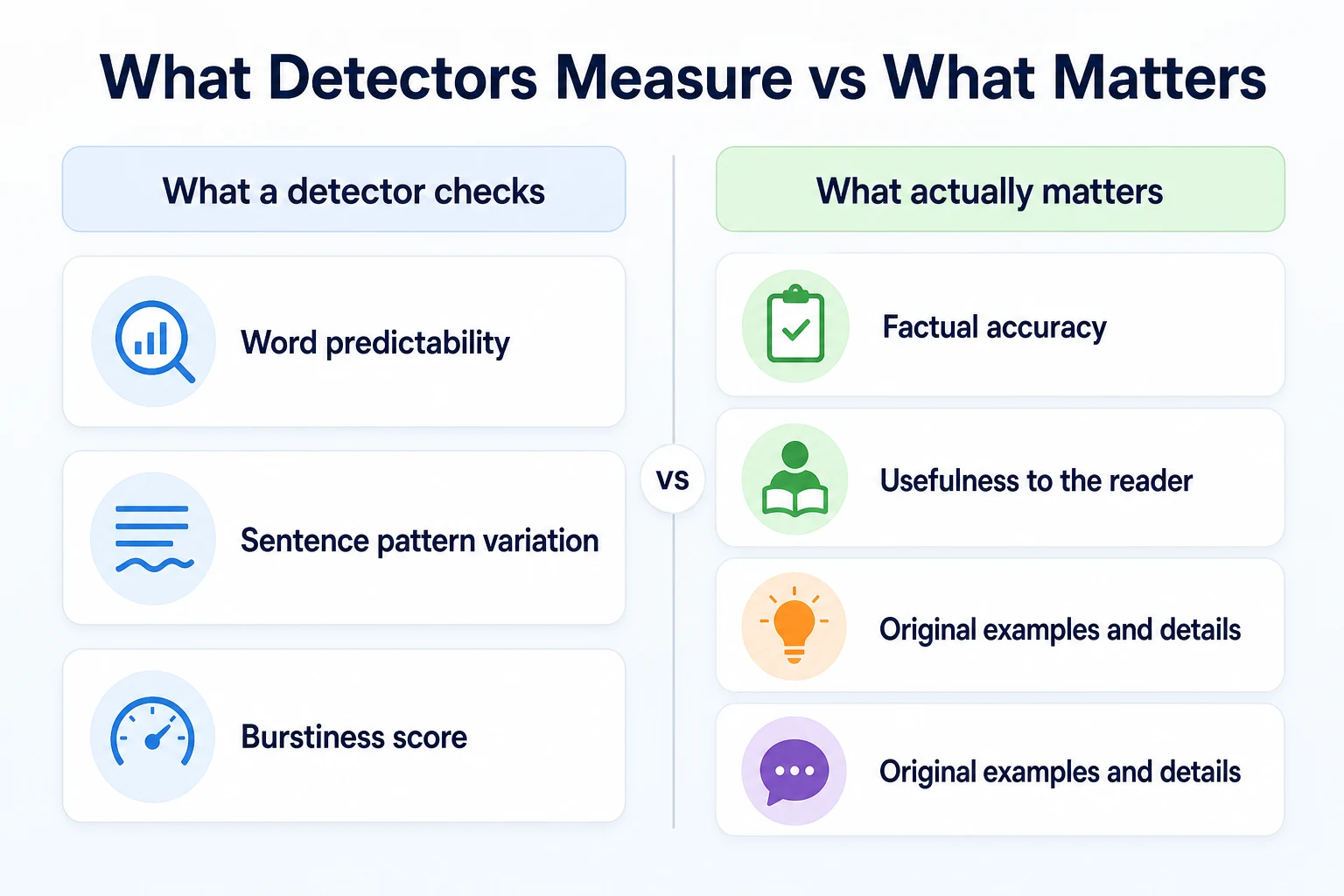
AI content detectors measure writing patterns such as word predictability, not whether a post is accurate or useful. Their accuracy isn't independently verified, and they flag plenty of human writing as AI-generated. Google has said it doesn't penalize content for being AI-assisted, only content that's unhelpful or unreliable. A pre-publish accuracy and quality check matters more than any detector score.
A shop owner pastes a blog post drafted with ChatGPT into a free AI content detector.
The result comes back: "68% AI-generated."
No explanation of what that number means, just a score and a vague sense that something needs fixing before the post goes live.
The owner isn't sure if 68% is a problem, or whether rewriting the post by hand would even change the number, let alone whether it matters to Google at all.
An AI content detector gives you a percentage, but it's worth knowing exactly what that percentage is measuring before you let it decide whether a post gets published. Here's what these tools actually check, why their accuracy has real limits, what Google has actually said about AI-assisted writing, and a sensible way to review a post before it goes live that doesn't depend on a detector score at all.
What an AI Content Detector Actually Does
An AI content detector doesn't read your post for accuracy, usefulness, or whether it says anything worth saying. It looks at patterns in the text itself and estimates how likely those patterns are to come from a language model rather than a person.
How detectors score text
Most detectors work by analyzing two things: how predictable each word is given the words before it, and how much a passage's sentence length and structure vary from one sentence to the next. Language models tend to choose the statistically likely next word more often than a person does, and they tend to produce sentences with less variation in rhythm and length. A detector measures both of these and turns the result into a probability score.
None of this involves checking a single fact, a single claim, or whether the post actually answers the question someone searched for. It's a statistical read on word choice and sentence shape, nothing more.
What a score like '80% AI' actually means
An 80% score means the detector's model estimates an 80% probability that the passage matches patterns it associates with machine-generated text. It doesn't mean 80% of the words were written by AI, and it doesn't mean the post is 80% likely to cause a problem with Google or with readers. It's a probability estimate from one model, trained on one set of examples, and different detectors routinely disagree with each other on the exact same passage.
Why AI Content Detector Accuracy Is Limited
The core problem with any AI content detector isn't that it's useless. It's that the thing it's trying to measure, whether a specific passage of text was generated by a machine, doesn't have a clean, verifiable answer the way a spelling error does.
False positives on ordinary human writing
Plenty of ordinary human writing is predictable and evenly structured, especially writing that follows a clear style guide, covers a familiar topic, or comes from a non-native English speaker who learned a more formal, consistent sentence pattern. Detectors routinely flag this kind of writing as AI-generated, because the statistical signals they're looking for, predictable word choice and even sentence rhythm, show up in careful human writing too, not just in machine output.
A business owner who writes plainly and checks their grammar carefully can score higher on an AI detector than a sloppier draft that happens to vary more in sentence length. That's not a flaw specific to one tool. It's a limit built into what these tools are actually measuring.
False negatives on edited AI text
The opposite problem is just as common. A passage drafted entirely by a language model, then lightly edited by a person, swapping a few words, breaking up a long sentence, adding a specific detail, can score as mostly human even though the underlying structure and most of the content came from the model. Editing changes the statistical patterns a detector looks for without necessarily changing much about where the content actually came from.
This means a detector score tells you more about how recently and how heavily a passage was edited than it tells you about its actual origin.
Why there's no independent accuracy standard
No AI content detector has its accuracy independently verified against a standard dataset the way, for example, a spam filter's false positive rate might be tested and published. Each detector is trained on its own set of examples, scores differently, and updates its model without publishing what changed or why. That makes it hard to say a given detector is 90% accurate, 70% accurate, or anything in between, because there's no shared, external measure to check it against. Treating any single score as a reliable verdict asks more of the tool than it can deliver.
What Google Actually Says About AI-Generated Content
Given all that, it's worth setting the detector question aside for a moment and asking what actually matters: what does Google say about content that was written with AI assistance.
Google's documented stance on automation
Google has addressed this directly. Its guidance on AI-generated content states that its focus is on the quality of content, not on how it was produced. Automation, including the use of AI, isn't against Google's guidelines on its own. What Google's systems look for is whether content is helpful, reliable, and created for people, regardless of whether a person, an AI tool, or some combination of the two did the writing.
What the helpful content guidance actually targets
Google's guidance on creating helpful content is built around a set of questions aimed at the content itself: does it demonstrate firsthand knowledge, does it provide real value beyond summarizing what's already out there, would a reader feel satisfied after reading it. None of those questions ask who or what typed the words. They ask whether the finished page is worth a reader's time. Our guide to how Google decides which sites to rank covers the full set of documented signals, which is worth a read if you want the complete picture beyond this one point.
Why 'AI-Written' and 'Low Quality' Aren't the Same Thing
It's easy to collapse these into one idea: AI-written content is risky, human-written content is safe. Google's own guidance doesn't support that split, and it's worth separating the two clearly.
What actually causes a quality problem
A post that's thin, vague, factually wrong, or generic enough that it could apply to any business in any city causes a quality problem whether a person or a language model wrote it. A human writer who pads a post with filler to hit a word count, repeats common knowledge without adding anything, or gets a fact wrong creates the same kind of page Google's helpful content guidance is aimed at, with no AI involved anywhere in the process.
The reverse is also true. A post drafted with AI assistance, then checked for accuracy, filled in with specific details only the business would know, and edited until it reads clearly, doesn't carry some invisible mark that separates it from a post written entirely by hand.
Where AI assistance helps and where it doesn't
AI tools are genuinely useful for a first draft, an outline, or rephrasing a clumsy sentence. They're much weaker at the things that make a post actually useful to a specific reader: a real example from your own business, an accurate current price, a detail about your specific service area, or a judgment call that only someone who does the work would know to make. Our guide to AI SEO automation covers this same line in more detail, including which parts of content work are reasonable to automate and which ones still need a person's attention before anything goes live.
A Worked Example: Running the Same Post Through Two Detectors
Imagine a service business drafts a 1,200-word blog post with an AI writing tool, then runs it through two different AI content detectors before editing anything. This example is illustrative.
Detector | Score on original draft | Score after light editing |
|---|---|---|
Detector A | 91% likely AI-generated | 34% likely AI-generated |
Detector B | 62% likely AI-generated | 58% likely AI-generated |
These figures are illustrative.
The two detectors disagree by nearly 30 points on the same unedited draft. After the business owner spends twenty minutes rewording a few sentences, breaking up some long paragraphs and swapping in one real example from a recent job, Detector A's score drops sharply while Detector B barely moves.
Nothing about the post's accuracy changed in that edit. No fact was added, checked or corrected. The only thing that changed was sentence rhythm and word choice, which is exactly what both tools are built to notice and exactly why a score shift like this doesn't tell you whether the post is actually any better.
A business that chased Detector A's number down to zero would have spent real time changing phrasing with nothing to show for it beyond a lower percentage. The post would read differently, not necessarily better, and it would still have whatever factual or structural problems it started with.
What to Check Instead of a Detector Score
If a percentage from a detector isn't a reliable guide, something else has to take its place before you hit publish. The good news is that the real checks are more straightforward than they sound, and they don't need a tool at all.
Questions worth asking before publishing
A short list of direct questions does more work than any score. Is every fact, price, and claim in the post actually correct as of today. Does the post include at least one detail, example or opinion that only your business would know to include. Would a customer reading this learn something useful, or could they have gotten the same thing from the first three search results. Does it sound like your business, or could it have been published by any company in any city offering a similar service.
Signs a post needs work regardless of its score
A few patterns show up in weak posts whether they were drafted by a person or a language model. Watch for vague claims with no specifics attached, like
Watch for vague claims with no specifics attached, like "we provide excellent service" with nothing concrete backing it up, sentences that repeat the same idea in different words just to add length, and whole paragraphs that could be copied onto a competitor's site without changing a single detail. None of these show up in a detector score. All of them matter more than one.
A Sensible Policy for AI-Assisted Blog Posts
Most small businesses don't need a long document for this. They need a short, written rule that everyone drafting or approving a post actually follows, so the question of whether a post is "too AI" never comes down to a guess at publish time.
What to do before you publish
Write down a short list and treat it as the actual gate, not a detector score. A reasonable version: every fact, price, and claim gets checked against a current source before publishing. Every post includes at least one detail, example, or opinion that only your business would know to add. One named person reads the full post before it goes live, not just skims it. No post publishes with a placeholder, a broken link, or a sentence that doesn't make sense on a second read.
None of these checks require a tool. They require a person who knows the business reading the post with attention, which is the same thing a careful editor would have done before AI drafting tools existed at all.
What to do if you're still unsure
If a post still feels thin or generic after that review, the fix is almost always to add something specific, not to reword what's already there. A real number from a recent job, a photo caption describing an actual project, a sentence about a mistake you see customers make often: these are the things that make a post sound like it came from your business rather than from a template. If you genuinely can't add anything specific to a topic, that's often a sign the topic doesn't deserve its own post yet, which is a more useful conclusion than any percentage a detector would give you.
A 20-Minute Pre-Publish Review You Can Actually Do
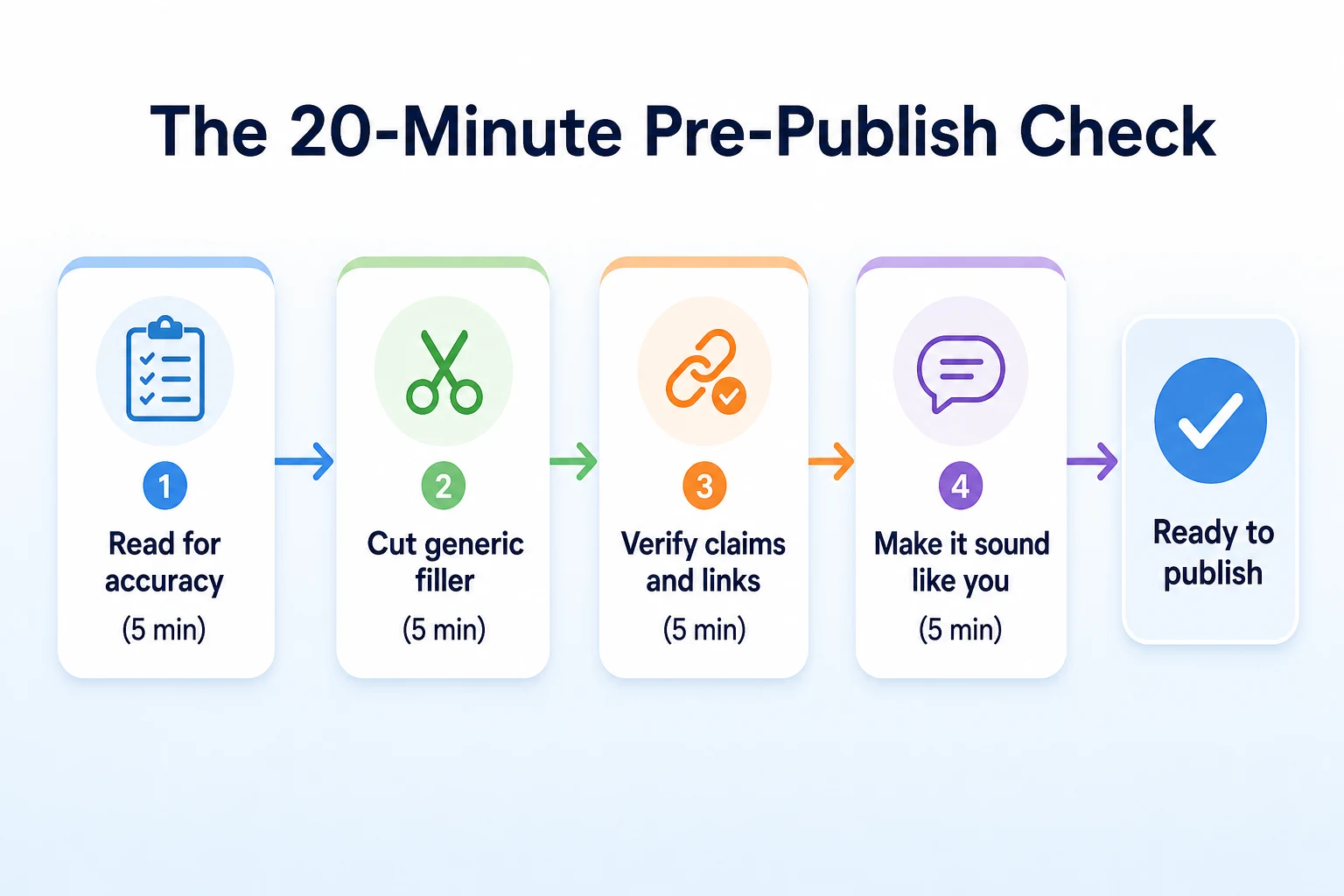
A review process only gets used if it's short enough to actually happen every time. Twenty minutes, broken into four five-minute steps, is enough to catch most of the problems that matter, without turning publishing into a chore nobody wants to do.
The four-step review
Start by reading the post once for accuracy alone, checking every price, date, service detail, and claim against what you actually know to be true today. Then read it again looking only for generic filler: sentences that could apply to any business, repeated ideas, and padding that doesn't add information. Next, check every link actually goes where it says it goes, and verify any statistic or claim that isn't your own firsthand knowledge. Finally, read the whole thing out loud, or close to it, and fix any sentence that doesn't sound like something you'd actually say to a customer standing in front of you.
Step | Time | What you're checking for |
|---|---|---|
Read for accuracy | 5 minutes | Prices, dates, service details and claims that are current and correct |
Cut generic filler | 5 minutes | Sentences that could apply to any business, repeated ideas, padding |
Verify claims and links | 5 minutes | Every link works, and any stat or claim that isn't firsthand knowledge checks out |
Make it sound like you | 5 minutes | Reads like something you'd actually say to a customer, not a template |
A pass through our Keyword Density Checker during that same review is worth a glance too, mainly to confirm the post is actually about the topic its title promises and isn't drifting into generic territory that doesn't match what someone searching that phrase is looking for.
When it's worth a second pair of eyes
A solo business owner reviewing their own draft can miss things a second reader catches easily, especially a fact that feels obviously true to the writer but turns out to be outdated. If you have even one other person involved in the business, whether a partner, an employee, or someone who handles the work the post describes, it's worth having them skim it before it goes live. They'll often catch the one detail that's wrong faster than a full read-through by the original writer would.
Common Mistakes Small Businesses Make With AI Content Detectors
A handful of habits turn a reasonable caution about AI writing into wasted time, and most of them trace back to treating a detector score as more meaningful than it actually is.
Treating a detector score as a pass or fail test is the first. A number from one tool, disagreed with by a second tool on the same passage, isn't a verdict worth rewriting a post over. Chasing a score down to zero by rewording sentences that were already accurate and useful is the second, and it burns time that would do more good spent fact-checking or adding a specific detail instead.
Skipping an accuracy check because a post "scored human" is the third, and it's the riskiest one. A low AI score says nothing about whether the prices, dates, or claims in a post are correct. It only means the sentence patterns happened to look human to one model.
Assuming a detector's result reflects anything Google checks is the fourth. As covered above, Google has been clear that it doesn't evaluate content based on how it was produced, so a detector score has no documented relationship to how a page performs in search. Our piece on AI backlinks covers a similar pattern: a tool that promises an SEO shortcut without anything in Google's own documentation to back up the claim.
Treating a single detector's percentage as a pass or fail test.
Rewording accurate, useful sentences just to lower a score.
Skipping fact-checking because a post "scored human."
Assuming a detector result reflects anything Google's ranking systems check.
Where RepGet fits
RepGet doesn't run or recommend an AI content detector, and nothing in this article changes based on what one of those tools reports. A detector score isn't part of how RepGet evaluates a page, because it isn't part of how Google evaluates one either.
What RepGet actually does is write articles that stay as drafts for you to read and edit before anything publishes, which is the same review step this article has been describing all along, just built into the workflow instead of left to chance. You still read the draft, check the facts, and add the detail that makes it sound like your business before it goes live.
RepGet's free website audit crawls your site and gives it a 0 to 100 SEO score, flagging the technical and content issues actually worth fixing: thin pages, missing details, crawlability problems, the kind of thing that affects whether a page ranks or not, regardless of whether a sentence in it was drafted with AI assistance. No account or credit card required. RepGet doesn't guarantee a ranking, a Maps position, or a mention in an AI assistant's answer from any article, drafted with AI or otherwise.
The bottom line
An AI content detector measures word predictability and sentence rhythm, not accuracy, usefulness, or anything Google has documented as part of how it ranks a page. Two detectors can disagree by dozens of points on the same passage, and a light edit can swing a score without changing a single fact.
Google has said plainly that it doesn't evaluate content based on how it was produced. It looks at whether a page is helpful, reliable, and created for people, a question a detector score was never built to answer. A post written entirely by hand can fail that test just as easily as one drafted with AI assistance, and a post that started as an AI draft can pass it once it's checked for accuracy and filled in with something specific to your business.
That check, not a percentage, is what's worth spending your twenty minutes on before a post goes live.
Find out what your website needs first
Before worrying about a detector score, see what your site actually needs. Run a free website audit with RepGet to check for the technical and content issues that actually affect how your pages perform. No account or credit card required.
FAQ
Can Google detect if my blog post was written by AI?
Google hasn't documented a system that flags content as AI-written and treats it differently for that reason. Its stated focus is on whether a page is helpful and reliable, not on how it was produced.
Do AI content detectors actually work?
They estimate a probability based on word patterns, not a verified fact. No detector's accuracy is independently confirmed, and different tools often disagree on the exact same passage.
Will AI-written content hurt my SEO rankings?
Not because it was written with AI. Google has said automation isn't against its guidelines on its own; thin, inaccurate, or unhelpful content is the actual problem, whoever or whatever wrote it.
What percentage of AI content is too much for Google?
There's no documented threshold, since Google doesn't evaluate pages by that measure at all. A post is judged on whether it's accurate and useful, not on any percentage a detector reports.
Is it safe to publish ChatGPT-written blog posts?
Yes, once you've checked every fact and claim, added a specific detail only your business would know, and read it through for accuracy. The drafting tool used doesn't change Google's evaluation of the result.
How do I check if my content sounds too AI-generated?
Read it out loud and fix any sentence that doesn't sound like something you'd actually say to a customer. That catches generic phrasing more reliably than any detector score.
Does Google penalize AI-generated content?
Google's own documentation says its focus is content quality, not production method, and that automation including AI isn't against its guidelines by itself. Unhelpful or unreliable content is what causes problems.
Can AI content detectors be wrong?
Yes, in both directions. They flag plenty of careful human writing as AI-generated, and lightly edited AI text often scores as mostly human, since editing changes the patterns detectors look for.