

Shopify AI Agent: What It Does and Whether It Helps Your SEO
Short answer
Shopify's AI agents, from Shopify Magic and Sidekick to storefront shopping assistants, can answer questions, recommend products and speed up admin tasks. None of that is a documented Google ranking factor. What affects search and AI-assistant visibility is the product data and page quality those agents read, which still needs separate work.
A boutique owner installs an AI shopping assistant app from the Shopify App Store after a sales email promised it would "boost SEO and conversions together."
It answers sizing questions well in its first week.
A customer asks about a restock date at midnight and gets a useful answer instead of silence.
The owner has no idea whether any of this touches how the store shows up in Google, or in a ChatGPT answer, or whether it's just a convenience sitting on top of the site.
A Shopify AI agent covers a handful of different tools that rarely get separated in a sales pitch. Here's what each one actually does, where they genuinely touch search visibility, and where they don't come close.
What counts as a "Shopify AI agent" right now
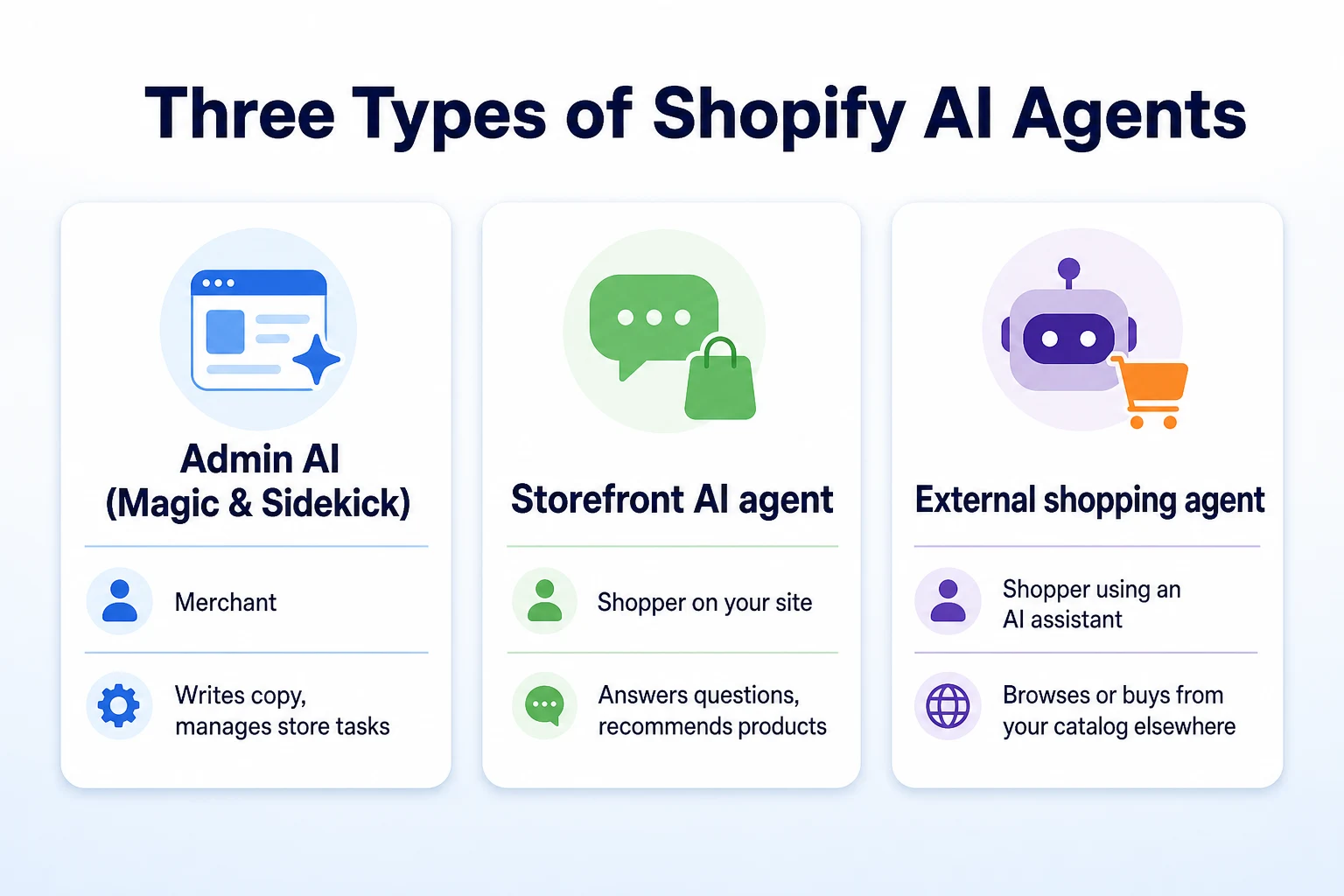
The phrase gets used for at least three different things, and a single pitch rarely tells you which one it's selling.
Shopify Magic and Sidekick, the admin-side AI
Shopify Magic and Sidekick are built into the Shopify admin itself. They're aimed at the merchant, not the shopper. Magic can draft product descriptions, generate image edits, and write email copy from a short prompt. Sidekick works more like an assistant inside the admin, helping with tasks like finding a setting, summarizing store data, or drafting a discount. Neither one appears on your storefront where a customer can see or talk to it.
AI shopping assistants and chatbots on the storefront
A second kind of tool sits on the customer-facing side of the store, usually as a chat widget added through an app. It talks to shoppers directly, answering questions about sizing, shipping, returns, or whether an item is in stock. Some of these are simple scripted bots. Others are built on a language model and can hold a looser conversation, often with access to the store's live product catalog, inventory, and order status.
AI agents that browse or shop on a customer's behalf
A third kind doesn't live on your store at all. This is an AI assistant a shopper is already using elsewhere, in a chat app or browser extension, that can browse a merchant's catalog, compare products, and in some setups move a shopper toward checkout without them ever typing into your site directly. This is the newest and least settled of the three, and it's covered on its own later in this article.
Type | Where it lives | Who it's for | What it does |
|---|---|---|---|
Shopify Magic and Sidekick | Shopify admin | The merchant | Drafts copy, edits images, helps with admin tasks |
Storefront AI shopping assistant | Your store's theme, usually a chat widget | The shopper on your site | Answers questions, recommends products from your catalog |
External AI shopping agent | A chat app or browser the shopper already uses | The shopper, away from your site | Browses or helps buy from your catalog without a visit to your store |
How a storefront AI agent differs from a general customer service chatbot
Most of what applies to a general chatbot on any website still applies here, and our guide to customer service AI chatbots and SEO covers that ground in more detail. A Shopify-specific agent has one real difference worth calling out.
What a catalog-connected agent can see
A generic chatbot usually works from a fixed script or a document someone uploaded. A Shopify storefront agent, when it's built well, can read live data straight from the store: current stock levels, prices, variant options, and sometimes order status for a logged-in customer. That's a meaningful upgrade over a bot repeating a script written months ago, because it means an answer about whether a size is in stock reflects what's actually true right now, not what was true when the bot was configured.
What it still can't do without a person
Live catalog access doesn't give the agent judgment. It can tell a shopper a jacket is out of stock in medium. It can't decide how to handle a customer who's upset that a different size arrived, or weigh a one-off exception to a return policy. Those moments still need a person, and a well-built agent hands off to one rather than guessing.
Does a Shopify AI agent affect your Google rankings?
This is the part of the sales pitch worth checking against what Google actually says, rather than what a vendor implies.
What Google's ranking systems actually document
Google's Search Essentials documentation describes what its ranking systems evaluate: whether a page can be crawled and indexed, whether the content is helpful and reliable, and page experience signals like loading speed and mobile usability. An AI chat widget isn't part of that documentation, because it isn't something Google's systems are described as checking for. Our guide to how Google decides which sites to rank covers the full documented list, which is worth comparing against any vendor claim that leans on the word SEO.
Why an AI agent isn't a technical SEO fix
A technical SEO fix changes something Google's crawler can actually measure: a blocked page, a slow server response, a broken mobile layout. A chat widget sits on top of a page after it has already loaded. It doesn't touch whether that page can be crawled, indexed, or rendered correctly. If a Shopify store has a real crawlability problem, an AI agent app does nothing to fix it.
Engagement changes aren't the same as a ranking signal
A shopper who gets a quick answer from an agent might stay on the page longer or browse another product afterward. That's a real, measurable change in behavior. Google has not documented time on site, pages per visit, or similar engagement metrics as direct ranking inputs, which is a different category from the Core Web Vitals and page experience signals it has documented. A behavior change on the page isn't the same thing as a documented ranking change.
Where AI agents do intersect with search visibility
None of this means a Shopify AI agent has nothing to do with search. The connection runs through the product data both Google's crawler and an AI agent read from the same pages, not through the agent itself.
Product titles, descriptions and structured data
A storefront agent and Google's crawler often draw from the same source: your product title, description, and Product structured data. A vague title or a description missing key details, like material, size range, or availability, gives both a search engine and an AI agent less to work with. Writing that information clearly for a shopper tends to serve both audiences at once.
Making product pages readable by AI crawlers
Whether an AI system can read your product pages at all depends on basic technical access: whether its crawler is allowed in robots.txt, and whether the page's actual text is present in the HTML rather than buried behind JavaScript that only renders after a script runs. Our guide to how an AI web crawler reads and indexes a website covers what that access actually requires.
What llms.txt does and doesn't guarantee
An llms.txt file is a proposed way to point AI systems toward a summary of a site's key pages. It's a young, voluntary convention, not a Google or Shopify standard, and there's no guarantee a given AI system reads it or weighs it in any particular way. It's worth having if it's easy to add, but it isn't a substitute for the product page itself being clear, accurate, and technically readable.
Agentic commerce: AI agents that can browse and buy from your store
This is the newest and least settled part of the AI agent conversation, and it's worth describing carefully rather than overselling it.
What this looks like for a shopper
Some AI assistants that people already use in a chat app or browser can now browse product listings, compare options, and in some setups carry a shopper closer to checkout without them typing a search into your store directly. The shopper asks a question like "find me a waterproof jacket under $100," and the assistant pulls from whatever product data it can access, which may or may not include your store, depending on how your data is set up and whether that assistant's system has crawled or connected to it at all.
How far this goes, and how reliably it works, varies by assistant and changes as these systems develop. There's no single, settled standard yet for how a Shopify store plugs into this kind of shopping flow, and no guarantee that any given assistant surfaces a particular store's products.
What a store needs for an agent to describe products correctly
An outside agent can only describe a product as well as the store's own page describes it. That means an accurate title, a clear description, correct pricing, and current stock status, the same basics that help a human shopper and a search engine. A page that's vague about size, material, or availability gives an outside agent nothing solid to repeat, and it may simply skip the product or describe it wrong. Our guide to getting mentioned in ChatGPT covers the broader version of this same idea: being accurately described by an AI system starts with the business's own pages being accurate and easy to read, not with a special trick aimed at the assistant itself.
What a Shopify AI shopping assistant can realistically do for conversions
Set agentic commerce and rankings aside, and a storefront assistant still has a real, modest job: helping a shopper who's already on the page decide to buy.
Answering the questions that stall a purchase
Most stores field the same handful of questions over and over: does this run small, how long does shipping take, what's the return window. A shopper who has to email and wait for an answer often just leaves instead. An assistant that answers these instantly, synced to the store's actual policies, removes a small but real piece of friction right before a purchase decision.
Recommending products from what's actually in stock
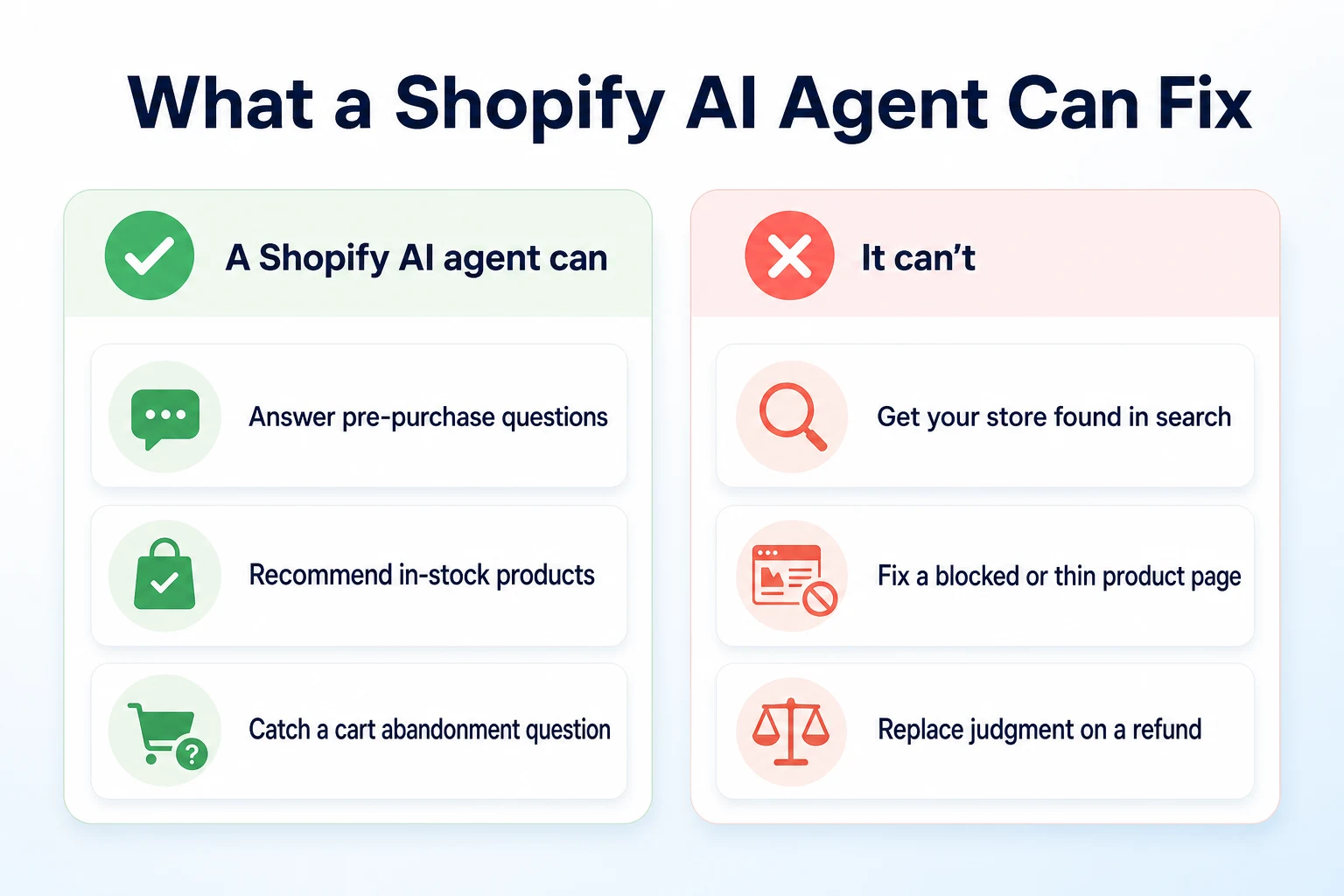
A catalog-connected assistant can suggest an alternative when a shopper's first choice is out of stock, or recommend a similar item based on what they've described wanting. That only works well if the assistant is actually reading live inventory. A recommendation built on a stale product feed can suggest something that's no longer available, which creates a worse experience than no recommendation at all.
Catching a question before cart abandonment
A shopper who stalls at checkout with an unanswered question, about a shipping cost, a delivery date, or whether a discount code still works, often just closes the tab rather than emailing to ask. An assistant that catches that moment and answers on the spot can recover a sale that would otherwise be lost, though it won't rescue a cart abandoned for reasons unrelated to a question, like price or a change of mind.
Question type | Agent fit | Why |
|---|---|---|
"Does this run true to size?" | Good fit | Fixed, factual answer the store already knows |
"Is this back in stock?" | Good fit | Simple lookup against live inventory |
"What's a good gift for someone who likes hiking?" | Reasonable fit | Works if the catalog is well tagged, weaker otherwise |
"My order arrived damaged, what now?" | Poor fit | Needs a person who can take ownership of the fix |
A custom or bulk order request | Poor fit | Needs judgment and negotiation a script can't apply |
What a Shopify AI agent can't do for your store
An agent is a tool for the shoppers a store already has. It has nothing to offer the shoppers it never reaches, and it's worth being honest about that before expecting too much from it.
It can't fix a store that isn't getting found
An agent only talks to someone who has already landed on a product page. If the store isn't showing up in search results, isn't being crawled properly, or has thin product pages that don't answer what shoppers are actually looking for, an agent does nothing about any of that. It's sitting in the corner of a page nobody reaches. If traffic itself is the problem, that's separate work, closer to what's covered in our guide on what to fix first on a website that gets no traffic.
It can't replace judgment on a refund or complaint
A shopper asking about a damaged item, a late delivery that's cost them something, or a one-off exception to a stated policy needs a person who can weigh the situation and take responsibility for the answer. An agent that tries to handle these anyway, rather than handing off quickly, tends to make the moment worse, since a generic or overly cheerful response to a genuine problem reads as dismissive even when that wasn't the intent.
The risk of an answer that doesn't match your live catalog
An agent is only as current as its connection to the store. A pricing change, a discontinued product, or a promotion that ended last week can all sit unnoticed in an agent's answers if the sync isn't working correctly, or if the app wasn't built to pull live data in the first place. That gap is usually invisible until a customer points it out, which is exactly the kind of small, avoidable failure worth checking for before trusting an agent with a store's busiest pages.
What to check before installing an AI agent app on your store
Most of what separates a useful AI agent app from a liability shows up in questions a listing on the Shopify App Store rarely answers directly. These are worth working through before installing anything, not after a customer points out a problem.
Whether it stays in sync with your live catalog
Ask how the app connects to your product data: does it read inventory and pricing live, on a schedule, or only at setup. A sync that runs once a day is fine for a store that rarely changes prices. It's a real problem for a store that sells out of sizes or colors quickly, since the agent keeps recommending something that's already gone. Ask, too, what happens to a variant you've discontinued. Some apps keep repeating outdated product details until someone manually removes them.
How and when it hands off to a person
Ask what the agent does when it doesn't know an answer, or when a conversation turns into a complaint or a refund request. A well-built setup recognizes its own limits quickly and routes the shopper to a contact form, an email address, or a phone number without much delay. An agent that keeps guessing, or that buries the option to reach a person several clicks deep, turns a minor question into a reason to abandon the page entirely.
Its effect on page speed and Core Web Vitals
Every app added to a Shopify theme is extra script the browser has to load, and a chat widget is no exception. Check the app's effect on load time before and after installing it, particularly on a product page where a slow load can cost a sale regardless of how good the agent's answers are. Google's Core Web Vitals documentation describes the specific speed and responsiveness measures worth checking. A few seconds added to a mobile load time is a real cost, and it's one a chat widget can create without anyone noticing until a speed test flags it.
A worked example: a small Shopify store trials an AI shopping assistant
Imagine a small outdoor gear store installs a catalog-connected AI shopping assistant for a one-month trial, mainly to see if it's worth a longer subscription. This example is illustrative.
Metric | Before the agent | After one month with it |
|---|---|---|
Pre-purchase questions answered instantly | 0, all routed to email | Roughly 60 per week, mostly sizing and shipping |
Checkout abandonment follow-ups | None captured | A handful of carts recovered after a shipping question was answered on the spot |
Organic search traffic | No change observed | No change observed |
Google ranking for main product pages | Unchanged | Unchanged |
These figures are illustrative.
The store sees faster answers to the questions that used to sit in an inbox overnight, and a few recovered carts that would likely have been lost otherwise. Organic traffic and product page rankings stay exactly where they were, because nothing about a chat widget touches either one. That's the expected outcome of a trial like this, not a disappointing one.
A 30-day plan to trial a Shopify AI agent before committing
Most AI agent apps bill monthly, which makes a short trial a reasonable way to find out whether one earns its place before signing up for a longer plan.
Week | Focus | Tasks |
|---|---|---|
1 | Set up and check the sync | Confirm the agent is reading live inventory and pricing correctly, and load in correct, current answers to the five or six questions customers ask most often |
2 | Test it like a shopper would | Ask it the same questions a real customer might, phrased a few different ways, and check it hands off to a person when it should rather than guessing |
3 | Monitor real conversations and page speed | Read through a sample of actual transcripts, flag any answer that was wrong or outdated, and recheck load time on a busy product page |
4 | Review the results and decide | Compare questions answered and any recovered carts against the previous month, confirm organic traffic and rankings are unaffected as expected, and decide whether to keep, adjust, or drop the app |
None of this trial is built to catch a ranking change, because there isn't one to look for. It's built to answer a narrower question: did the agent make it easier for a shopper who was already on the page to actually buy something.
Common mistakes small Shopify stores make with AI agents
A handful of habits turn a reasonable AI agent trial into wasted app fees, and most of them show up in the first month of using one.
Expecting the agent to move search rankings is the first, and it's worth repeating plainly: nothing in Google's documentation treats a chat widget as a ranking signal. A store that installs an agent instead of fixing a thin product page or a crawlability issue has spent money solving a problem it never had, while leaving the actual one untouched.
Letting it answer from a stale product feed is the second, and it causes the most visible damage. A size that sold out last week, a price that changed, or a discontinued color can sit in an agent's answers long after a person would have caught it on a normal page, and a shopper who orders based on a wrong answer is a real refund request waiting to happen.
Giving shoppers no clear path to a person is the third. An agent that keeps offering the same three suggestions without ever surfacing an email address or a phone number turns a simple pre-purchase question into a reason to abandon the page.
Ignoring the page-speed cost of adding another app rounds out the list. Every chat widget is extra script the browser has to load, and a slow product page can cost a sale regardless of how good the agent's answers are once a shopper actually gets one.
Expecting an AI agent app to move organic Google rankings.
Letting the agent answer from inventory or pricing that's gone stale.
Giving a shopper no clear way to reach a person when the agent can't help.
Adding the app without checking what it does to page load time.
Where RepGet fits
RepGet doesn't build, install or manage AI shopping agents on Shopify, and nothing about this article changes whether that's the right call for your store. What it can do is answer the question that matters more for most Shopify sites before an agent ever comes up: whether the product pages and technical setup underneath it are actually in shape.
RepGet's free website audit crawls a site and gives it a 0 to 100 SEO score, flagging technical and content issues worth investigating, including the kind of thin product descriptions and crawlability problems that a chat widget sitting on top of the page has no way to fix. No account or credit card required.
Beyond the audit, RepGet brings keyword research, content planning, article writing, publishing and search performance reporting from Google Search Console into one workflow, which is useful for building out the product and category pages that both search engines and any AI agent, storefront or external, actually read from. RepGet doesn't manage a Shopify app, doesn't write or sync product data for an AI agent, and doesn't guarantee a ranking, a Maps position, an AI-assistant mention or a sales result from any tool added to a store.
The bottom line
A Shopify AI agent, whether it's Shopify Magic drafting copy in the admin, a storefront assistant answering sizing questions, or an outside agent browsing a catalog from a chat app, isn't a documented Google ranking factor. Google's ranking systems evaluate crawlability, content quality and page experience, and a chat widget sits outside all three.
What these agents can do is real, if modest: answer repeated pre-purchase questions instantly, recommend products from live stock, and sometimes catch a shopper before they abandon a cart over an unanswered question. The actual connection to search and AI-assistant visibility runs through the product titles, descriptions and structured data both a crawler and an agent read from the same page, not through the agent itself.
If a vendor's pitch blurs those two things together, it's worth separating them before you pay for either.
Find out what your Shopify store needs first
Before adding an AI agent or anything else, see what your store actually needs. Run a free website audit with RepGet to check whether your product pages and technical setup are ready for search and AI visibility. No account or credit card required.
FAQ
What is Shopify Sidekick and how is it different from a chatbot?
Sidekick is an assistant built into the Shopify admin that helps merchants with tasks like finding settings or drafting a discount. It's for store owners, not shoppers, unlike a storefront chatbot that talks to customers.
Do AI shopping assistants help my Shopify store rank higher on Google?
No. Google's documented ranking systems evaluate crawlability, content quality and page experience, and a chat widget isn't part of that list, so adding one has no documented effect on rankings.
What is agentic commerce and does it affect my Shopify store?
It refers to AI assistants that can browse or help buy from a catalog within a chat app. How reliably this works varies by assistant, and it depends on your store's product pages being accurate and readable.
Can ChatGPT or other AI assistants buy products directly from a Shopify store?
Some assistants can browse and compare products, and certain setups move a shopper closer to checkout, but this varies by assistant and isn't guaranteed to work with any particular store's catalog.
How do I make my Shopify product pages readable by AI crawlers?
Make sure product text is present in the page's HTML rather than hidden behind scripts, allow relevant crawlers in robots.txt, and write clear titles and descriptions with accurate structured data.
Will adding an AI agent app slow down my Shopify store?
It can. Any added app is extra script for the browser to load, so check page speed and Core Web Vitals before and after installing one, especially on busy product pages.
What's the difference between Shopify Magic and a storefront AI agent?
Shopify Magic lives in the admin and helps merchants draft copy or images. A storefront AI agent sits on the customer-facing site and talks directly to shoppers about products, sizing or stock.
Should a small Shopify store install an AI shopping assistant?
It depends on your traffic and how often customers ask the same pre-purchase questions. It helps conversions when it's kept synced to live inventory, but it won't fix a store that isn't getting found.