

AI Backlinks: Do They Actually Help Your SEO at All?
Short answer
Most AI backlinks, generated by automated tools or sold as bulk packages, do little for small business SEO. Google's spam policies treat links built to manipulate rankings as link spam, and links from unrelated, low-quality sites rarely change anything. What works instead is earning fewer, relevant links through directories, real relationships and useful content.
An email lands in a small business owner's inbox with the subject line "50 High-Authority Backlinks for $99."
Inside is a screenshot of a rankings graph pointed straight up and to the right.
The pitch mentions AI a few times. AI-powered placement. AI-matched sites. AI-written content around each link.
None of it explains what's actually being delivered, or why it would be worth anything to a site that sells plumbing repairs in one city.
The owner isn't sure whether to buy it, ignore it, or worry they're already behind because everyone else seems to be doing this.
Here's an honest look at what AI backlinks actually are, why most of them do little for a small business, and what to spend that time or money on instead.
What 'AI Backlinks' Actually Means
"AI backlinks" isn't a single technical term. It's a marketing phrase that gets attached to a few different things, and the pitch rarely says which one you're getting.
AI-generated links from automated tools
Some services use software to scan for any site that will accept a submitted link, then post it automatically: a blog comment, a forum signature, a directory nobody has updated in years. The word "AI" here usually just means a script decides where to post, not a person.
The sites involved are often chosen for how easy they are to post on, not for any relationship to your business or your industry.
AI-sold backlink packages and marketplaces
Other services sell backlinks as a product on a marketplace, sometimes packaged with AI-written articles that exist purely to host a link back to your site. You pick a quantity, pay a flat fee, and receive a report listing the URLs where your link now appears.
The content wrapped around the link is often generated quickly and loosely related to your business at best, written to justify the link's existence rather than to say anything a reader would want.
Why the label describes marketing, not one method
Because "AI backlinks" covers both of these approaches and several variations in between, it's worth asking a seller directly what's actually being built: where the links go, what content surrounds them, and whether a human reviews any of it. A vague answer is itself useful information.
How Backlinks Fit Into Google's Ranking Systems
Before judging whether a particular backlink is worth having, it helps to know what Google has actually said about links as a signal, rather than what a sales page implies.
What Google has documented about links as a signal
Google's own documentation on Search Essentials describes links as one of the ways its systems discover and understand pages, alongside content and overall site quality. Links can help Google find new pages and can act as a signal of how pages relate to each other across the web.
Google doesn't publish a formula for how much any single link is worth, and it has never suggested that link quantity alone is something to chase. Our guide to how Google decides which sites to rank covers where links sit among the other signals Google has documented.
Why relevance and context matter more than raw counts
A link from a site that has nothing to do with your business, placed with no real reader behind it, isn't the same kind of signal as a link from a site your actual customers already read or trust. Google's systems are built to evaluate context, not just presence, which is exactly why a pile of unrelated links rarely behaves the way a seller's pitch deck suggests it will.
This is the gap that most AI backlink offers fall into. They can produce a number, fifty links, a hundred links, without producing anything resembling the context that makes a link useful in the first place.
Why Most AI Backlinks Don't Move the Needle
Put the marketing language aside and look at what's mechanically happening with most AI-generated or AI-sold links, and it's easier to see why they tend to do so little.
Low-relevance, unrelated placements
A link placed on a site with no connection to your industry, your location, or your customers carries little of the context that makes a link meaningful. A gardening supply store getting a link from a page about car insurance in another country isn't a coincidence a search engine is likely to read as a vote of confidence.
Automated or spun content wrapped around the link
Content written quickly around a link, often by the same automated process that places it, tends to read as generic or slightly off, because it exists to host the link rather than to say something a reader came looking for. That kind of content rarely earns an actual reader's attention, and it rarely holds up if anyone looks closely at where it came from.
No real audience or traffic behind the link
A link only carries weight if it sits somewhere people, or systems that model people, would plausibly encounter it. Many of the sites used in bulk link packages get little to no real traffic themselves. A link sitting on a page nobody visits isn't doing the job a link from an active, relevant site would do.
Signal | Typical AI-sold link | Link worth having |
|---|---|---|
Relevance to your business | Little or none, placed wherever a script found an open slot | Comes from a site in your industry, location, or a related field |
Content around the link | Generic or automated, written to justify the link's existence | Genuine content a reader would choose to read on its own |
Real traffic to the linking page | Often little to none | An active page with real visitors |
How the link was placed | Bought or automated, with no editorial judgment involved | Earned through a relationship, a mention, or useful content |
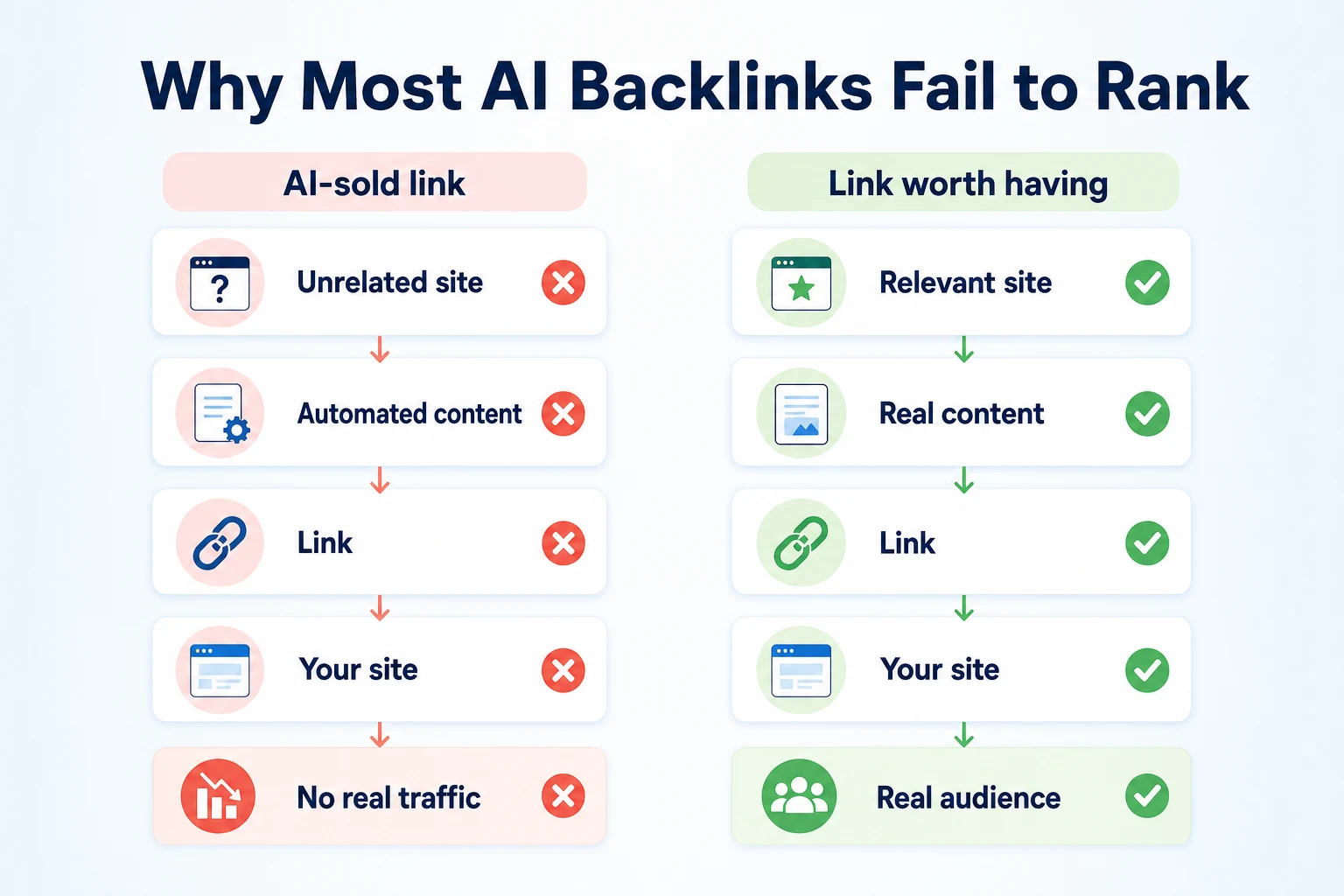
These figures are illustrative.
The Real Risks of Buying AI Backlinks
The worst case for most AI backlink purchases isn't that nothing happens. It's that something happens, just not the thing being promised.
Manual actions and link spam penalties
Google's spam policies specifically address link spam, including buying or selling links intended to manipulate rankings. A site found to be involved in this kind of link scheme can receive a manual action, which can affect how it appears in search results until the issue is addressed and a reconsideration request is reviewed.
A manual action is a real cost, not a hypothetical one, and it's a far worse position than simply not having gained the links in the first place.
Money spent with nothing to show for it
Even without a penalty, the more common outcome is simply that the money doesn't produce anything measurable. Rankings don't move, because the links never carried the kind of relevance or context that Google's systems weigh. The budget is gone either way.
What happens when the vendor disappears
Some sellers of bulk link packages are short-lived operations themselves. A report of fifty live links today can shrink to a handful within months, as the low-quality sites hosting them get removed, deindexed, or simply taken offline. There's usually no refund, no renewal, and no way to hold the seller to the numbers in their original pitch.
How to Spot an AI Backlink Pitch Before You Pay
Most of these offers share a handful of tells, once you know to look for them. None require technical knowledge to spot, just a careful read of what's actually being promised.
Guarantees that no legitimate link builder makes
Nobody who actually builds links for a living can guarantee a ranking position, a page one spot, or a specific traffic increase from a set number of links. Google doesn't publish a formula that would let anyone make that promise honestly, and a seller who makes it anyway is either misunderstanding how rankings work or hoping you won't ask how they'd deliver on it.
A guarantee attached to a backlink package is one of the clearest signs the offer isn't worth paying for, regardless of how confident the pitch sounds.
Bulk volume sold at a price that doesn't add up
Building a genuine relationship with a relevant site, or earning a mention through real outreach, takes time. A person has to find the right site, make contact, and often wait for a reply. That work doesn't scale to fifty placements for the price of a dinner out.
When a package promises a large number of links at a price that couldn't cover even a fraction of an hour of someone's time per link, the links are almost certainly automated, low-quality, or both. The price itself is often the most honest part of the pitch.
What the pitch says | Red flag | What legitimate outreach looks like instead |
|---|---|---|
"Guaranteed first-page ranking" | No one can guarantee where a page lands in search results | No ranking promises, only a description of the work being done |
"50 high-authority links for $99" | The price doesn't cover the time real placement would take | A smaller number of links, priced in a way that reflects actual research and contact time |
"AI-powered placement on premium sites" | Vague on which sites, with no way to check relevance beforehand | A named list of sites considered, so you can judge relevance yourself |
"Instant results within days" | Link effects, where they exist at all, aren't instant or guaranteed on a timeline | An honest timeline with no promise of a specific speed or outcome |
A Worked Example: What a $99 Backlink Package Buys
Imagine a small landscaping business pays $99 for a package advertised as 50 high-authority AI backlinks. This example is illustrative.
Running the numbers on the package
At $99 for 50 links, each one costs just under $2. No research into relevance, no outreach to a real site owner, and no editorial review could realistically happen at that price per link. What can happen at that price is a script posting the link automatically on whatever site will accept it.
A few weeks after delivery, the business checks the report of 50 URLs. A handful lead to directories with no real content. Several lead to pages in unrelated languages or industries. A few no longer load at all. None are sites the business's actual customers would ever visit.
What's promised | What's typically delivered | Likely effect on rankings |
|---|---|---|
50 high-authority backlinks | A mix of unrelated, low-traffic sites, some already offline within months | Little to none, since relevance and context are missing |
AI-matched to your industry | Sites chosen for ease of posting, not industry fit | No measurable improvement in how the site is understood by search systems |
Content written around each link | Short, generic articles that exist only to host the link | No real readers, so no genuine signal of interest or relevance |
These figures are illustrative.
The $99 isn't refundable, and the business is no closer to appearing for the searches that actually bring in work. The same $99, spent on an hour of a freelance writer's time to properly answer one common customer question on the site itself, would likely do more for the business than the entire package.
What Link Building Actually Works for a Small Business
None of this means link building is pointless for a small business. It means the kind that works looks slower and less dramatic than a bulk package, and it's built around relevance rather than volume.
Local directories and citations
A consistent listing on directories relevant to your location and industry, chambers of commerce, local business associations, trade-specific directories, gives real customers a genuine way to find you, and gives search engines a link from a site with actual context behind it. These aren't glamorous, but they're free or low-cost, and they tend to stay live for years rather than disappearing within months. Our guide to local SEO for small businesses covers how directory listings and citations fit alongside a Google Business Profile.
Relationships with suppliers, partners and customers
A supplier who already lists its retailers, a trade partner who mentions who it works with, or a satisfied customer willing to mention you on their own site are all sources of links that come with built-in relevance. These links exist because of a real relationship, not because a fee changed hands for a URL.
A short email asking a supplier or partner if they'd be willing to add a link, where one genuinely makes sense, costs nothing and often works better than any paid package.
Earning mentions through real activity
Sponsoring a local event, being quoted in a local news story, or showing up in an industry roundup because someone found your work useful are all ways a link happens naturally, as a byproduct of something real rather than the goal itself. None of these can be manufactured on demand, but each one is worth more than a dozen links bought in bulk, because they carry exactly the context a bought link lacks.
Content That Earns Links Without Buying Them
The most reliable source of links a small business can control directly is its own content, written well enough that someone else chooses to point to it.
What makes a page worth linking to
A page earns a link when it answers a question thoroughly enough that linking to it is easier than re-explaining the answer. A detailed guide to a specific local regulation, a clear breakdown of pricing and what it includes, or a genuinely useful explanation of a process customers often ask about are all the kind of pages someone else might reference, because referencing it is more useful to their own reader than writing the explanation themselves.
Why thin or generic pages rarely earn links
A page that repeats what's already available everywhere else gives nobody a reason to point to it specifically. If a dozen other sites already say the same thing in the same amount of detail, there's no advantage to linking to yours over any of theirs.
Building a smaller set of pages that each cover a real topic in genuine depth tends to earn more over time than a larger number of shallow pages built mainly to exist. Our guide to topical authority SEO covers how a focused set of pages like this can build up credibility on a subject without needing hundreds of articles.
A Checklist for Evaluating Any Link Opportunity
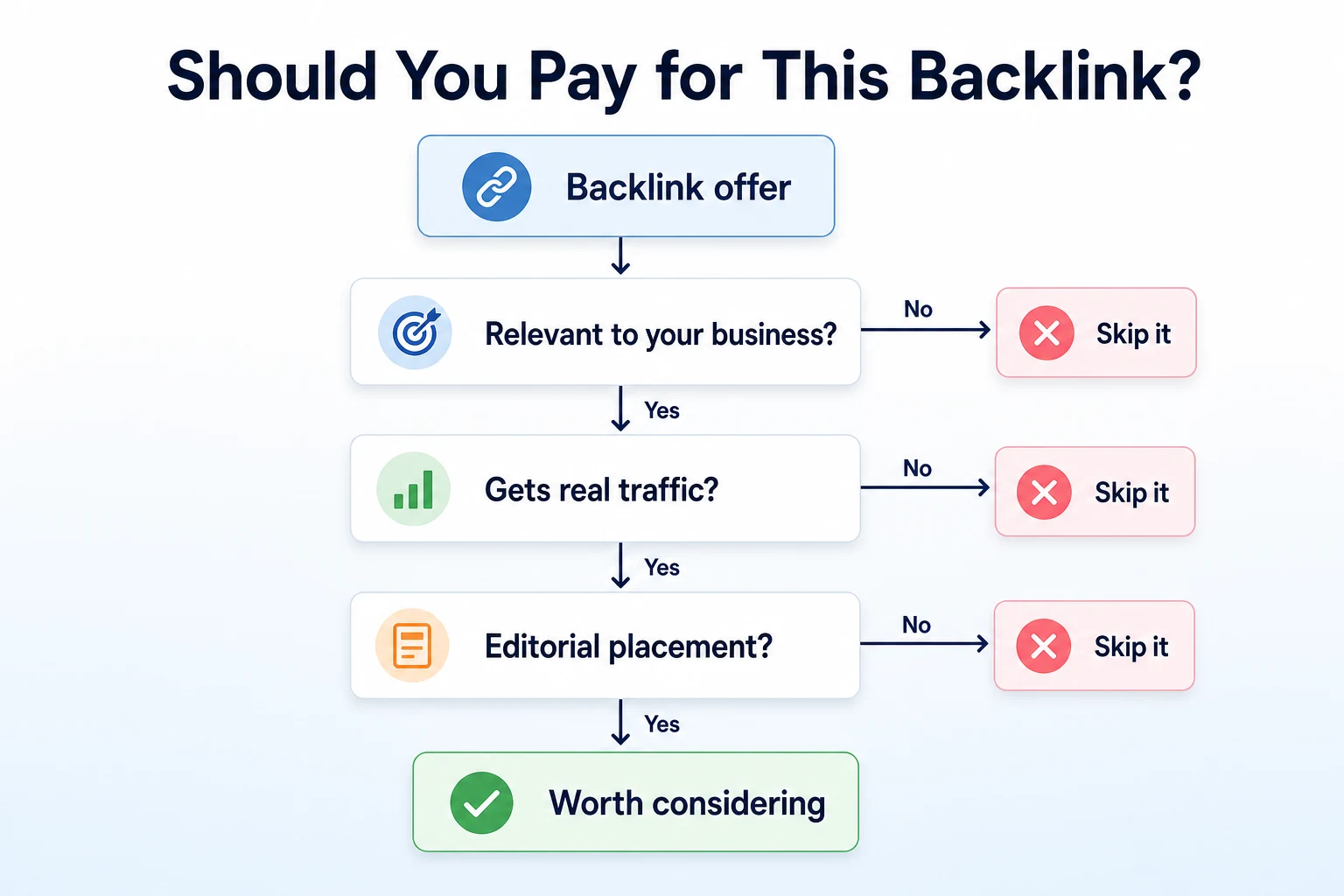
Whether a link is offered for free or sold as part of a package, the same few questions separate something worth having from something that will sit quietly doing nothing.
Question to ask | Why it matters | Pass or skip |
|---|---|---|
Is the site relevant to your industry or location? | Relevance is the context that makes a link meaningful rather than incidental | Pass if yes, skip if the connection is forced or absent |
Does the site appear to get real visitors? | A link on a page nobody reads carries little of the weight a link is meant to carry | Pass if the site looks active, skip if it reads as abandoned |
Was the link placed editorially, not bought in bulk? | Google's spam policies specifically address links built to manipulate rankings | Pass if it came from a genuine mention, skip if it was purchased as part of a package |
Could you explain this link to someone and not feel awkward about it? | A useful gut check for whether a link would hold up to scrutiny | Pass if you'd happily explain it, skip if you'd rather not mention how it happened |
Would this page still exist if your link weren't on it? | Pages created purely to host a link rarely carry any real audience behind them | Pass if the page clearly serves its own purpose, skip if it exists only for the link |
A 30-Day Plan to Replace AI Backlinks With Real Work
The time or money set aside for a bulk backlink package goes further spent on a month of smaller, relevant tasks instead.
Week | Focus | Tasks |
|---|---|---|
1 | Take stock | List any links already pointing to your site, note which directories you're already listed in, and identify two or three relevant ones you're missing |
2 | Local directories and citations | Submit or update your listing on the directories identified in week one, making sure your name, address and phone number match across all of them |
3 | Relationships | Reach out to one supplier, partner or past customer who might reasonably mention or link to your business, and ask directly where it makes sense |
4 | Content worth linking to | Write or update one page that answers a real customer question in genuine depth, then share it somewhere your actual audience will see it |
None of this produces a graph pointed straight up within a month, and it isn't meant to. It produces a small number of links that actually carry the context a search engine's systems are built to notice, plus a page worth linking to going forward. Our SEO content calendar guide covers how to keep that kind of content work going past the first month, rather than treating it as a one-off push.
Where RepGet fits
RepGet doesn't build, sell or broker backlinks, and it won't pretend a package of them is the shortcut this article has just spent several sections explaining why to avoid. What it does is help with the parts of this plan that are genuinely within a business's control.
RepGet's free website audit crawls a site and gives it a 0 to 100 SEO score, flagging technical and content issues worth investigating, including whether existing pages are thin or generic in a way that makes them unlikely to earn a link on their own merit. No account or credit card required.
Beyond the audit, RepGet brings keyword research, content planning, article writing, publishing and search performance reporting from Google Search Console into one workflow. That's useful for the content side of link building covered above: finding the questions worth answering in depth, and getting a well-researched page written and published, with articles able to stay as drafts for a business to review before anything goes live.
RepGet doesn't replace a Google Business Profile, Search Console, or a person's judgment about which directory, partner or mention is worth pursuing, and it can't guarantee a ranking, a Maps position, or a traffic result from any content or outreach work, however carefully it's done.
The bottom line
Most AI backlinks, whether generated by an automated tool or sold as a bulk package, carry little of the relevance or genuine audience that makes a link useful in the first place. Google's own spam policies treat links built to manipulate rankings as something to act against, not reward, and a report listing fifty new URLs doesn't change that.
What actually works is slower and less dramatic: a presence on directories that genuinely relate to your business, relationships with people who have a real reason to mention you, and content detailed enough that someone else chooses to point to it. None of that can be bought in bulk, and none of it comes with a guarantee attached, because nobody can honestly offer one.
The money or time set aside for an AI backlink package almost always does more good spent directly on the site itself.
Find out what your website needs first
Before spending anything on a backlink package, see what your site actually needs. Run a free website audit with RepGet to check your site's technical setup and content before any link-building budget gets spent. No account or credit card required.
FAQ
Do AI backlinks actually work for SEO?
Mostly no. Most AI-generated or AI-sold links come from unrelated, low-traffic sites with little real relevance, which is exactly the context Google's systems weigh most heavily when judging a link.
Can buying backlinks get my website penalized?
Yes. Google's spam policies specifically address links bought or placed to manipulate rankings, and a site found doing this can receive a manual action affecting its search visibility.
How much should I pay for a single backlink?
There's no fixed price, because a genuine link isn't really something you buy. Money is better spent on directory listings, outreach time, or content detailed enough to earn a link on its own.
Are backlink packages sold on freelance marketplaces safe?
Most bulk packages sold this way rely on unrelated, low-quality sites placed automatically. They carry real risk of a manual action and rarely produce a measurable change in rankings.
What's the difference between AI backlinks and regular backlinks?
"AI backlinks" usually describes links placed by automated tools or sold in bulk packages. A regular, useful backlink comes from a relevant site through a genuine mention, relationship, or piece of content.
How many backlinks does a small business actually need?
There's no set number Google has published. A handful of relevant, genuine links from local directories, partners, and real mentions matters far more than a large count of unrelated ones.
Is link building still worth doing in 2026?
Yes, but the kind that holds up is slower: local directories, genuine relationships, and content worth referencing. Bulk-bought or automated links remain a poor use of time and money.
How do I get backlinks without paying for them?
List your business on relevant local and trade directories, ask suppliers or partners who already mention their contacts to add you, and write content detailed enough that others choose to link to it.