

AI Search Citations vs Brand Mentions vs Backlinks: What's the Difference?
Short answer
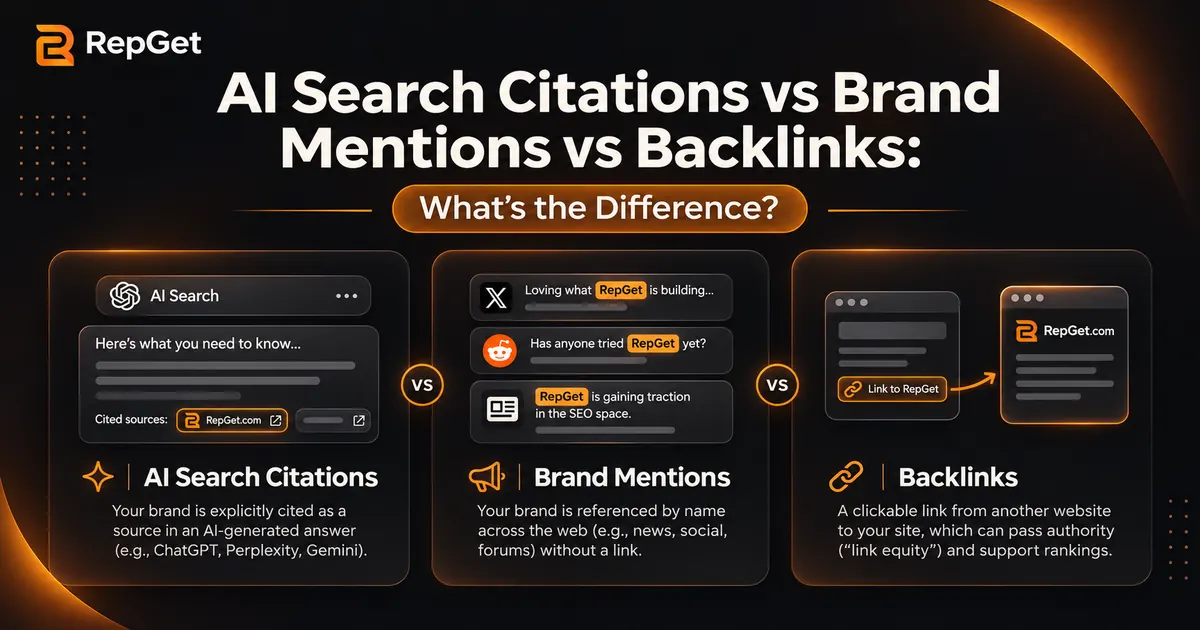
An AI citation is when an assistant like ChatGPT or Google's AI Overviews names your business in an answer, with or without a link. A brand mention is any place your name appears online, cited or not. A backlink is a clickable link from another site to yours. All three can help visibility, but only backlinks are a confirmed Google ranking factor; citations and mentions are not.
A business owner checks Google Search Console and sees her backlinks climbing steadily.
Then she asks ChatGPT a question about her own industry.
Her business never comes up.
A competitor with far fewer backlinks gets named in the AI answer almost every time.
She starts wondering if she's been tracking the wrong thing, or if backlinks even matter anymore. The honest answer is that she's looking at three different signals, not one. AI citations vs backlinks isn't really a competition between two versions of the same thing. A citation, a brand mention and a backlink each do a different job, show up in different places, and respond to different work. Here's what separates them, what Google and AI assistants actually say about each one, and what's worth tracking on your own site.
What Counts as an AI Citation
An AI citation is what happens when a chatbot or an AI-generated answer, like Google's AI Overviews, ChatGPT, Perplexity or Claude, names your business as part of its response to someone's question.
That's the whole definition. It doesn't require a link. It doesn't require the person reading the answer to click anything. It just means the assistant decided your business, or a page from your site, was worth mentioning when it put the answer together.
How an AI citation can show up with or without a link
Some AI answers include a visible source, a clickable link or a small card pointing back to the page the assistant drew from. Google's AI Overviews often show links alongside the generated text. Other tools answer in plain prose with no link at all: ChatGPT might say
A specific business might come up by name in a conversational answer, with nothing underneath it to click. Either way, the mention happened inside the answer itself, not as a link beneath it.
Why a citation isn't the same as a click
A citation describes what happens inside the AI answer, not what happens afterward. Someone reading an AI Overview or a ChatGPT response might see your business named, decide that's enough information, and never visit your site at all. That's still a citation. It just isn't traffic.
This matters because the value of a citation is harder to measure than the value of a visit. A backlink that sends someone to a page shows up as a session in your analytics. A citation that only exists inside someone's chat window usually leaves no trace on your own site at all, even though it may have shaped what that person believed or decided. Our guide to getting mentioned in ChatGPT goes further into what actually increases the odds of this kind of mention happening in the first place.
What Counts as a Brand Mention
A brand mention is simpler to define than a citation, and it existed long before anyone was asking an AI assistant anything.
A brand mention is any place your business's name shows up online. A customer naming you in a Facebook review. A local news article listing you among a handful of shops on a main street. A forum thread where someone recommends you by name in answer to a question. A social post that tags you or just types your name out. None of this requires a link, and none of it requires an AI assistant to ever notice it.
Linked mentions vs unlinked mentions
Some mentions come with a link attached, a news article that names your bakery and also links to your website, for example. Others don't: a customer typing your business name into a Facebook comment almost never adds a clickable link, and most review sites don't link out from the review text itself. The mention still exists either way. What changes is whether it also functions as a backlink, which is a separate thing covered next.
Why unlinked mentions still carry weight with AI tools
An unlinked mention doesn't do anything for a backlink profile, since there's no link to count. But it can still be text that an AI crawler reads when it's building an understanding of what people say about your business. If your name shows up consistently across several review sites, local news coverage and forum threads, that consistency is something an AI system can notice even without a single link pointing back to your site. A mention that never turns into a visit to your website might still shape whether an assistant decides your business belongs in an answer later on.
What Counts as a Backlink
A backlink is the most concrete of the three signals, because it has a specific technical definition rather than a loose description.
A backlink is a clickable HTML link on one website that points to a page on another website. It's the <a href> tag itself, not the surrounding text, that makes something a backlink. A business directory listing your shop with a working link to your homepage is a backlink. The same directory listing your shop's name in plain text with no link is a mention, not a backlink.
What makes a link count as a backlink
For a link to function as a backlink in the usual sense, it needs to be a real, crawlable link on a live, indexable page, not an image of a link, not a link sitting behind a login wall a crawler can't reach, and not a broken link pointing at a page that no longer exists. The page carrying the link also matters. A link from a page that search engines have never indexed does less than a link from a page that's part of the normal, crawlable web.
Followed vs nofollow links, briefly
Not every backlink is treated the same way. A link can carry a rel="nofollow", rel="sponsored" or rel="ugc" attribute, which tells search engines the link is there for a reason other than a straightforward editorial endorsement, a paid placement or a piece of user-generated content, for example. Google's Search Central documentation describes these attributes as hints Google can use when deciding how much weight to give a link, rather than an instruction that a link counts for nothing. A nofollow link from a major review site can still send a reader to your site and still represent a real mention, even if it's not treated the same as an unmarked link. Our guide to AI backlinks covers what's realistic to expect from backlink building generally, which is worth reading before assuming more links automatically means more AI visibility.
Citations, Mentions and Backlinks Side by Side
Laid out next to each other, the differences are easier to see than they are to describe in separate paragraphs.
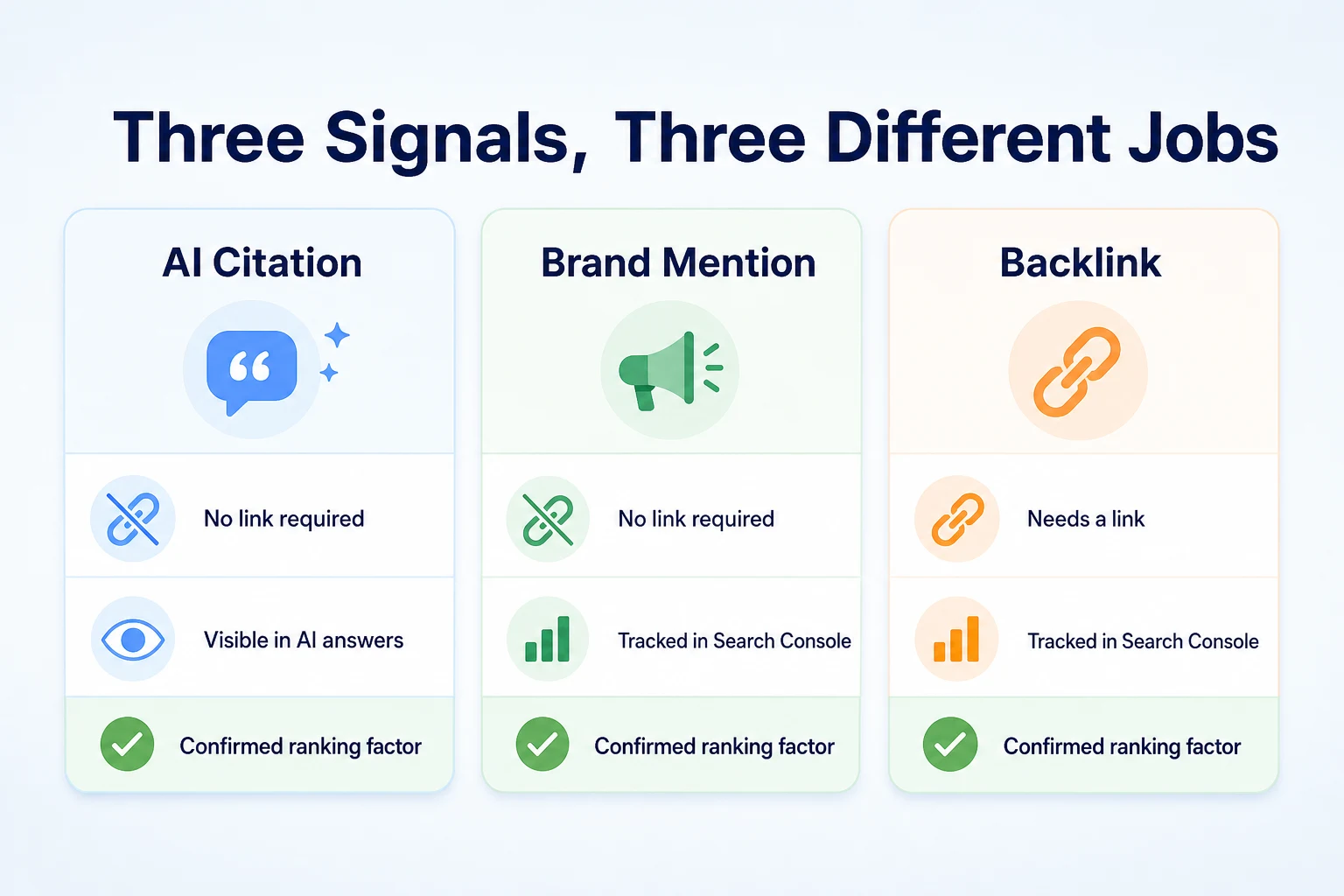
Signal | Needs a link? | Where it appears | Confirmed Google ranking factor? | Can an AI assistant cite it? |
|---|---|---|---|---|
AI Citation | No | Inside an AI-generated answer, with or without a visible source | No | This is the citation itself |
Brand Mention | No | Reviews, forums, news articles, social posts, anywhere your name appears | No | Yes, if an AI tool reads the page it's on |
Backlink | Yes | An | Yes, documented by Google as a signal | Yes, if the linking page is crawled |
How Google's Documentation Treats Each One
It helps to separate what Google has actually documented from what gets repeated as common SEO wisdom, since the two don't always match.
What Google's documentation says about links
Google's Search Central documentation describes links as something Google uses to discover new pages during crawling and as one of the signals it uses to understand how pages relate to each other. This is long-standing, documented behavior, not a guess. Google's own guidance on link building and on attributes like nofollow, sponsored and UGC treats links as a real signal worth getting right, while also warning against link schemes built purely to manipulate rankings. None of that documentation promises that a specific link will move a specific ranking, and no legitimate source can promise that either.
What Google hasn't documented about mentions
Google's public documentation does not describe an unlinked brand mention, on its own, as a ranking factor. That's worth saying plainly, because it's common to hear that Google can somehow sense your business name being mentioned without a link and reward the site for it. Nothing in Google's own Search Central documentation makes that claim. The same goes for AI citations: being named inside an AI Overview or a chatbot answer isn't described anywhere in Google's documentation as something that feeds back into how the site itself ranks in regular search results. These are two separate systems, and treating a citation as proof of ranking progress, or the reverse, isn't something Google's own guidance supports.
How AI Assistants Decide What to Name in an Answer
Google hasn't published a formula for how AI Overviews or any other assistant picks which businesses to name, and nobody outside these companies has the full picture either. What's worth working from instead is documented, observable behavior: these systems have to read a page before they can cite it, and they tend to favor sources that make a claim easy to verify.
What makes a business easier for an AI assistant to cite
An AI assistant can only cite what it can actually read. That starts with whether its crawler is allowed onto your site at all, something you can check directly rather than guess at. Beyond access, content that states a fact plainly tends to get picked up more easily than content that buries the same fact in a long, vague paragraph. A page that says your bakery opens at 7am on weekdays is easier for an assistant to lift into an answer than a page that only implies it somewhere in a story about the owner's background. Structured, direct answers to specific questions, the kind a person might actually type into a chat box, give an assistant something concrete to repeat.
Why consistency across sources matters more than any single link
No single backlink or mention seems to be the deciding factor in whether an assistant names a business. What shows up more often in how these tools behave is a pattern across several sources saying the same thing. If your business name, address and hours match across your own site, a couple of review platforms and a local directory, that agreement gives an assistant more confidence than one glowing mention on a single site with everything else quiet or inconsistent. This is closer to how a person checks a claim before repeating it than how a search engine counts links. Our guide to how AI assistants decide which businesses to recommend goes further into what's actually documented about this, separate from guesswork that gets repeated as fact.
A Worked Example: Three Businesses, Three Different Results
It helps to see these three signals pull apart in practice rather than just in definitions, so imagine three fictional local businesses, all plumbing companies in the same mid-sized town.
Business | Backlinks | Mentions | AI citations | Likely reason |
|---|---|---|---|---|
Business A | High | Low | Low | Years of directory and partner links, but a thin website with vague service pages |
Business B | Low | High | Medium | Active on local Facebook groups and reviewed often, but rarely linked to |
Business C | Medium | Medium | High | Clear, specific service pages that answer common questions directly, consistent details everywhere it's mentioned |
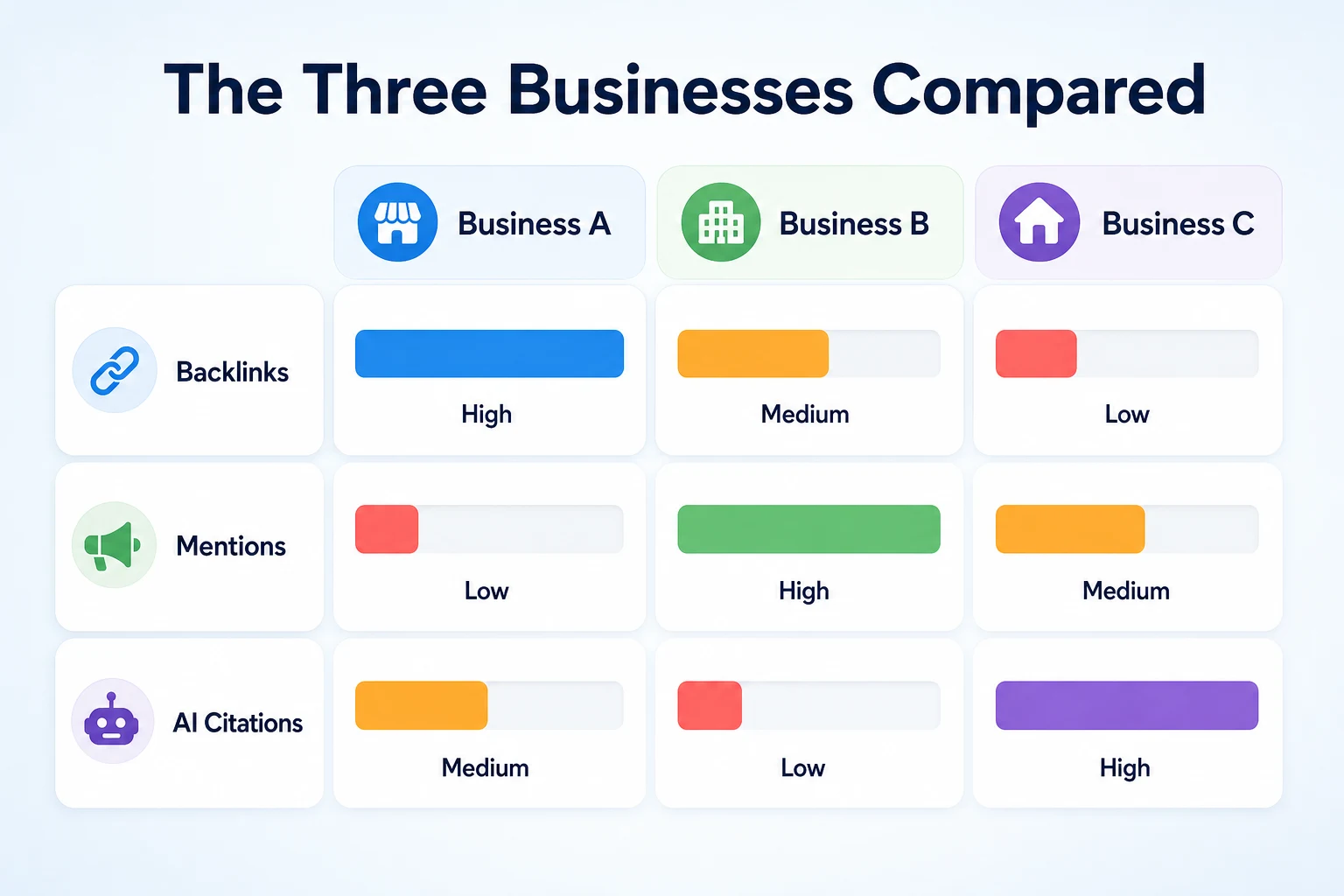
These figures are illustrative.
Why the AI-cited business doesn't have the most backlinks
Business A has the most backlinks of the three, built up over several years from supplier directories and trade partnerships. None of that shows up when someone asks an AI assistant for a plumber nearby, because the site itself doesn't give an assistant anything specific to repeat. Business B gets talked about constantly in the local Facebook group and has a steady stream of reviews, almost none of them linked, and that visibility does earn it a reasonable number of AI citations even without the link profile to match.
Business C sits in the middle on both backlinks and mentions, but comes out ahead on AI citations because its website answers exactly the kind of question people tend to ask an assistant: what does an emergency callout cost, how fast can someone come out, do they work weekends. The answers are plain and consistent with what review sites say about the same business. None of the three outcomes was guaranteed by any single signal on its own.
How to Track Each Signal
Each of these three signals needs a different place to check it, since none of the usual tools track all three at once.
Tracking backlinks
Google Search Console's Links report is the most direct source for your own site, showing which pages link to you and which of your pages get linked to most. It only reflects links Google has found and recorded, not every link that exists anywhere on the web, so treat it as a solid baseline rather than a complete count.
Tracking mentions
Mentions are harder to track in one place, since there's no dedicated report for them the way there is for backlinks in Search Console. A regular search of your own business name, checking review platforms directly, and setting up a simple alert for your business name are the practical options most small businesses actually use. None of this is automated the way link tracking is, so it tends to work best as a monthly habit rather than something checked daily.
Tracking AI citations
This is the newest and least standardized of the three to measure. Manually asking a handful of assistants the kinds of questions a customer might ask, and noting whether your business comes up, is a blunt but workable starting point. Our guide to tracking ChatGPT traffic covers how to catch the sessions that do result from an AI citation that included a link. Before any of that matters, it's worth confirming AI crawlers can actually reach your site in the first place, which RepGet's free AI Crawler Checker checks directly.
A 30-Day Plan to Build All Three
None of these three signals responds to a single afternoon of work, but a month is enough time to make real progress on all three at once, in a sensible order.
Week | Focus | Tasks |
|---|---|---|
Week 1 | Make sure you're crawlable and readable | Check robots.txt doesn't block AI or search crawlers, confirm your sitemap is valid, and review your service pages for plain, direct answers to common questions |
Week 2 | Fix consistency across existing mentions | Search your own business name, check your details match across your website, review sites and directories, and correct anything out of date |
Week 3 | Earn new mentions and links | Reach out to local sites, partners or publications where a genuine mention makes sense, and ask for a link where one fits naturally |
Week 4 | Check what's actually citing you | Ask a few AI assistants the questions a customer might ask, review your Search Console Links report, and note where each signal stands before repeating the cycle next month |
Common Mistakes When Chasing One Signal Over the Others
Most of the trouble with AI citations vs backlinks comes from treating one signal as a stand-in for all three, rather than tracking each one on its own terms.
Buying backlinks from low-quality directories hoping it also improves AI citations, when the two have no documented connection and the links themselves can do more harm than good.
Ignoring unlinked mentions because they don't show up anywhere in Search Console, even though an AI assistant can still read and repeat them.
Assuming a citation in an AI answer brings the same value as a clicked backlink, when a citation with no link often leaves no trace in your own analytics at all.
Letting business details drift out of sync across review sites, directories and your own website, then wondering why an assistant seems unsure whether to name you.
Writing vague service pages that read fine to a person but give an AI assistant nothing specific enough to lift into an answer.
Checking AI citations once, getting a disappointing result, and giving up rather than treating it as a monthly habit the way backlink tracking already is.
None of these mistakes are unusual. They mostly come from applying old habits, built around backlinks, to two signals that behave differently.
Where RepGet fits
RepGet doesn't promise a mention in a ChatGPT answer or a spot in an AI Overview, and nobody honestly can. What it does is work on the parts of this problem that are actually within a business's control.
RepGet brings website auditing, keyword research, content planning, article writing, publishing to your website, and search performance reporting from Google Search Console into one workflow. The content side matters here directly: clear, specific service pages that answer a real question plainly are the kind of page this article keeps coming back to as easier for an AI assistant to cite, and RepGet's writing and publishing workflow is built around producing exactly that kind of page. Articles RepGet writes can stay as drafts for your team to review before anything goes live, so you can check a page actually states its facts plainly before it's published.
RepGet also includes AI search visibility tracking and access to a backlink partner network, which cover two of the three signals in this article directly. It does not track unlinked brand mentions across every review site and forum on its own, and it doesn't replace a manual check of what review sites and local directories say about your business. RepGet does not replace Google Business Profile, Search Console or your own judgment, and it doesn't guarantee rankings, Google Maps positions, traffic or mentions in AI answers.
Before any of that, it's worth knowing where your own site actually stands. RepGet's free website audit crawls your site and gives it a 0 to 100 SEO score, with the technical and content issues worth fixing listed out. No account or credit card required.
The bottom line
AI citations, brand mentions and backlinks aren't three names for the same thing. A citation happens inside an AI answer, with or without a link. A mention is any place your name shows up, cited or not. A backlink is a clickable link from one site to another, and it's the only one of the three that Google's own documentation describes as a signal it uses.
That doesn't make citations or mentions worthless. It means they're worth tracking for what they actually are, rather than folding into a single backlink count and hoping the rest follows along on its own. A business with a strong link profile and a thin, vague website can still go unnamed by an AI assistant. A business with almost no links but clear, specific pages and consistent details across the web can get cited often. Tracking all three, even loosely, tells you more about where your visibility actually stands than watching any one of them alone.
Find out what your website needs first
Run a free website audit with RepGet to see what your site needs fixed before chasing citations, mentions or backlinks any further. No account or credit card required.
FAQ
What is the difference between a backlink and an AI citation?
A backlink is a clickable HTML link from one website to yours. An AI citation is when an assistant names your business inside an answer, with or without a link attached.
Do brand mentions help SEO without a link?
Google's documentation doesn't describe an unlinked mention as a ranking factor on its own, but an unlinked mention can still be text an AI tool reads when deciding what to cite.
Can you get cited by ChatGPT without any backlinks?
Yes. Being named in a chatbot answer depends on whether the tool can read and verify your content, not on how many backlinks point to your site.
Does Google count AI citations as a ranking factor?
No. Google's Search Central documentation doesn't describe being named in an AI Overview or a chatbot answer as something that affects a site's ranking in regular search results.
How do I track mentions of my business that AI assistants use?
Search your own business name regularly, check the main review platforms directly, and ask a few AI assistants the questions a customer might ask about your business.
Are unlinked mentions as good as backlinks?
Not for ranking purposes, since only a backlink is documented by Google as a signal. An unlinked mention can still matter for consistency and for AI tools reading it.
What should a small business prioritize, backlinks or AI citations?
Neither alone. Fixing crawlability and writing clear, specific pages tends to support all three signals, so start there before chasing one signal in isolation.
How does Google's AI Overviews choose which sites to cite?
Google hasn't published the exact method, but AI Overviews tends to favor pages it can crawl easily and that state facts plainly, based on documented, observable behavior.
Comments
1 shownShare your thoughts about this article.
New to RepGet? Create a free account to join the conversation.
The future of online visibility goes far beyond traditional SEO. Backlinks still matter, but being mentioned by trusted sources and cited by AI platforms is becoming increasingly important for businesses. These are different signals, and understanding how they work together is essential. This is exactly why we're building RepGet: to help businesses strengthen their authority, understand their visibility, and get discovered wherever customers are searching. Dumitru Culiuc Founder of RepGet