

TikTok AI Advertising Tools: What Brands Can Actually Do With Them
Short answer
On October 5, 2026, TikTok announced AI advertising tools covering agentic campaign management, creative automation, customer discovery and outcome tracking. The tools can set budgets, adjust bids and generate ad variations, though approval is still required at key steps. Access varies by account, and TikTok hasn't published performance guarantees, so test with a capped budget first.
A small business owner logs into TikTok Ads Manager and sees a new prompt offering to run her whole campaign with AI.
It asks for a goal and a budget, then offers to handle the rest: targeting, creative, bidding.
She isn't sure what she would be handing over, or what she would get back.
That hesitation is reasonable. TikTok's new TikTok AI advertising tools, announced on October 5, 2026, do automate more of a campaign than anything the platform has offered before, but they don't remove a business from the process entirely. Here's what TikTok actually said, what the tools do and don't decide on their own, and how a small business can test them without handing over more control than it means to.
What TikTok Announced on October 5, 2026
On October 5, 2026, TikTok announced a set of AI-powered advertising tools built around four areas: agentic campaign management, creative automation, customer discovery, and outcome tracking. The company framed the announcement as a shift toward advertising that an AI system can run with less manual setup, rather than a single new feature.
The four areas TikTok announced
The first area covers what TikTok calls agentic tools, meaning AI that can take actions inside a campaign, like adjusting a bid or reallocating budget, rather than only suggesting them. The second is creative automation, which generates and tests variations of an ad's video or image content. The third is customer discovery, aimed at finding and expanding the audiences a campaign reaches. The fourth is outcome tracking, tying ad spend more directly to the specific result a business says it wants, rather than only impressions or clicks.
Why TikTok is calling this 'agentic' advertising
TikTok used the word agentic to describe tools that act on a business's behalf within limits it sets, rather than tools that simply recommend a next step and wait for a person to click a button. That's a meaningful distinction. A recommendation engine tells a business what to do. An agentic tool does some of it, inside boundaries the business has already approved, like a budget cap or a target outcome. Whether that distinction matters much in daily use depends on how much of the campaign a business is comfortable automating, which is the question the rest of this article works through.
What Agentic Advertising Tools Actually Do
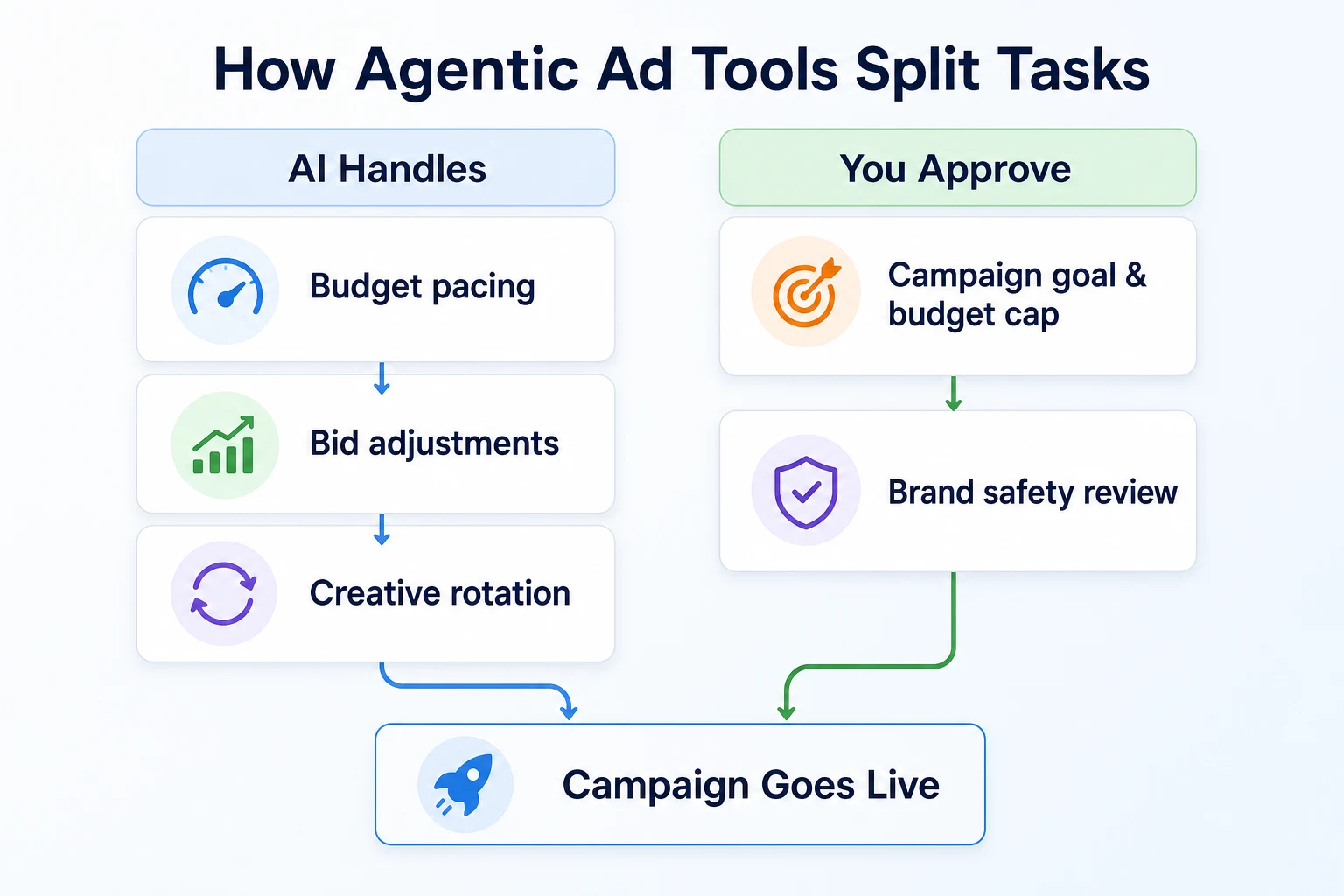
The practical question for any business is which decisions the tool makes without being asked, and which ones still require a person to say yes first.
Decisions the tools make automatically
Within the limits a business sets at setup, the agentic tools can adjust bids, pace a budget across a day or a campaign period, and rotate between creative variations based on how each one performs. These are the kinds of adjustments that used to require a person checking the dashboard and making small manual changes throughout a campaign's run. TikTok's framing is that the tool handles the ongoing, repetitive optimization, freeing a business from checking in constantly.
What still needs human approval
The campaign's overall goal and its budget cap are set by the business before anything runs, and TikTok hasn't described a version of these tools that changes either without a business going back in to adjust it. Brand safety review, meaning whether an ad runs alongside content a business would rather avoid, also still sits with settings a business configures rather than something the AI decides on its own. In other words, the tool optimizes inside a box the business draws, it doesn't redraw the box.
How this differs from TikTok's existing Smart+ automation
TikTok already offered Smart+, an automated campaign type that handles targeting and bidding with less manual input than a standard campaign. The October 2026 agentic tools build on that same direction but go further, adding the ability to act across more parts of a campaign, including creative generation and testing, rather than automating targeting and bidding alone. A business already using Smart+ campaigns is likely to find the agentic tools a natural next step rather than a completely different system to learn.
Creative Automation: How TikTok Generates and Tests Ad Variations
Creative is usually the part of running TikTok ads that takes the most time for a small business, since it means filming, editing and testing multiple versions of the same idea. TikTok's announcement addresses that directly.
AI-generated video and image variations
The creative automation tools can generate variations of an ad's video or image content starting from material a business already has, such as an existing video or a set of product images. The intent is to produce several versions quickly, varying things like pacing, text overlay or framing, rather than requiring a business to film a new version of an ad for every test it wants to run.
Automated testing across audiences
Once multiple variations exist, the tool can test them against different audience segments and shift spend toward whichever version performs better for a given segment. That's a meaningful time saver for a business that doesn't have the staff to run manual A/B tests and check results daily. TikTok hasn't published figures on how much faster this testing is compared to a manual approach, so it's worth treating the time saved as likely to vary by business rather than assuming a specific number.
Customer Discovery: How the AI Finds New Audiences
The third area TikTok announced is aimed at finding audiences a business might not have targeted on its own, beyond the lookalike or interest-based targeting that's been available for a while.
How audience expansion works
The customer discovery tools are designed to identify users who behave similarly to a business's existing customers or engaged users, then expand a campaign's reach to include them, adjusting that reach as the campaign collects more performance data. The tool is meant to keep refining who it shows an ad to as it learns which segments actually convert, rather than targeting a fixed audience for the whole campaign.
What TikTok hasn't detailed about targeting data
TikTok hasn't published a full, itemized breakdown of exactly which signals the customer discovery tool uses to decide who counts as similar to an existing customer. What's clear from the announcement is that it draws on a business's own campaign and engagement data to find patterns, but the specific weighting of any one signal isn't something TikTok has detailed publicly. A business with privacy questions about how its own customer data factors into this should check TikTok's own advertising and privacy documentation directly, rather than assume a specific mechanism that hasn't been confirmed.
Measurable Marketing Outcomes: What TikTok Says It Tracks
The fourth part of the announcement is about what a business is actually paying for, and how closely that ties to a result rather than just a click or a view.
Outcome-based bidding options
TikTok said the new tools let a business bid toward a specific outcome, such as a completed purchase, a lead form submission, or an app install, rather than only toward clicks or impressions. The idea is that the AI adjusts bidding and targeting to chase that outcome directly, instead of a business having to guess which clicks are likely to turn into the result it actually wants. This isn't a new concept in digital advertising generally, but TikTok's announcement ties it more directly into the same agentic system that handles budget pacing and creative rotation, so the outcome a business sets becomes the thing the whole campaign optimizes toward, not just the bidding strategy on its own.
Changes to reporting and attribution
Alongside outcome-based bidding, TikTok described changes to how results get reported back to a business, aiming to connect ad spend more clearly to the outcome it was aimed at. TikTok hasn't published a detailed technical breakdown of how its attribution model works under this update, or how it compares to attribution models on other platforms. A business that already tracks conversions through its own website or booking system should keep doing so independently and treat TikTok's own reporting as one input, not the only record of what actually happened.
Who Has Access to These Tools Right Now
Announcements like this one usually reach a platform's blog before they reach every account, and TikTok's is no exception.
What's confirmed about availability
TikTok confirmed the announcement on October 5, 2026 and described the tools as part of its advertising platform going forward. It didn't publish a single, universal date by which every advertiser, in every country, would see every tool available in their own Ads Manager account. As with most platform rollouts, the honest approach is to check inside a specific account rather than assume a named feature is already switched on simply because it was announced.
What's still rolling out
Some parts of the announcement, particularly the newer agentic and customer discovery tools, are likely to reach larger or more established advertisers first, with smaller accounts seeing access later, though TikTok hasn't published an exact schedule for that sequencing. The table below reflects what's reasonable to expect based on how TikTok has rolled out previous automated ad features, not a confirmed timeline from TikTok itself.
Phase | Who likely has access | What's typically included |
|---|---|---|
Initial rollout | Larger advertisers and existing Smart+ users | Agentic campaign management, outcome-based bidding |
Broader rollout | Mid-size and smaller advertisers as access expands | Creative automation and customer discovery tools |
Full availability | Most advertisers in supported regions | All four areas from the announcement, subject to regional rules |
This phasing is a reasonable expectation based on past rollouts, not a confirmed TikTok timeline.
Agentic Ads vs Traditional Campaign Manager: Which Fits Your Business
Neither option is automatically the right choice. It depends on how much time a business has to manage a campaign day to day, and how comfortable it is letting software make ongoing adjustments.
Time and control tradeoffs
Agentic ads trade a business's hands-on control for time saved on daily monitoring and manual creative testing. Traditional Campaign Manager trades that time savings for a business keeping every targeting, bidding and creative decision in its own hands, checked and changed manually whenever the business decides to. Our comparison of Meta AI ads covers a similar tradeoff on a different platform, and the underlying question is the same one worth asking here: is the time saved worth less direct say over each decision.
When manual control still makes sense
A business running a tightly regulated campaign, working with a strict brand style, or testing a completely new offer for the first time may prefer to keep manual control until it has a clearer sense of what works, then hand routine optimization to the automated tools once it trusts the pattern. This mirrors the broader point in our piece on Google Search Ads versus SEO: paid tools can run alongside manual oversight, but one doesn't need to fully replace the other.
Factor | Agentic ads | Traditional Campaign Manager |
|---|---|---|
Setup time | Shorter, mainly setting goal and budget | Longer, manual targeting and creative setup |
Control level | Lower, within set boundaries | Full, every setting chosen manually |
Best for | Businesses short on time for daily monitoring | Businesses testing a new offer or strict brand rules |
Learning curve | Lower once goal and budget are set | Higher, requires understanding of bidding and targeting |
Three Practical Examples for Small Businesses
None of these businesses are real. They're meant to show how a small team might realistically test one part of the announcement without handing over an entire campaign at once.
Example 1: a local service business testing creative automation
Imagine a window cleaning company with one decent video of a job in progress, filmed on a phone, and no budget for a video editor. Instead of running that single clip as its only ad, the owner uploads it to the creative automation tool and lets it generate a handful of variations, different pacing, different text overlay, one version that leads with a price and one that leads with a before-and-after shot. The owner still writes the captions and picks the final set that gets approved to run. The tool does the editing work the business didn't have time for. It doesn't decide what the ad says.
Example 2: an online store testing customer discovery
Imagine a small home goods store that has a loyal group of repeat buyers but has never looked much beyond its existing email list for new customers. It sets a campaign goal, a budget cap, and lets the customer discovery tool expand reach to people who behave similarly to its existing buyers, checking back weekly rather than daily. If the expanded audience starts producing orders, it keeps the budget where it is. If it doesn't, it pulls the cap back down. The tool finds candidates. The store still decides whether the result is worth the spend.
Example 3: a restaurant testing outcome-based bidding
Imagine a neighborhood restaurant that wants more online reservation bookings, not just more views of its page. Rather than bidding toward clicks, it sets the campaign's outcome as a completed reservation and lets the bidding adjust toward people likely to actually book, not just browse. It keeps checking its own reservation system against what TikTok reports, the way the measurement section above suggests, rather than trusting TikTok's number as the only record. A business planning this kind of test alongside its other content might find it useful to map it against an SEO content calendar, so the ad push lines up with whatever else is going out that month rather than competing with it.
A 30-Day Plan to Test TikTok's AI Ad Tools Safely
A short, capped test tells a business more than reading about the announcement ever will. This plan assumes access to at least some of the tools is already showing up in an account.
Week | Action | What to check |
|---|---|---|
Week 1: Set up | Choose one tool to test, not all four at once, and set a firm budget cap for the month | That the goal, budget cap and brand safety settings reflect limits you're actually comfortable with |
Week 2: Launch | Run the test campaign alongside, not instead of, whatever is already working | Early spend pacing and whether creative variations look consistent with your brand |
Week 3: Compare | Check TikTok's reported results against your own website or booking data | Whether reported outcomes match what actually happened in your own records |
Week 4: Decide | Keep, expand or pause the automated test based on what you actually saw | Whether the time saved was worth the reduced control, for this specific tool |
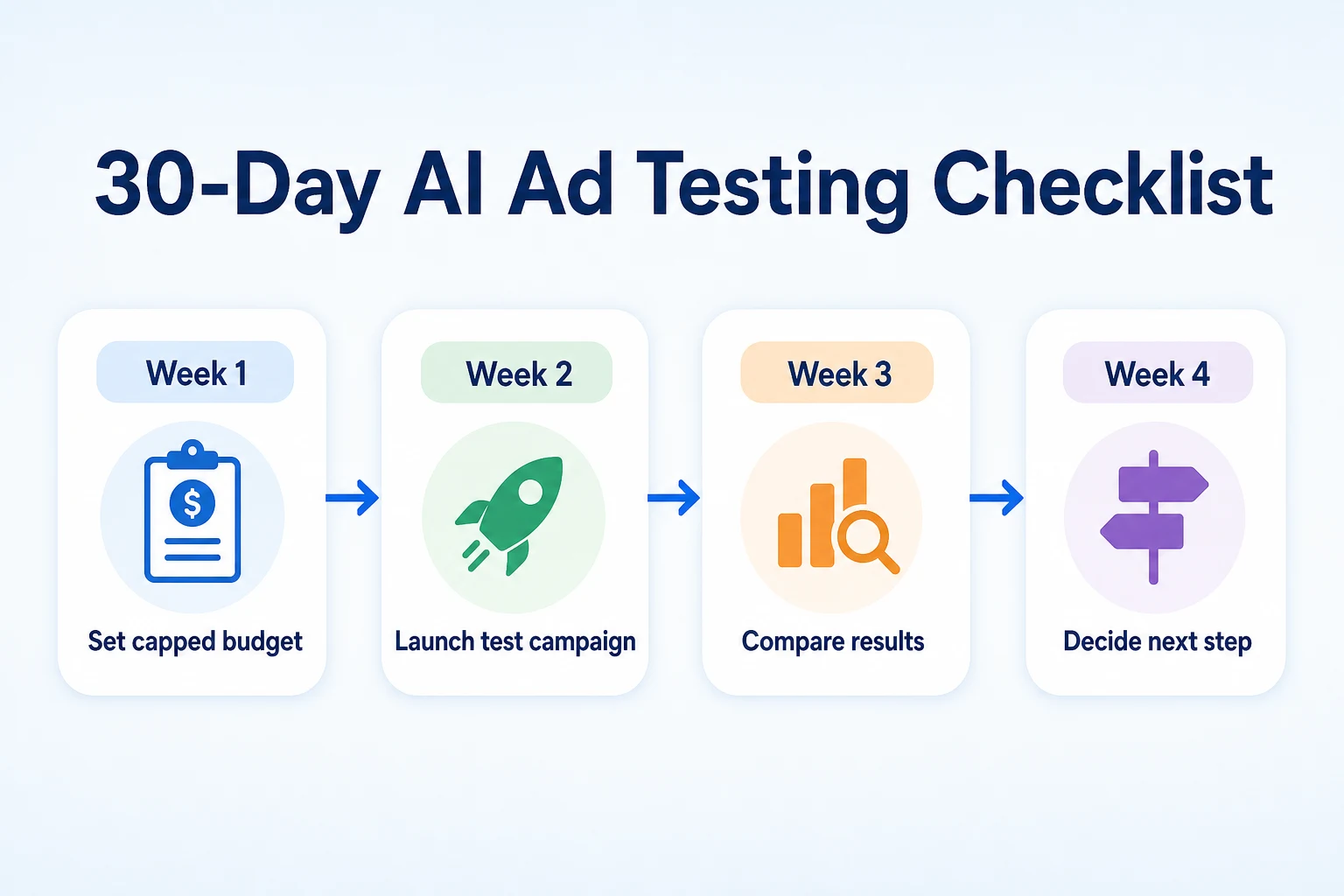
Thirty days isn't long enough to draw firm conclusions about a brand new advertising tool, but it's long enough to spot whether a tool's early behavior fits a business's comfort level before committing more budget to it.
Common Mistakes to Avoid With AI-Run Campaigns
A handful of reactions to automated ad tools show up often enough, on TikTok and elsewhere, that they're worth naming directly.
Mistake | What it leads to | Fix |
|---|---|---|
Testing all four tools at once | No clear way to tell which change in performance came from which tool | Test one tool at a time, with everything else held constant |
Setting no budget cap | Spend that climbs faster than expected while the tool chases its outcome | Set a firm cap before launch and check it in the first few days, not just at month end |
Trusting TikTok's reporting as the only record | A gap between reported outcomes and what the business actually sold or booked | Cross-check results against your own website, booking or sales data each week |
Skipping brand safety review | Ads running alongside content that doesn't fit the business | Set and review brand safety settings before approving the campaign, not after |
The pattern underneath most of these mistakes is the same one that shows up with any new automated tool: treating automation as a reason to stop checking in, rather than a reason to check in on a different schedule.
What TikTok Hasn't Said Yet
It's worth being just as clear about what TikTok hasn't confirmed as what it has, since most of the overreach around an announcement like this comes from filling in those gaps with assumptions.
TikTok hasn't published performance figures for any of the four tools it announced on October 5, 2026. It hasn't said how much faster creative automation is than a manual approach, how much further customer discovery typically expands a qualified audience, or what a typical result looks like for a business using outcome-based bidding instead of standard bidding. Any specific percentage or result attributed to these tools, if it isn't sitting in TikTok's own documentation, isn't something TikTok has confirmed.
It also hasn't published a full rollout schedule by country or account size, so the phasing described earlier in this article is a reasonable expectation based on how similar tools have reached advertisers before, not a published timeline. And it hasn't detailed, beyond the general description of using a business's own campaign and engagement data, exactly which signals the customer discovery tool weighs most heavily. A similar gap shows up in other AI advertising formats launched this year. Our look at ChatGPT Ads covers a comparable case where a platform confirmed a real expansion without publishing the targeting or performance detail that would let a business plan around specific numbers.
None of that means the tools aren't worth testing. It means the honest position is to treat them as a new, still-developing part of TikTok's advertising platform, not a system with a track record a small business can rely on yet.
Where RepGet fits
RepGet doesn't run TikTok ad campaigns, generate ad creative, or manage any part of TikTok Ads Manager. Nothing about this announcement runs through RepGet, and that isn't going to change.
What RepGet does help with is the website sitting behind any TikTok ad, whether it's run manually or through one of these new agentic tools. An ad that sends someone to a landing page with outdated pricing, a broken form, or unclear service details wastes the budget a business just spent getting them there, automated bidding or not. RepGet's content planning and article writing can help keep that kind of page current, and anything it writes can stay as a draft for a business to review before it goes live.
Before testing a new ad tool, it's worth knowing what the site it points to already needs fixing. RepGet's free website audit crawls a site and gives it a 0 to 100 SEO score, flagging technical and content issues worth addressing regardless of which ad platform sends a visitor there. No account or credit card required. Its free SEO tools cover things like page titles and meta descriptions, which matter just as much for a visitor arriving from a TikTok ad as one arriving from a search result.
RepGet doesn't guarantee ad performance on TikTok or anywhere else, and it has no say in how TikTok's agentic tools bid, target, or generate creative. What it can do is make sure the page an ad sends someone to is actually ready for them.
The bottom line
TikTok confirmed a real, dated announcement on October 5, 2026: new AI advertising tools covering agentic campaign management, creative automation, customer discovery, and outcome-based tracking. These tools can adjust bids, pace budgets, generate creative variations, and bid toward a specific business outcome, all within limits a business sets at setup.
What hasn't been confirmed is just as important. TikTok hasn't published performance figures, a full rollout timeline, or a detailed breakdown of its targeting signals. A business shouldn't assume full access is live simply because the announcement happened, and it shouldn't hand over an entire campaign's budget to a brand new tool before checking how it behaves on a small, capped test first. The sensible response is to test one tool at a time, keep a firm budget cap, and check TikTok's reported results against your own records before deciding whether to expand.
Find out what your website needs first
Run a free website audit with RepGet to see what your own site needs before sending traffic to it from a new advertising tool. No account or credit card required.
FAQ
What are TikTok's new AI advertising tools?
Announced October 5, 2026, they cover agentic campaign management, creative automation, customer discovery, and outcome-based tracking, letting AI adjust bids, generate ad variations, and bid toward a specific business result.
When did TikTok announce its AI advertising tools?
TikTok made the announcement on October 5, 2026, describing it as a shift toward advertising tools that can take actions inside a campaign rather than only suggest them.
Is TikTok's agentic advertising available to small businesses?
TikTok hasn't published a universal availability date for every account size or region. Access is likely to roll out in phases, so checking your own Ads Manager account directly is the only reliable way to know.
Do I need a large ad budget to use TikTok's AI ad tools?
TikTok hasn't set a minimum budget for these tools in its announcement. A business can set its own budget cap when configuring a campaign, which makes a small, capped test possible before spending more.
Can AI write my TikTok ad creative for me?
TikTok's creative automation tool can generate variations of video or image content from material a business already has, but a business still approves captions and the final versions that run.
How does TikTok's AI find new customers?
The customer discovery tool identifies users who behave similarly to a business's existing customers and expands reach to them, refining that audience as the campaign collects more performance data.
Does TikTok's AI advertising guarantee better results?
No. TikTok hasn't published performance figures or guarantees for these tools. Results depend on the business, the campaign setup, and factors TikTok hasn't detailed publicly.
What's the difference between agentic ads and TikTok Smart+?
Smart+ automates targeting and bidding with less manual input. The newer agentic tools build on that, extending automation to creative generation, testing, and broader campaign actions within limits a business sets.