

ChatGPT Ads 2026: What the 26-Country Expansion Means
Short answer
On October 21, 2026, OpenAI expanded ChatGPT Ads to 26 more countries, building on its US test. Sponsored results appear as labeled, separate blocks inside a conversation, not as part of ChatGPT's own generated answer. Access still varies by market. Paying for a placement doesn't change the organic answers ChatGPT gives, so small businesses still need a plan for both.
A boutique owner in Lisbon reads that ChatGPT now shows ads in her country, opens the app expecting a straightforward way to run a campaign, and finds no such option waiting in her account yet.
She checks her business account, then asks a friend running a cafe nearby to check theirs too.
Nothing changes. The chat window looks exactly like it did last week.
That gap between the headline and what actually shows up in an account is the real story behind ChatGPT ads 2026. OpenAI did expand its sponsored result format to 26 additional countries on October 21, 2026, but an expansion of availability and a ready-to-use ad account are two different things, and most small businesses are still sorting out what this actually changes for them.
Here's what OpenAI actually confirmed, how the ad format works inside a conversation, what's known about getting access, and how to think about paid placements next to the organic visibility that still does most of the work for most businesses.
What OpenAI Announced on October 21, 2026
On October 21, 2026, OpenAI said it was expanding ChatGPT Ads, the sponsored result format it had been testing, to 26 additional countries. The company framed this as building on an earlier, more limited test that had run in the United States.
The core announcement
The announcement itself is narrow and specific: a sponsored result format that previously reached a smaller set of users is now available more broadly, across a named group of additional markets. OpenAI didn't describe this as a finished advertising product rolled out to everyone at once. It described it as an expansion of where the format can appear, which is a different claim from saying every business in those 26 countries can now buy a placement.
How it builds on the earlier US test
Before this expansion, OpenAI had been testing sponsored results with a smaller group of users inside the United States. That earlier phase let OpenAI work out how a sponsored result should look, when it should appear, and how clearly it needed to be labeled, before taking the format anywhere else. The October 21, 2026 announcement is the next step in that same rollout, not a separate product launched from scratch. Treating it as a continuation matters, because some of what applied during the US test, like labeling and placement logic, carries forward into the new markets rather than being reinvented for each one.
Which Countries and Markets Now Have Access
This is the part worth being precise about, because country lists tied to a platform rollout tend to keep moving after the initial headline.
What's confirmed about the rollout
What's confirmed is that OpenAI named 26 additional countries as part of this expansion, on top of the US market where the format had already been tested. That's a meaningful jump in geographic reach for a format that, until this point, had only been visible to a limited set of users in one country. Because the exact list of countries can be updated or extended as OpenAI continues the rollout, the most reliable place to check which markets currently have access is OpenAI's own announcement and help documentation, rather than any secondhand summary, including this one.
Phase | Date | Markets | Access |
|---|---|---|---|
Initial test | Before October 21, 2026 | United States only | Limited to a smaller test group |
Expansion | October 21, 2026 | 26 additional countries, alongside the US | Broader availability, exact eligibility not fully detailed |
What hasn't been detailed yet
OpenAI hasn't published, as part of this announcement, a breakdown of how availability differs between the US test and the newly added countries, whether every business in a listed country can expect the same features, or whether some markets are getting a lighter version of the format first. That kind of detail, if it comes, would show up in OpenAI's own documentation rather than in general coverage of the announcement. Until then, the safest assumption is that access and features can vary by market, and that a business should check its own account rather than assume a country being named means every option is already switched on.
How ChatGPT Ads Actually Work Inside a Conversation
Understanding the mechanics of the format matters more than the country list, because it determines what a business is actually buying if it does get access.
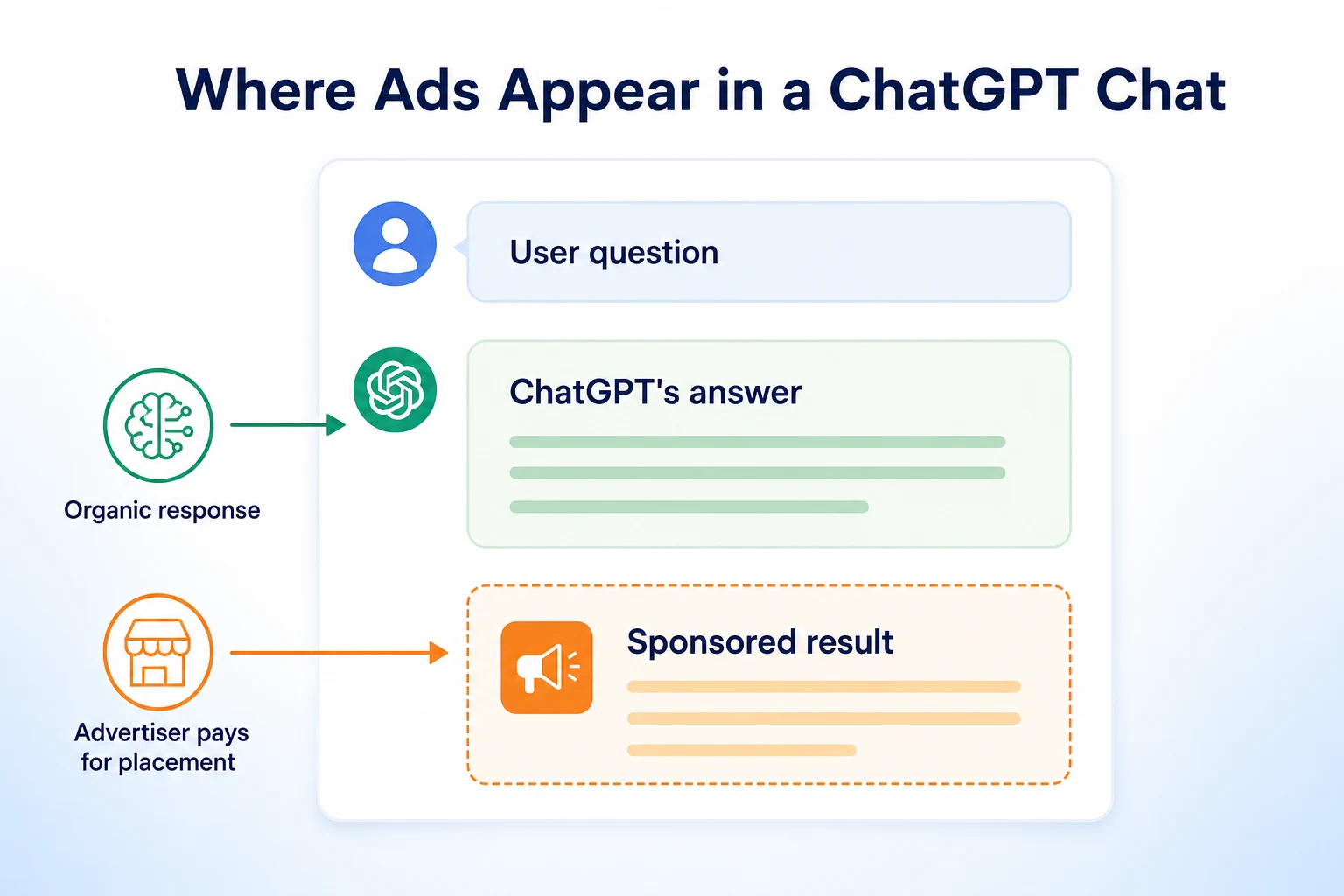
What a sponsored result looks like
OpenAI designed the format as a sponsored result that appears as its own distinct, labeled unit inside a conversation, separate from the answer ChatGPT generates itself. The idea is that a user can tell the difference between what ChatGPT wrote on its own and what a business paid to have shown. That distinction is similar in spirit to how a labeled ad sits apart from an organic listing on a traditional search results page, even though the surface, a conversational answer rather than a list of links, is different. Our look at Meta AI ads covers a comparable example of a platform building a labeled ad product directly alongside AI-generated content, which is a useful reference point for how these formats tend to be built.
What can trigger an ad to appear
A sponsored result is tied to certain queries, meaning it doesn't show up in every conversation regardless of topic. OpenAI hasn't published a full, detailed breakdown of exactly which queries can trigger a sponsored result or how that decision gets made for a given conversation. What's clear from the format's design is that it's meant to be relevant to what a user is actually asking about, rather than appearing at random, but the precise triggering logic isn't something OpenAI has laid out in full public detail.
How to Get Access: Current Options for Businesses
This is usually the first practical question a small business owner has once they hear ChatGPT Ads has reached their country, and it's the one with the least public detail attached so far.
Self-serve vs invitation-based access
OpenAI hasn't published a single, universal description of whether access in the newly added countries is self-serve, meaning any business can sign up and start building a campaign, or invitation-based, meaning OpenAI selects which businesses get in first. Rollouts of this kind often start narrower than the headline suggests, the same way the original US test wasn't open to every advertiser from day one. A business in one of the 26 countries shouldn't assume a sign-up form is necessarily waiting for them simply because their country was named in the announcement.
What to check in your own account
The only reliable way to know what's actually available is to check directly, through OpenAI's own advertising or business documentation and through any account settings tied to a business's OpenAI account, rather than relying on general news coverage of the expansion. If a specific country isn't showing an option yet, that's consistent with a staged rollout rather than a sign that something is broken. The practical move is to keep checking periodically and to treat the absence of an option today as expected, not unusual, given how similar rollouts have played out on other platforms.
Privacy: What OpenAI Documents About Ad Data
Any new ad format raises the same question for a business owner weighing whether to get involved: what information does the platform actually use to decide who sees what.
What can inform targeting
OpenAI hasn't published a full, itemized list of every signal that can inform which sponsored result appears in a given conversation. What's clear from how the format is described is that relevance to the conversation itself plays a role, since a sponsored result is tied to certain queries rather than shown at random. Beyond that, a business considering ChatGPT Ads should look directly at OpenAI's own privacy and advertising documentation for the specifics, rather than assume targeting works the same way it does on a platform OpenAI hasn't built. Guessing at signals OpenAI hasn't confirmed isn't a reliable basis for a marketing decision, and it isn't something this article is going to do.
Controls available to users
Users interacting with ChatGPT are a different audience than businesses buying placements, but the controls available to them still matter to a business thinking about how its ad will be received. OpenAI has described the sponsored result as a labeled, distinct unit precisely so a user can recognize it as paid content rather than mistake it for ChatGPT's own answer. Beyond that labeling, any specific setting a user has to limit or manage ads should be checked in OpenAI's own account and privacy documentation, since that's the only place such controls would be authoritative and current.
Paid Placement vs Organic AI Visibility: The Key Difference
This is the distinction that matters most for a small business deciding where to put its attention, and it's easy to blur the two together once ChatGPT Ads starts showing up in headlines.
How a paid placement gets bought
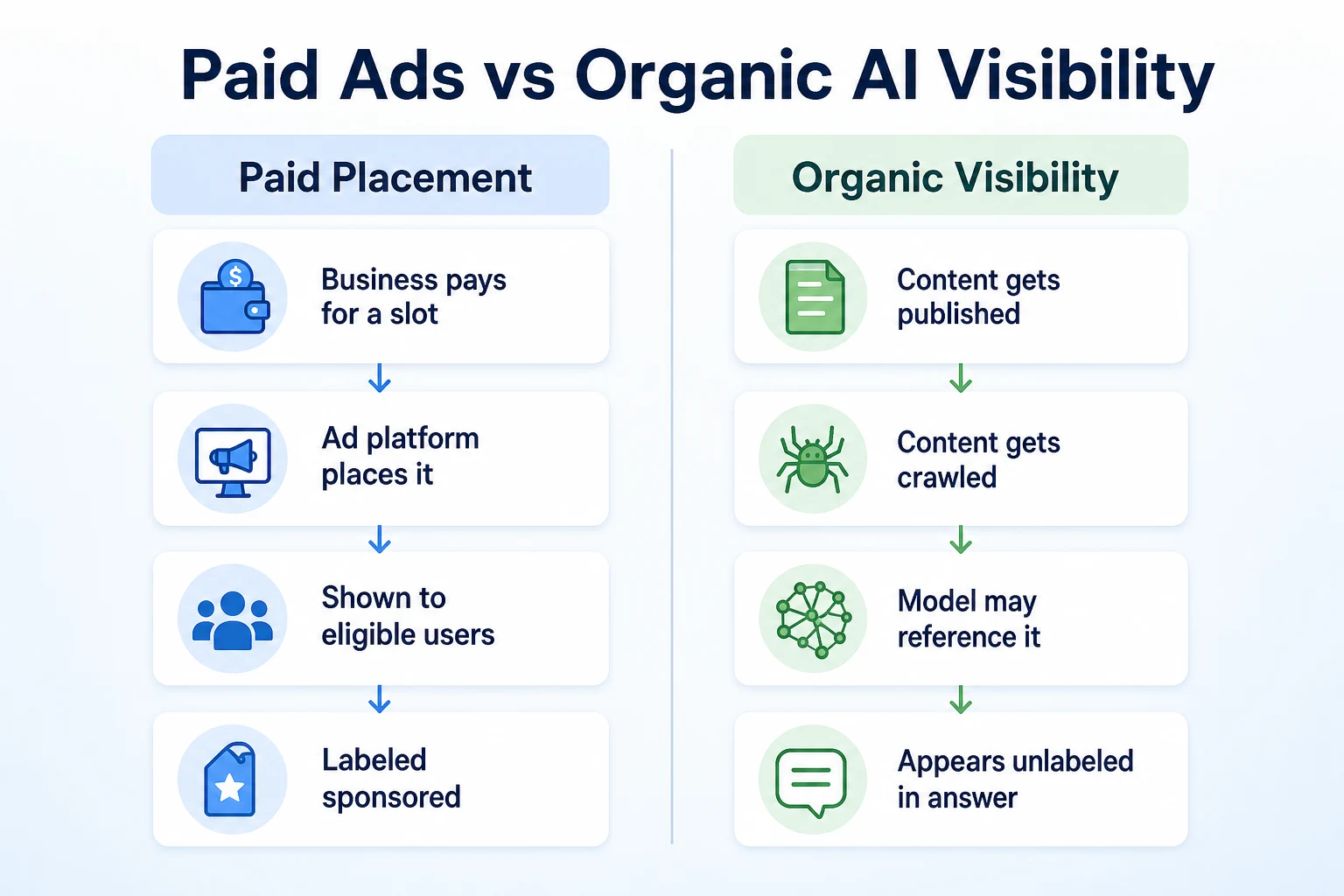
A paid placement is a transaction. A business sets up an account where OpenAI allows it, agrees to terms for a sponsored result, and that result then has a chance of appearing as a labeled block next to relevant conversations. It's a bought slot, not a judgment about the business. Buying a placement doesn't require ChatGPT to think the business is a good answer to a question. It requires the business to have access to the ad format and to meet whatever OpenAI's advertising terms require.
How organic mentions get decided
An organic mention works differently, and OpenAI hasn't published a detailed formula for how it decides what to reference in a generated answer. What's reasonable to say is that it depends on the information the model has access to and judges relevant to the question asked, not on a payment. Our guide to how AI assistants decide which businesses to recommend goes into this in more depth, and our guide to getting mentioned in ChatGPT covers what a business can reasonably do to make itself easier for a model to find and describe accurately. Neither of those outcomes can be bought the way a sponsored result can.
Aspect | Paid Ads | Organic Visibility |
|---|---|---|
How it's obtained | Bought through an ad account, where access exists | Not purchasable; depends on what the model references on its own |
How it appears | Labeled as sponsored, shown as a distinct block | Woven into the generated answer, unlabeled |
Who controls it | The business, within OpenAI's ad terms | The model's own process, not the business directly |
Availability | Limited to markets and accounts with access | Not tied to a country list or ad eligibility |
Guaranteed outcome | A chance of appearing as a sponsored result, not a guaranteed result | No guarantee of a mention at all |
What This Means for Small Businesses Right Now
None of this means a small business needs to pick a side between ads and organic visibility. It's worth being clear-eyed about what each one plausibly offers, and what neither can promise.
Plausible opportunities
A business in one of the 26 newly added countries might, once access arrives, have a new paid channel worth testing alongside whatever it already runs on search engines and social platforms. For a business that already buys search ads, this could be another place to put a modest test budget once eligibility is confirmed in its own account. Our comparison of Google Search Ads and SEO covers a similar tradeoff between paid and unpaid visibility that applies here too: paid placements can work alongside organic efforts, but they don't replace the need for a site and content that stand on their own.
What nobody can promise yet
OpenAI hasn't published performance figures for sponsored results, hasn't said how many users in the newly added countries will actually see ads, and hasn't said what a typical cost or result looks like for a business that gets access. Any specific number circulating about ChatGPT Ads performance isn't something OpenAI has confirmed. The honest position is that this is a new, still-developing ad format in most of these markets, and a small business testing it should treat early results as exactly that, early, rather than as evidence of what the format will reliably do over time.
A Worked Example: Weighing Ads Against Organic Visibility
Imagine a small travel agency based in one of the 26 newly added countries, booking local tours and day trips for visitors. This example is illustrative.
The owner reads about the ChatGPT Ads expansion and checks her account the same day, finding no ad option available yet. Rather than waiting on that, she spends the week on two things she can control regardless of ad access. First, she reviews her website to make sure her tour descriptions, pricing and booking details are written clearly enough that a model summarizing her business would have accurate information to draw from. Second, she sets up a simple way to track where her website inquiries come from, so that if ChatGPT Ads does become available to her later, she'll already have a baseline to compare it against.
Neither action depends on OpenAI's rollout schedule. The clearer website content is useful whether or not a model ever references it directly, and the tracking setup means that whenever a paid option does arrive, she's not testing it blind.
A 30-Day Plan to Prepare Either Way
A short, structured month of preparation makes more sense than waiting on a country list or refreshing an ad account that isn't ready yet. This plan works whether ChatGPT Ads reaches a given business this month, next year, or not at all.
Week | Action | What to check |
|---|---|---|
Week 1: Review | Check your OpenAI business account for any ad option, and review your website's core pages for accuracy and clarity | Whether an ad option has appeared, and whether your service descriptions, pricing and contact details are current |
Week 2: Track | Set up a simple way to track where website inquiries and visits come from, including any that mention ChatGPT | That you have a baseline before any paid or organic AI visibility changes land |
Week 3: Strengthen | Fix unclear or outdated content on pages most likely to be referenced in an answer, like service pages and FAQs | Whether a model summarizing your business would have accurate information to draw from |
Week 4: Reassess | Check your ad account access again, and review whether organic AI mentions or referral traffic have changed at all | Real activity in your own analytics, not assumptions based on the announcement alone |
Our guide to tracking ChatGPT traffic covers how to set up that kind of measurement in more detail, which is useful groundwork regardless of whether ChatGPT Ads ever reaches a given account.
Common Mistakes to Avoid With ChatGPT Ads
A handful of reactions to this expansion show up often enough that they're worth naming directly.
Mistake | What it leads to | Fix |
|---|---|---|
Assuming your country being named means access is live | Time spent hunting for a sign-up option that hasn't reached your account yet | Check your own account directly, and treat a missing option as expected during a staged rollout |
Confusing a sponsored result with an organic mention | Assuming a paid placement will shape how ChatGPT describes your business in unpaid answers | Treat ads and organic visibility as separate efforts that don't buy each other |
Waiting on ads instead of fixing the website behind them | A campaign, if access arrives, pointing to pages that are outdated or unclear | Use the time before access arrives to get the website itself in order |
Expecting published performance figures that don't exist yet | Budgeting or planning around numbers nobody has confirmed | Treat early results, your own or anyone else's, as early, not as a reliable benchmark |
The pattern underneath most of these mistakes is familiar from other platform announcements: treating a confirmed expansion as though it also confirms access, targeting detail, or an outcome. OpenAI confirmed the format now reaches more countries. It hasn't confirmed what that means for any specific business.
Where RepGet fits
RepGet doesn't run or manage ChatGPT Ads, and it doesn't have any special access to OpenAI's advertising accounts or rollout schedule. Nothing about this expansion happens through RepGet, and that isn't going to change.
What RepGet does help with is the website that sits behind both paths, the one a paid ad would link to and the one a model draws from when it answers a question without being paid to. Clear, accurate pages matter either way, and RepGet's content planning and article writing can help build or update that content, with articles staying as drafts for a business to review before anything goes live.
Before deciding where to put time this month, it's worth knowing what the site already needs fixing. RepGet's free website audit crawls a site and gives it a 0 to 100 SEO score, flagging technical and content issues worth addressing regardless of whether traffic eventually comes from a sponsored result, an organic AI answer, or a regular search listing. No account or credit card required. Its free SEO tools cover things like page titles, meta descriptions and how readable a page is to a crawler, which matter whether a visitor arrives through a paid ad or finds the business another way.
RepGet doesn't guarantee ad access, ad performance, or a mention in a ChatGPT answer. What it can do is make sure the site behind either outcome is actually ready.
The bottom line
OpenAI confirmed a real, dated expansion on October 21, 2026: ChatGPT Ads now reaches 26 additional countries on top of its earlier US test. That's a genuine step toward a wider advertising product, and it's worth watching if a business operates in one of those markets.
What hasn't been confirmed is just as important. OpenAI hasn't published a full list of eligibility rules, a clear self-serve process for every new market, detailed targeting signals, or any performance figures for sponsored results. A paid placement is a bought, labeled slot. An organic mention is a separate thing a business can't buy, and the two shouldn't be confused. The sensible response isn't to wait on ad access or assume it will reshape marketing on its own. It's to keep the website accurate and ready, track what's already happening, and treat ChatGPT Ads as one more channel to test once access actually arrives, not a plan to build a strategy around today.
Find out what your website needs first
Run a free website audit with RepGet to see what your own site needs before building a plan around a new, still-developing ad format. No account or credit card required.
FAQ
What is ChatGPT Ads?
It's a sponsored result format OpenAI has been testing inside ChatGPT conversations. It appears as a distinct, labeled block separate from ChatGPT's own generated answer, not blended into the response itself.
Which countries have ChatGPT Ads in 2026?
On October 21, 2026, OpenAI expanded the format to 26 additional countries beyond its earlier US test. The exact, current list is best checked directly in OpenAI's own documentation, since it can be updated.
Can small businesses advertise on ChatGPT?
OpenAI hasn't published a universal, self-serve process for every newly added country. Whether a specific account can access ads depends on checking that account directly, since availability can vary by market.
How do I get access to ChatGPT Ads?
OpenAI hasn't published a public sign-up method or confirmed whether access is self-serve or invitation-based in the newly added countries. The only reliable way to check is through your own OpenAI business account.
Does ChatGPT Ads affect organic AI recommendations?
No. A paid placement is a bought, labeled slot, while an organic mention depends on what the model references on its own. OpenAI hasn't described paid ads as influencing unpaid, generated answers.
Is ChatGPT Ads the same as Google Ads?
No. They're separate products from different companies. ChatGPT Ads show as a labeled sponsored block inside a chat conversation, while Google Ads appear within Google's own search results pages.
What data does OpenAI use for ChatGPT Ads targeting?
OpenAI hasn't published a full, itemized list of targeting signals. What's clear is that a sponsored result is tied to relevant queries, and further detail should come from OpenAI's own advertising documentation.
How much does ChatGPT advertising cost?
OpenAI hasn't published pricing or performance figures for ChatGPT Ads. Any specific cost or result circulating outside OpenAI's own documentation isn't something the company has confirmed.