

Social Media SEO: How to Get Found on Instagram, TikTok and LinkedIn

Short answer
Social media SEO means optimizing profiles, captions, hashtags and video text so Instagram, TikTok and LinkedIn's search systems, along with Google and AI assistants reading public posts, can match your content to what people search for. It depends on keyword-rich bios, consistent captions, and real engagement, not just one well-tagged post.
A pottery studio owner posts a new class announcement on Instagram every week.
She writes a friendly caption, picks a few hashtags, and hits publish.
But when she types the exact words a student would search, "beginner pottery wheel classes near me," her own post never turns up. Not in Instagram's search bar, not in TikTok's, and not on Google either.
Her content exists. It's just invisible to the search boxes people actually use to find it.
That's the real problem behind social media seo: platforms like Instagram, TikTok and LinkedIn now have their own search tools, separate from the feed algorithm, and most small businesses write for the feed without ever writing for the search box. Here's how each platform's search actually works, what still matters in a caption or bio, and how to fix a profile so it shows up when someone types a real question.
What Social Media SEO Actually Means in 2027
Social media SEO means writing a profile, caption, bio and video description so a platform's own search tool can match it to what someone types in. That's a different job from writing for the algorithm that decides what shows up in a feed nobody searched for.
Platform search vs. the algorithm feed
A feed algorithm decides what to show someone who didn't ask for anything specific, based on what they've watched, liked or followed before. A search tool is different. Someone opens Instagram, TikTok or LinkedIn, types a phrase into the search bar, and expects the platform to match that phrase to actual posts and profiles. Social media SEO is about winning that second moment, not the first. A post can do well in the feed and still be unfindable in search, and the reverse is also true.
Why people are searching social platforms directly
More people now start a search for a local business, a product recommendation or a how-to directly inside a social app instead of opening Google first. Nobody can measure exactly how much of this happens for any one business, and it varies a lot by industry and age group. What's not in dispute is that each platform has built out its own search function specifically because people use it. Instagram, TikTok and LinkedIn all document search as a core part of how people find content on their platforms, not a secondary feature. If your profile and captions are written only with the feed in mind, you're competing for one kind of visibility and ignoring another.
How Instagram Search Actually Works
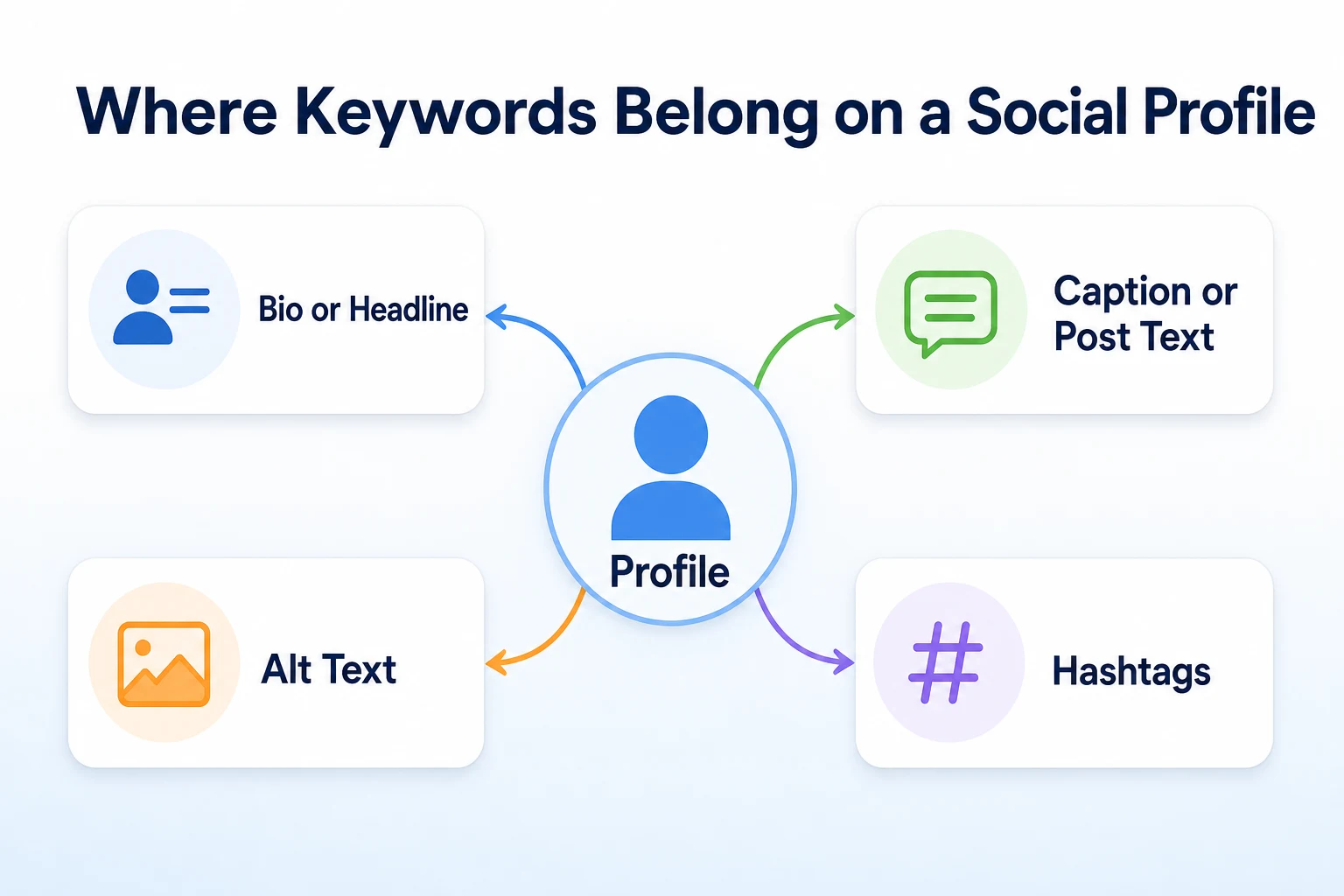
Instagram's own help documentation describes its search tool as reading more than hashtags. It looks at words in a profile's name and bio, text in a caption, and alt text added to a photo or video, to match a search query to relevant accounts and posts.
What Instagram's search tool reads
When someone searches Instagram, the platform is trying to match their words to accounts, captions and alt text that contain similar language, not just posts tagged with a matching hashtag. That means a business whose bio says only "creating beautiful things since 2015" gives the search tool almost nothing to match against, while a bio that says "handmade pottery classes and custom ceramics in Portland" gives it real words to work with.
Writing a bio and caption with real keywords
The fix is straightforward, even if it feels unnatural at first. Write the bio the way a customer would search, not the way a brand would describe itself in an ad. Use the same approach in captions: describe what the post is actually about in plain words near the start, before the hashtags, rather than relying on tags alone to carry the meaning. A caption that opens with "Beginner pottery wheel class starting this month in Portland" gives Instagram's search tool far more to match than one that opens with an emoji and a single vague sentence.
Why alt text is worth filling in
Alt text was built for accessibility, so screen readers can describe an image to someone who can't see it. Instagram also reads that text as part of its search index, which makes it a second, quieter place to add real keywords beyond the caption. Most businesses skip it entirely, which means filling it in is a low-effort way to stand out from accounts that don't bother.
How TikTok Search Actually Works
TikTok's own creator guidance frames search as a discovery path that sits alongside the For You feed, not a replacement for it. That guidance points to three places search can read: the caption, any on-screen text added to the video, and the words actually spoken in the video itself.
Captions and spoken keywords in the video itself
TikTok's documentation describes spoken words in a video as something its systems can process, which means saying the actual service or product name out loud in the first few seconds of a video carries more weight than most businesses assume. A pottery studio that opens a video with "here's how a beginner pottery wheel class actually works" is giving TikTok's search tool a much clearer signal than a video that jumps straight into visuals with no spoken context at all.
On-screen text and video descriptions
Text overlaid on the video, the kind added as a caption bar or a title card, is also part of what TikTok's search can read. Pairing that on-screen text with the caption underneath the video, using similar language in both rather than treating them as two unrelated spaces, reinforces the same keyword instead of splitting attention across different phrasing.
Why TikTok videos can surface in Google search too
TikTok videos are public web pages at their core, and Google's documentation on indexing doesn't exclude video platforms from being crawled and shown in regular search results. A TikTok video with a clear, keyword-rich caption and description has a better chance of being read correctly if it does get indexed, though nothing about posting on TikTok guarantees a Google search result, and whether any individual video appears there isn't something TikTok or Google promises.
How LinkedIn Search Actually Works
LinkedIn's help center guidance on search describes profile fields like the headline, the about section and a company page's description as the places its search tool draws from first, ahead of hashtags or post text alone.
Profile and company page keywords
A headline that says only "Owner" tells LinkedIn's search tool almost nothing. A headline that says "Pottery Studio Owner | Beginner and Advanced Wheel Classes in Portland" gives it real words to match against someone searching for exactly that. The same applies to a company page's about section, which is worth writing with actual service terms rather than only a mission statement.
Why post text outweighs hashtags on LinkedIn
LinkedIn treats hashtags as a much smaller part of how a post gets found compared to Instagram or TikTok. The words in the post itself carry more weight, which means a LinkedIn post written as a few vague lines followed by five hashtags is weaker than one that spells out what the post is actually about in full sentences, with hashtags added only as a light finishing touch. Our breakdown of LinkedIn post analytics 2026 covers how saves, sends and reach are measured on the platform, which is worth reading alongside this if you're trying to judge whether a post is actually working, not just whether it was found.
Finding the Right Keywords for Captions and Bios
Knowing that Instagram, TikTok and LinkedIn all read real words doesn't help much if you're guessing at which words to use. The good news is you likely already have this research done somewhere, even if it's sitting in a different folder than your social media plan.
Where to find the words customers actually use
If you've done any keyword research for your website, start there. The same phrases a customer types into Google are usually close to what they'd type into Instagram or TikTok's search bar, since it's the same person with the same question, just a different app open. Our guide to keyword tools covers free ways to find those phrases if you haven't done this yet. Beyond that, each platform's own search bar is a free research tool in itself. Type the start of a phrase, like "beginner pottery," and watch what autocomplete suggests before you finish typing. That list is built from what real people search, and it's often more current than any keyword tool built for Google alone.
Turning a keyword into a caption that still reads naturally
A keyword dropped into a sentence without care reads like a keyword dropped into a sentence. "Beginner pottery wheel classes Portland" sitting alone at the top of a caption looks like it was written for a search tool, not a person, because it was. The better approach is writing the sentence a person would actually say, then checking whether the keyword survived inside it. "If you've never touched a pottery wheel before, this beginner class in Portland walks you through the basics" says the same thing, reads like a real sentence, and still carries the exact phrase someone would search.
Keyword type | Best placement | Illustrative example |
|---|---|---|
Service or product name | Bio or headline | "Beginner pottery wheel classes" in an Instagram bio |
Location | Bio, caption or company page | "In Portland" added after the service name |
Specific question or problem | Caption or video spoken text | "If you've never used a pottery wheel before" spoken in a TikTok video |
Broad category | Hashtag | #potterystudio added at the end of a caption |
Descriptive detail | Alt text | "Hands shaping wet clay on a spinning pottery wheel" on a photo |
These figures are illustrative.
Hashtags, Alt Text and Video Text: What Still Matters
Hashtags used to carry most of the weight in how a post got found. That's no longer true on any of the three platforms covered here, and treating hashtags as the whole strategy is one of the most common gaps in a small business's social media SEO.
What hashtags actually do now
A hashtag still helps group a post into a broader category someone might browse or follow. It's a weaker signal than it once was for matching a specific search phrase, because the platforms now read the actual words in a caption, bio and alt text first. A handful of specific, relevant hashtags still adds value. A caption padded with twenty broad, generic tags adds little beyond clutter, and on some platforms it can read as an attempt to game the system rather than describe the post. Our guide to the AI hashtag generator covers whether tools built to spit out tags automatically are actually worth using, given how much less hashtags carry on their own now.
Writing alt text that search can use
Alt text works best as a plain, specific description of what's actually in the image or video, not a second place to stuff in every keyword you can think of. One or two natural phrases describing the scene are enough. A photo of a finished ceramic bowl is better served by alt text that says
A photo of a finished ceramic bowl is better served by alt text that says "a glazed blue bowl cooling on a wooden shelf" than one stuffed with every term the business hopes to rank for. The first describes the image. The second describes an attempt to be found, and a platform's search tool, along with any person who turns on a screen reader, can usually tell the difference.
Engagement Signals and Why They Affect Discovery
Writing the right words in a bio or caption gets a post in front of a platform's search tool. What happens after that, whether people actually engage with it, is a separate signal that affects whether it keeps showing up.
What counts as a strong signal on each platform
Each platform documents slightly different behavior as meaningful. Instagram's own guidance points to saves and shares as stronger signals than a like, since saving a post suggests someone found it useful enough to return to later. TikTok's creator documentation points to watch time and completion rate, how much of a video someone actually watches before scrolling away, as a central part of how a video is evaluated. LinkedIn's help documentation points to comments and reposts, particularly a repost with added commentary, as carrying more weight than a reaction alone. None of these are secret formulas, and none of them are published as a precise scoring system. They're documented as the kinds of behavior each platform pays attention to, which is different from a guarantee that any one post will be shown to more people because of them.
Posting consistency vs. one viral post
A single post that performs unusually well doesn't change whether a business shows up in search a month later. Consistency does more for discoverability than a one-off spike, mainly because a search tool needs a body of content to match against in the first place. A profile with three posts from eighteen months ago gives Instagram, TikTok or LinkedIn very little recent material to surface, even if one of those three posts did well at the time. A profile that posts regularly, each time with real words in the caption and alt text, builds a larger, more current library for the platform's search tool to draw from. That's a more reliable path to being found than waiting for one post to take off.
How Social Posts Show Up in Google and AI Search
Social media SEO isn't only about each platform's own search bar. Public posts and profiles are also web pages, and that opens a second and third door: regular Google search, and the crawlers behind AI assistants.
When a social post can appear in Google search
Google's Search Central documentation on indexing doesn't carve out an exception for social platforms. A public Instagram profile, a public LinkedIn post or a public TikTok video is a web page like any other, and it can be crawled and indexed the same way. Whether a specific post actually appears in a Google search result depends on the same general factors Google documents for any page: whether it's accessible to crawl, whether it has clear, relevant text, and how it compares to everything else Google has indexed on that topic. Nothing about posting on a social platform guarantees a Google result, and a post with no real words in it, just an image and a string of hashtags, gives Google very little to work with even if it is indexed.
What AI assistants are documented to read
Several AI assistants read public web content through named, documented crawlers, and a public social post is one of the things those crawlers can encounter if it's accessible. Our guide on how AI assistants decide which businesses to recommend covers what's actually documented about this process in more detail, including the kinds of signals that seem to matter beyond any single post. Whether a specific social post ends up informing an AI assistant's answer isn't something any of these companies document in a way that lets a business check it directly after the fact.
What nobody can guarantee
No platform, and no tool, can promise that a well-written caption will rank in Google or get cited in an AI assistant's answer. What's documented is narrower and more useful: accessible, keyword-rich, genuinely descriptive text gives a post a better chance of being read correctly wherever it's crawled, compared to a post with none of that. Our guide on how to get mentioned in ChatGPT covers the same honest limits for a business's own website, and the same caution applies here.
A Worked Example: One Announcement, Three Platforms
This example is illustrative, not a record of a real business's posts.
Imagine the pottery studio owner takes the same announcement, a new beginner wheel class starting next month, and writes it three separate times instead of copying one caption across every app unchanged.
Platform | Caption or on-screen text | Keywords worked in |
|---|---|---|
"New beginner pottery wheel classes start next month in Portland. No experience needed, we walk you through every step." | Beginner pottery wheel classes, Portland, no experience needed | |
TikTok | Spoken in the first few seconds: "If you've never touched a pottery wheel before, this is the class for you." On-screen text: "Beginner pottery classes, Portland, starting next month." | Beginner pottery wheel, Portland, starting next month |
"We're opening a new round of beginner pottery wheel classes in Portland next month, aimed at people who've never worked with clay before and want a low-pressure way to start." | Beginner pottery wheel classes, Portland, people who've never worked with clay |
These figures are illustrative.
The core phrase, beginner pottery wheel classes in Portland, survives in all three. What changes is the shape around it: shorter and more direct on Instagram, spoken aloud early on TikTok, and written as a full sentence with more context on LinkedIn. None of the three versions reads like it was copied and pasted from the other two, and each one gives that platform's search tool the same keyword in the format it reads best.
A 30-Day Social Media SEO Checklist
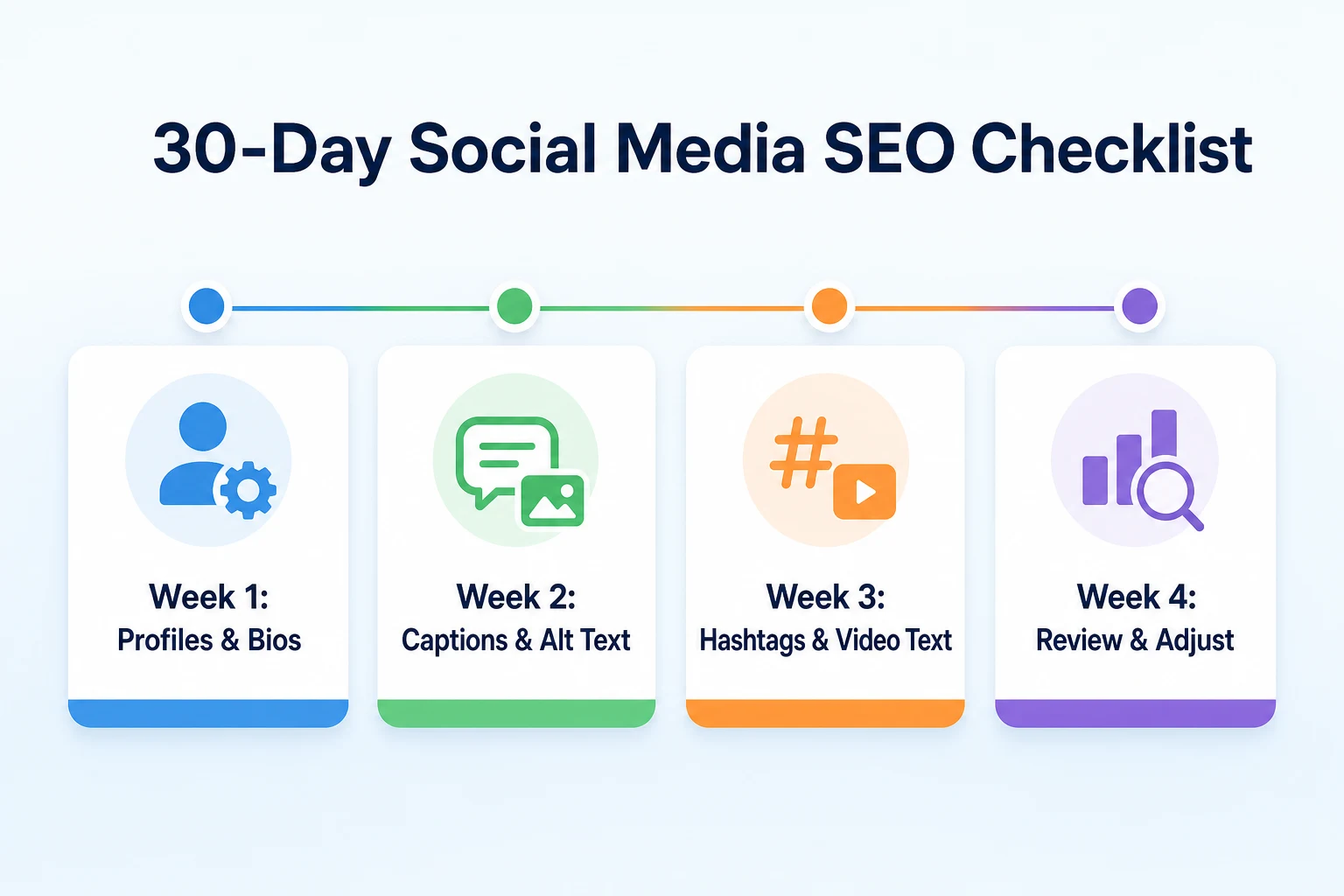
Fixing every profile, caption and video description at once isn't realistic for most small businesses. Spreading the work over a month keeps it manageable and gives each layer time to actually take effect before moving to the next.
Week 1: Profiles and bios
Start with the parts search tools read first. Rewrite the Instagram bio, the TikTok bio and the LinkedIn headline and about section using the actual words a customer would search, not a tagline. If there's a company page involved, update its description too. This is the smallest piece of work in the whole plan and usually the one with the most immediate effect, since a bio is read every time someone visits the profile from a search result.
Week 2: Captions and alt text
Go back through the last ten or so posts on each platform and check whether the caption describes what the post is actually about in plain words, near the start, before any hashtags. Add alt text to any image posts that are missing it. New posts going out this week should follow the same pattern from day one, rather than waiting until the backlog is fixed.
Week 3: Hashtags and video text
Trim any caption still carrying twenty broad hashtags down to a handful of specific, relevant ones. For video content, start adding on-screen text that matches the spoken words in the first few seconds, and say the actual service or product name out loud early in the video instead of only showing it visually.
Week 4: Review what's working
Search each platform yourself using the phrases a customer would type, and check whether your own posts and profile turn up. Note what still doesn't appear and treat that as the starting point for the next month, rather than a sign the whole approach failed. Our SEO content calendar guide covers a similar month-by-month approach for blog content, and the same habit, planning ahead instead of posting reactively, carries over well to social captions too.
Common Mistakes with Social Media SEO
Most of the work above falls apart for the same handful of reasons, not because the platforms are unpredictable.
Mistake | Why it backfires | Better move |
|---|---|---|
Copying one caption across every platform unchanged | Each platform's search tool reads text differently, so a caption built for Instagram often wastes the spoken-word and on-screen-text opportunity TikTok offers | Keep the core keyword the same, but reshape the sentence around it for each platform, as shown in the worked example above |
Treating hashtags as the whole strategy | Hashtags carry less weight than bio text, captions and alt text on all three platforms covered here | Write the caption or bio first with real words, then add a small number of specific hashtags as a finishing touch |
Leaving a bio vague to sound more polished | A bio that reads well but says nothing specific gives a search tool almost no words to match against a real query | Name the actual service, product or location in plain words, even if it reads less like a tagline |
Skipping alt text because it's invisible to most viewers | Alt text is part of what Instagram's search index reads, so skipping it quietly removes a second place keywords could live | Add one or two plain, specific phrases describing the image, not a list of unrelated keywords |
Posting in bursts, then going quiet for months | A thin, outdated library of posts gives a platform's search tool little recent, relevant content to surface | Post on a steady schedule, even a modest one, rather than clustering effort around a single campaign |
Assuming a viral post fixes discoverability going forward | One high-performing post doesn't change whether new searches find the profile weeks later | Treat consistent, keyword-written posting as the actual strategy, with any viral moment as a bonus, not the plan itself |
Where RepGet fits
RepGet doesn't post to Instagram, TikTok or LinkedIn, and it doesn't manage a social media calendar on your behalf. The work covered in this guide, rewriting a bio, reshaping a caption for each platform, adding alt text, still sits with whoever runs those accounts.
Where RepGet can help is with the keyword research behind that work. RepGet brings website auditing, keyword research, content planning, article writing, publishing to your own site, and search performance reporting from Google Search Console into one workflow, and the same customer language it surfaces for a blog post or a service page is usually the same language worth putting in a social bio or caption. If you're already using RepGet to find what customers search for on your website, there's no need to research it twice for social media.
It's also worth checking the website those social profiles link back to, since a social post that gets someone curious usually ends with a click through to a bio link. RepGet's free website audit crawls that site and gives it a 0 to 100 SEO score, with the technical and content issues worth fixing listed out. No account or credit card required. RepGet's free SEO tools cover related checks worth running on the destination page itself, from how its title reads in a search result to whether its meta description gives someone a reason to click. RepGet doesn't guarantee a mention in any platform's search results, in Google, or in an AI assistant's answer, and nothing here replaces checking each platform's own search bar yourself.
The bottom line
Social media SEO isn't a separate discipline from the rest of your marketing. It's the same habit of writing in real words, the ones a customer would actually type, applied to a bio, a caption and a video's spoken text instead of only a web page.
Instagram, TikTok and LinkedIn each read those words differently, and chasing the feed algorithm without ever writing for the search box leaves real visibility on the table. The fix isn't complicated. It's a bio rewritten in plain terms, a caption that says what the post is about before the hashtags start, alt text that actually describes the image, and a video that says the service name out loud instead of only showing it. None of that guarantees a result in any platform's search, in Google, or in an AI assistant's answer, but it gives each of them something real to work with, which a vague caption never does.
Find out what your website needs first
Run a free website audit with RepGet to check whether the site your social profiles link back to is actually ready for the traffic they send. No account or credit card required.
FAQ
Does using hashtags still help you get found on Instagram?
A little. Hashtags still group a post into a broader category, but Instagram's search tool reads bio text, captions and alt text first, so a handful of specific tags matters more than a long, generic list.
Can TikTok videos show up in Google search results?
Yes, since a public TikTok video is a web page Google can crawl like any other. Whether a specific video is actually shown depends on its text and accessibility, and nothing guarantees a result.
What should I put in my LinkedIn headline for better search visibility?
Name the actual role and service you offer, with a location if it's relevant, rather than a vague title. LinkedIn's search reads the headline and about section before hashtags or post text.
Does social media activity affect my Google rankings?
Social posts aren't documented as a direct Google ranking factor. A public post can still be crawled and indexed as its own page, separate from how it affects your website's own search rankings.
How do AI assistants like ChatGPT use social media posts?
Some AI assistants read public web content through documented crawlers, and a public social post is one thing those crawlers can encounter if it's accessible, though no company documents exactly how any single post is used.
How often do I need to post for social media SEO to work?
There's no documented minimum. A steady, regular schedule gives a platform's search tool more recent content to match against than a burst of posts followed by months of silence.
Do I need different keywords for Instagram, TikTok and LinkedIn?
The core keyword can stay the same across platforms, but how you present it should change: shorter in an Instagram caption, spoken aloud early in a TikTok video, and written as a fuller sentence on LinkedIn.
Is adding alt text to Instagram photos actually worth the time?
Yes. Instagram's search tool reads alt text as part of what it matches against a query, and most accounts skip it entirely, which makes filling it in a quick way to stand out.
Comments
0 shownShare your thoughts about this article.
New to RepGet? Create a free account to join the conversation.
No comments yet. Be the first to leave one.