

Semrush Alternative for Small Businesses: RepGet vs Semrush
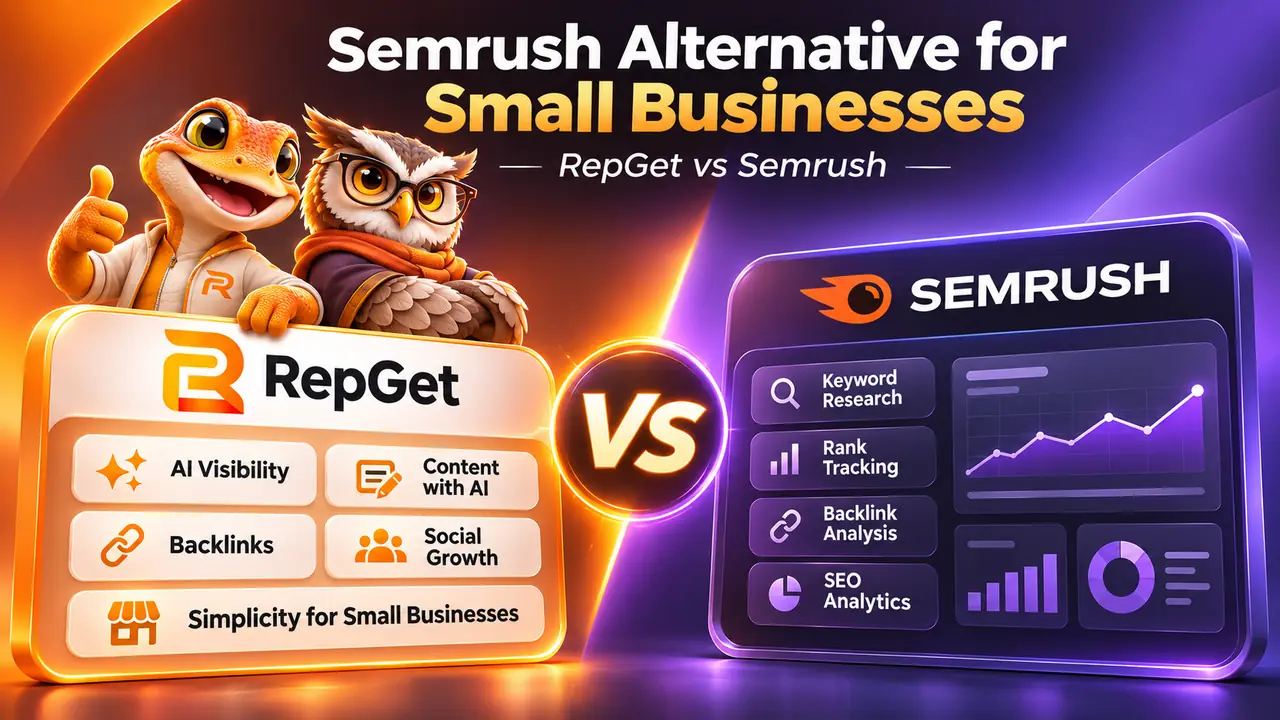
Short answer
Semrush is a large SEO and competitive intelligence platform with deep keyword, backlink and AI visibility data, but it stays a research tool you act on yourself. RepGet is a smaller, connected workflow: keyword research, AI content writing, publishing and AI search visibility tracking in one place, with less manual work. Neither can guarantee rankings, traffic or AI mentions.
A small business owner has a Semrush trial open in one tab and a spreadsheet of keyword ideas in another, and still hasn't published a single new page this month.
The keyword list keeps growing. The website doesn't.
She's not short on data. She's short on a way to turn that data into a page that actually goes live, without hiring someone else to do it.
That's the real question behind most searches for a semrush alternative for small businesses: not which platform has the bigger database, but which one actually gets the work done. Here's how RepGet and Semrush compare on pricing, keyword research, automation, backlinks and AI visibility, so you can see which one fits the way your business actually works.
The quick verdict: which one fits your business
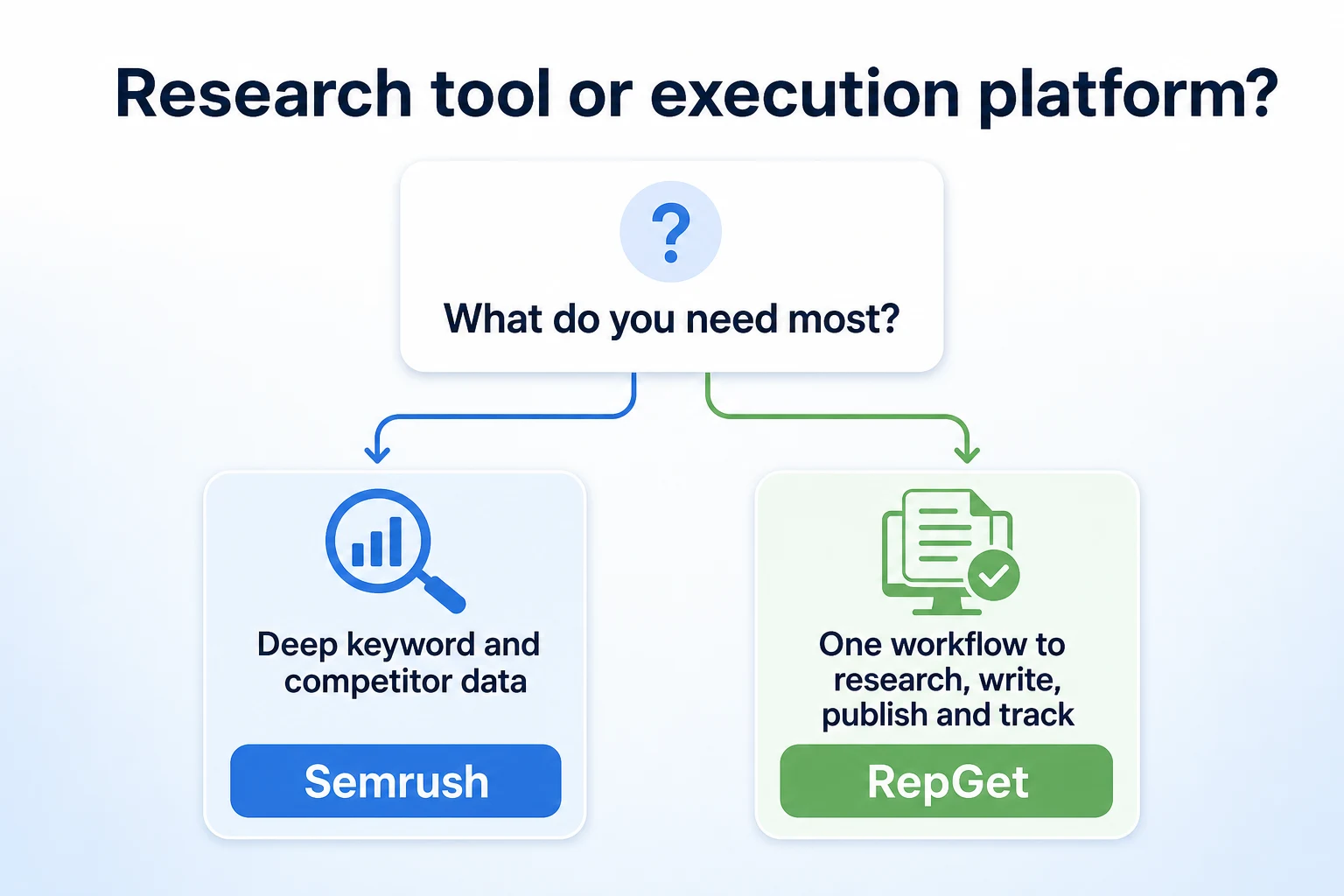
Semrush and RepGet solve different problems, even though both show up when you search for SEO software. Semrush is built as a research and competitive intelligence platform: a large keyword and backlink database, detailed competitor reports, and a growing set of AI visibility tools you use to understand your position. RepGet is built as a workflow: it researches keywords, writes content, publishes it, and tracks results from inside one connected system, with fewer separate tools to switch between.
Who tends to reach for Semrush
Semrush tends to fit a business, agency or marketer who already has someone dedicated to SEO, wants to dig into exactly what competitors rank for, and is comfortable taking that research and acting on it with their own writers, developers and publishing process. It's a strong choice when the bottleneck isn't knowing what to do, it's wanting more certainty about what to prioritize first.
Who tends to reach for RepGet
RepGet tends to fit a small business owner, founder or small team without a dedicated SEO specialist, who wants keyword research, content creation, publishing and reporting handled inside one workspace rather than stitched together from several tools. It's a better fit when the bottleneck is execution: good ideas that never turn into published pages. Either way, a free website audit is a reasonable first step before choosing a platform, since it shows what your own site needs fixed regardless of which tool you pick next.
How we compared RepGet and Semrush
This comparison looks at six things that actually matter for a small business deciding between the two: pricing and value, keyword research, SEO automation, backlink building, features and integrations, and AI search visibility.
Every claim about pricing, plan limits and features in this article comes from RepGet's and Semrush's own public pricing and feature pages, checked on November 18, 2026. Software pricing and plan limits change. Check each platform's current pricing page before deciding, since a number published here may no longer match what's live by the time you read it.
RepGet vs Semrush at a glance
Before the detailed breakdown below, here's a quick summary of how the two platforms differ on each of the six criteria.
Criteria | RepGet | Semrush |
|---|---|---|
Pricing and value | Three plans (Launch, Grow and Scale), each covering one website, with content, social and search-term limits built in. Exact dollar prices not confirmed in the sources we checked. | SEO plan from $117.33/mo billed annually ($139 monthly); Starter from $165.17/mo annually ($199 monthly); Pro+ from $248.17/mo annually ($299 monthly); Advanced is custom pricing. Extra user seats start at $45/mo. |
Keyword research | 300 to 1,500 search terms researched per month depending on plan, feeding directly into content planning rather than standing alone as a research tool. | A keyword database Semrush describes as 29 billion keywords, with dedicated keyword research and competitor analysis tools across its plans. |
SEO automation | Keyword research, AI-assisted content, CMS auto-publishing, SEO audits, metadata and schema, and an AI Growth Copilot all included on every plan. | Site Audit and Content solution tools help plan and optimize content; publishing and most follow-up actions are handled manually by you or your team. |
Backlink building | Access to a backlink partner network included on every plan. | A backlink database Semrush describes as 43 trillion backlinks, used mainly for analysis and competitor research rather than building links directly. |
Features and integrations | One connected workflow for research, writing, publishing and reporting, plus free standalone SEO tools. | A wider suite of separate solutions and add-ons, including MCP access on Starter plans and above. |
AI search visibility | AI search visibility tracking included on every plan. | AI Visibility tracking across all paid SEO plans, including prompt tracking, AI sentiment monitoring and AI visibility reports, with limits that scale by plan. |
Pricing and value: what each plan actually includes
Pricing is where the two platforms diverge most visibly, not just in the numbers but in how each plan is structured.
RepGet's plan structure
RepGet offers three paid plans: Launch, Grow and Scale. Each covers one website per subscription. The plans differ mainly in volume. Launch, Grow and Scale include 30, 60 and 100 branded SEO articles a month, 60, 90 and 240 social posts a month, and 300, 500 and 1,500 search terms researched a month. Every plan, regardless of tier, includes the AI Growth Copilot, CMS auto-publishing, SEO audits with metadata and schema, AI search visibility tracking, and access to a backlink partner network. Only the Scale plan adds featured placement on RepGet's own blog, priority promotion through RepGet's social channels and a priority email spotlight. The exact dollar price of each plan was not confirmed in the sources we checked, so check RepGet's current pricing page for the figures. RepGet's free trial runs for three days and gives you the full plan's features at its normal daily pace, plus 15 credits a day for social and content tasks, with nothing charged by card or PayPal during the trial.
Semrush's plan structure and add-ons
Semrush's entry-level SEO plan is aimed at freelancers and small businesses and costs $117.33 a month billed annually, or $139 billed monthly. It covers 5 websites to monitor, 500 keywords tracked daily, basic keyword research and competitor analysis, Position Tracking and Site Audit, and also includes tracking performance in AI search, monitoring AI sentiment, AI visibility reports for any domain and monitoring custom prompts. The Starter SEO + AI Search plan, aimed at small teams and agencies, costs $165.17 a month billed annually, or $199 billed monthly, and adds keyword research and optimization tools, competitor insight tools, MCP access, 50 AI prompts tracked daily for one domain, 300 AI visibility reports a day and an AI-ready Site Audit. The Pro+ SEO + AI Search plan, for growing teams and agencies scaling across multiple markets, costs $248.17 a month billed annually, or $299 billed monthly, and adds coverage for 15 websites, 1,500 keywords tracked daily, historical SEO data, content optimization, keyword cannibalization analysis and multi-location or device tracking, along with 100 AI prompts tracked daily. An Advanced plan covers 40 or more websites, 5,000 or more keywords tracked daily, SEO share of voice, advanced API data integration and unlimited AI prompt tracking, at custom pricing you get by talking to Semrush's sales team. Semrush also charges separately for add-ons, including additional user seats starting at $45 a month. The length of any free trial on Semrush's paid plans was not confirmed in the sources we checked.
Plan | Monthly price | Core limits |
|---|---|---|
RepGet Launch | Not confirmed in the sources we checked | 30 articles, 60 social posts, 300 search terms, 1 website |
RepGet Grow | Not confirmed in the sources we checked | 60 articles, 90 social posts, 500 search terms, 1 website |
RepGet Scale | Not confirmed in the sources we checked | 100 articles, 240 social posts, 1,500 search terms, 1 website, plus RepGet blog feature and priority promotion |
Semrush SEO | $117.33 (annual) / $139 (monthly) | 5 websites, 500 keywords tracked daily, basic keyword and competitor research, AI visibility tracking |
Semrush Starter SEO + AI Search | $165.17 (annual) / $199 (monthly) | Keyword research and optimization tools, MCP access, 50 AI prompts tracked daily for 1 domain |
Semrush Pro+ SEO + AI Search | $248.17 (annual) / $299 (monthly) | 15 websites, 1,500 keywords tracked daily, historical data, content optimization, 100 AI prompts tracked daily |
Semrush Advanced | Custom, talk to sales | 40+ websites, 5,000+ keywords tracked daily, unlimited AI prompt tracking |
Prices and plan limits may have changed since November 18, 2026. Check each platform's current pricing page before deciding.
Keyword research: depth of data vs speed to action
Keyword research is the one area where Semrush's scale is hard to match, and it's worth saying that plainly before getting into the detail.
Semrush's keyword research tools
Semrush's homepage describes its keyword database as 29 billion keywords, and that depth runs through its keyword research tools at every plan level. The entry-level SEO plan includes basic keyword research and competitor analysis. The Starter SEO + AI Search plan adds keyword research and optimization tools along with competitor insight tools, letting you dig further into search volume, difficulty, and what specific competitors already rank for. If your work involves comparing several competitors in detail, or researching a market you don't know well yet, that depth of data is genuinely useful. It's also a tool you still have to act on. Semrush surfaces the keyword, the volume, and who else ranks for it. Turning that into a page, written, optimized, and published, is a separate step you or your team still have to do.
RepGet's keyword research inside the workflow
RepGet's approach is smaller and more purpose-built. Its Launch, Grow and Scale plans allow researching 300, 500 and 1,500 search terms a month, depending on tier. That's a fraction of Semrush's database, and RepGet isn't trying to be a standalone keyword research tool you'd use the way you'd use a dedicated keyword planner. The search terms it researches feed directly into content planning: once a keyword is identified as worth targeting, it moves toward an article rather than sitting in a spreadsheet waiting for someone to write it. Our guides to keyword tools and finding low-competition keywords cover how to think about keyword research on its own, which is worth reading if you want a sense of what a dedicated research tool, Semrush or otherwise, actually adds beyond what RepGet researches for you automatically.
SEO automation: from research to published content
This is where the two platforms diverge most, and it's really the core of the semrush alternative for small businesses question.
What RepGet automates end to end
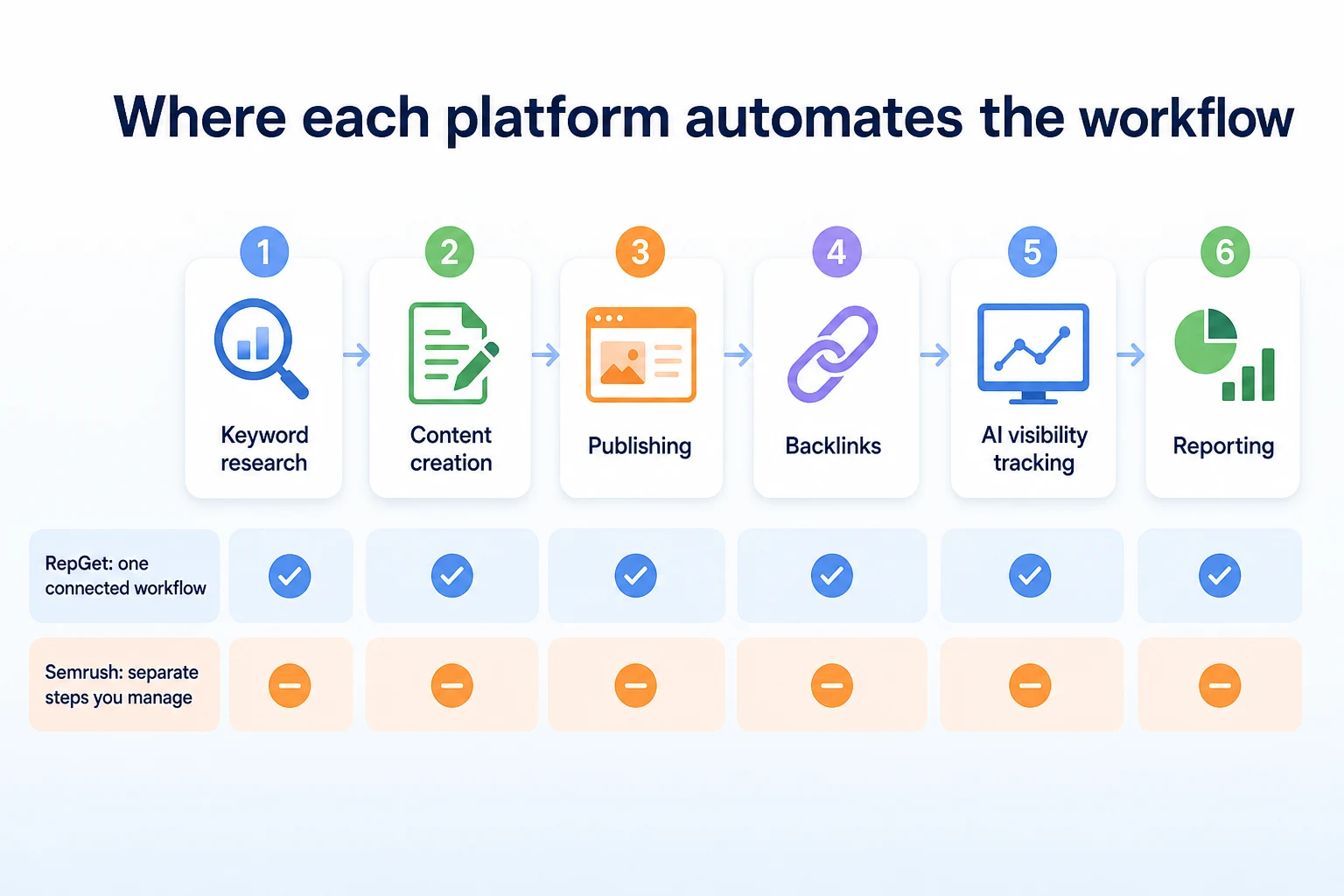
Every RepGet plan includes an AI Growth Copilot that gives website insights, recommendations and approved actions, with five free messages a day included before extra messages are billed in credits. Every plan also includes CMS auto-publishing, so an approved article goes live on your site without a separate manual upload. SEO audits, metadata and schema are included on every plan too, which means the technical groundwork for a page is checked as part of the same workflow that writes it. RepGet's own position is that no SEO experience is needed, because it brings keyword research, content creation, technical SEO checks and publishing into one workspace rather than asking you to coordinate separate tools for each step.
What Semrush still leaves for you to do manually
Semrush's Content solution helps find top-ranking topic ideas and uses AI to score and optimize content in real time, which is a genuinely useful step for improving a draft you've already written. Its Site Audit tools, included from the entry-level SEO plan up, flag technical issues worth fixing. What isn't part of either of those tools, based on Semrush's own plan pages, is publishing. Semrush helps you plan what to write and checks it once it exists, but getting that content onto your site, and keeping the publishing cadence going month after month, is still work you or your team carry yourself. For a small business without a dedicated person for that handoff, that gap is often where a growing keyword list turns into a website that doesn't change much. Our guides to SEO automation tools and what to automate versus review in AI SEO go into this trade-off in more depth, including where automation genuinely saves time and where a human check still matters.
Backlink building: database insight vs built-in partner network
Backlinks are the part of SEO most small business owners find hardest to act on, regardless of which platform they use, and it's worth being honest about what each one actually offers here.
Semrush's homepage describes its backlink database as 43 trillion backlinks, which it positions as the largest on the market. That scale is built for analysis: seeing which sites link to a competitor, auditing your own existing backlink profile, and spotting toxic or broken links worth cleaning up. It's a research and monitoring tool. Semrush's own feature pages, based on what we checked, describe this as database insight rather than a mechanism for actively building new links on your behalf.
RepGet takes a narrower, more direct approach: access to a backlink partner network is included on every plan, Launch, Grow and Scale alike. That gives a business a built-in path toward link opportunities without needing a separate outreach process or a third-party agency relationship. Neither platform, and nobody else in this space, can guarantee that a specific link gets placed, that a placed link improves a ranking, or that backlinks alone move a site up in search results. Our guide to AI backlinks covers what's realistic to expect from any backlink-focused tool, which is worth reading before treating either platform's backlink feature as a shortcut.
Features and integrations: how each fits into your workflow
Beyond the headline comparisons on pricing, keywords and backlinks, it's worth looking at how each platform actually sits inside the rest of your work week.
Semrush's wider toolset
Semrush is built as a suite of separate solutions rather than one single tool, and that's reflected in how its plans are structured. Starting from the Starter SEO + AI Search plan, Semrush includes MCP access alongside its keyword research and optimization tools, competitor insight tools, and AI visibility reporting. Each of these is a genuinely capable tool on its own: Site Audit for technical issues, the Content solution for topic ideas and real-time content scoring, Position Tracking for rank monitoring, and the AI Visibility solution for prompt-level tracking. The trade-off is that a small business using Semrush is typically moving between several of these modules to cover one piece of work, researching a keyword in one tool, scoring a draft in another, checking technical issues in a third. For an agency or a marketer who already has a process for stitching these together, that depth is an advantage. For a solo founder without the time to learn several interfaces, it's more to manage.
RepGet's single connected workflow
RepGet takes the opposite approach: fewer separate tools, with keyword research, content creation, CMS auto-publishing, SEO audits and AI search visibility tracking built into one workspace on every plan. There's no separate module to open for publishing once an article is approved, and no second tool needed to check metadata or schema on a new page. Outside the paid plans, RepGet also offers a set of free SEO tools that each run one specific check, a robots.txt checker, a sitemap checker, a meta tag checker, an AI crawler checker and others, which is useful if you want to check one thing on your site without committing to a subscription first. Our guide to which SEO tools a small business actually needs covers how to think about this trade-off between a wide suite and a connected workflow more generally, regardless of which platform you end up choosing.
The key differences that matter for a small business
Strip away the feature lists and the real difference between these two platforms comes down to where each one stops.
Semrush is, at its core, a research and competitive intelligence platform. It tells you what keywords exist, what competitors rank for, what's technically wrong with a page, and increasingly, how a domain shows up in AI-generated answers. All of that is genuinely useful information. What Semrush's own plan pages don't describe is a step that takes that information and turns it into a published page on your site without you or your team doing the writing and the uploading yourselves.
RepGet is built around that missing step. It researches a smaller set of keywords, but it carries each one through to a written article, a published page, and ongoing tracking, without asking you to hand the work off to a separate tool or a separate person in between. The two platforms also share more than it might first appear. Both include AI search visibility tracking on every paid tier. Both offer tools aimed at technical SEO issues. The difference isn't that one covers AI visibility and the other doesn't, it's that Semrush's AI Visibility solution is one module inside a larger suite you act on yourself, while RepGet's AI search visibility tracking sits inside the same workflow that already wrote and published the page being tracked.
The trade-offs of each platform
Neither platform is free of downsides, and being honest about them matters more than picking a side.
Semrush's trade-offs
Semrush's depth comes at a cost beyond the monthly price. Its entry-level SEO plan starts at $117.33 a month billed annually, which is a meaningful commitment for a business testing whether SEO software is worth the spend at all. Learning to use several separate tools well, keyword research, Site Audit, Content, AI Visibility, takes time that a founder without a dedicated marketer may not have. And even with all that research in hand, nothing about Semrush's own plan pages describes it finishing the job of writing and publishing content for you. Additional user seats, starting at $45 a month, add further cost for any team larger than one or two people.
RepGet's trade-offs
RepGet's trade-off runs the other way. Its keyword research allowance, 300 to 1,500 search terms a month depending on plan, is a fraction of what Semrush's 29 billion keyword database offers, and RepGet isn't built to replace a dedicated competitor research tool for a business that genuinely needs to study rivals in detail. Each RepGet plan also covers one website, which doesn't suit an agency managing several client sites from one account the way Semrush's multi-website plans do. And RepGet's exact pricing wasn't confirmed in the sources checked for this article, so it's worth checking RepGet's own pricing page directly before assuming it costs less than Semrush's entry plan.
Which should you choose
The right answer depends less on which platform is better overall and more on what kind of work you're actually short on time for.
If you're a solo founder or small team
A founder running a small business alone, or with a team of one or two, usually doesn't have the hours to learn several separate tools and still coordinate writing and publishing on top of that. RepGet's single workspace, researching a keyword, writing the article, publishing it and tracking the result without leaving one system, tends to fit that situation better. Semrush's entry-level SEO plan is still usable at this scale, but the publishing and content creation steps it doesn't cover would need to be handled some other way, by you, a freelancer, or a second tool. A free website audit is a reasonable way to see what your own site needs fixed before committing to either platform's monthly cost.
If you're an agency or need deep competitor data
An agency managing several client websites, or a marketer who genuinely needs to study what competitors rank for in detail, has different requirements. Semrush's multi-website plans, its 29 billion keyword database, and its competitor insight tools are built for exactly that kind of breadth. RepGet's one-website-per-subscription structure isn't designed to replace that, and its 300 to 1,500 monthly search terms won't match a dedicated research tool's depth. For this use case, Semrush's strengths line up with the actual job.
If you mainly want AI visibility tracking without extra setup
Both platforms track AI search visibility on every paid plan, so this isn't a case of one having the feature and the other missing it. The difference is where that tracking sits. Semrush's AI Visibility solution is a module inside a larger suite, with prompt tracking and sentiment monitoring that scale by plan. RepGet's AI search visibility tracking sits inside the same workflow that researched the keyword and published the page being tracked, so there's less setup connecting separate tools together. If AI visibility tracking is the main thing you're after, and you'd rather it be attached to content you're already creating than a standalone report you check on its own, that points toward RepGet. If you want deeper prompt-level detail and don't mind it living in a separate module, Semrush's AI Visibility tools go further.
Where RepGet fits
RepGet is one of the two platforms compared in this article, not a neutral referee, so it's worth being direct about what it actually does and doesn't do.
RepGet brings website auditing, keyword research, content planning, article writing, publishing to your website, and search performance reporting from Google Search Console into one workflow. That's the core of what makes it a reasonable semrush alternative for small businesses specifically: fewer tools to open, fewer handoffs between research and a published page. Articles RepGet writes can stay as drafts for your team to review before anything goes live, which matters if you want a person checking tone or accuracy before a page is public. RepGet doesn't replace Google Business Profile, Search Console or your own judgment, and it doesn't guarantee rankings, Google Maps positions, traffic or mentions in AI answers, no matter which plan you're on. It also isn't built to match Semrush's keyword or backlink database size, and it shouldn't be chosen for that reason. RepGet's free website audit crawls your site and gives it a 0 to 100 SEO score, with the technical and content issues worth fixing listed out. No account or credit card required, which makes it a low-risk way to see what your site needs before deciding whether a connected workflow or a research-heavy suite fits better.
The bottom line
Semrush and RepGet aren't really competing for the same job. Semrush is a research and competitive intelligence platform with real depth in keyword data, backlink analysis and growing AI visibility reporting, but it stops at giving you the information. RepGet is a smaller, connected workflow that researches, writes, publishes and tracks results with less manual handoff, at the cost of a far smaller keyword database and no multi-website support.
Choosing between them comes down to whether your business is short on information or short on execution. A business with no dedicated SEO person and a backlog of unpublished ideas usually gets more value from a workflow that finishes the job. A business or agency that needs to study competitors in real depth usually gets more value from Semrush's research tools, even knowing the writing and publishing still happens elsewhere.
Find out what your website needs first
Run a free website audit with RepGet to see what your site needs fixed before choosing a platform to fix it with. No account or credit card required.
FAQ
Is Semrush worth it for a small business?
It can be, especially if you need deep keyword and competitor data and have time to act on it yourself. Its entry plan starts at $117.33 a month billed annually, which is worth weighing against your budget first.
What is a good Semrush alternative for small businesses?
RepGet is one option, built as a connected workflow covering keyword research, AI content, publishing and AI visibility tracking on every plan, with less manual handoff between steps than a research-focused suite.
Does RepGet replace Semrush?
Not entirely. RepGet doesn't match Semrush's keyword or backlink database size, so a business needing deep competitor research may still want a dedicated research tool alongside or instead of RepGet.
How much does Semrush cost per month?
Semrush's SEO plan starts at $117.33 a month billed annually ($139 monthly), with Starter and Pro+ plans going up to $165.17 and $248.17 a month. Advanced pricing is custom, through Semrush's sales team.
Can RepGet track AI search visibility like Semrush does?
Yes, AI search visibility tracking is included on every RepGet plan, Launch, Grow and Scale alike, built into the same workflow that researches and publishes content rather than a separate module.
Does Semrush help with AI search visibility?
Yes. Semrush's AI Visibility solution tracks prompt-level visibility and AI market share, with features like prompt tracking and AI sentiment monitoring included from its entry-level SEO plan upward.
Which tool is easier to use with no SEO experience?
RepGet is built for that case specifically, combining keyword research, content creation, technical checks and publishing in one workspace. Semrush's separate tools typically suit someone with more SEO background.
Does RepGet build backlinks automatically?
RepGet includes access to a backlink partner network on every plan, giving a built-in path to link opportunities. No platform, RepGet included, can guarantee a specific link placement or ranking improvement.
Comments
0 shownShare your thoughts about this article.
New to RepGet? Create a free account to join the conversation.
No comments yet. Be the first to leave one.