

RepGet vs RankYak: Which SEO Automation Platform Fits Your Business?
Short answer
RepGet and RankYak both automate keyword research, content creation, publishing and backlinks. But their differences become important when you need AI visibility tracking, existing-page improvements or more publishing capacity. This comparison examines the actual features, costs and trade-offs.
SEO automation becomes attractive when the same work keeps returning to your calendar. There are keywords to research, articles to prepare, technical problems to investigate and existing pages that slowly lose visibility while you're occupied with something else.
Two platforms promising to handle much of that work are RepGet and RankYak.
Both combine AI-assisted SEO research with content planning, automated publishing and backlink building. Both aim to reduce the amount of manual work required to maintain a consistent search presence.
That makes the choice less obvious than comparing a basic AI writing tool with a complete SEO platform.
The real question in the RepGet vs RankYak comparison is which parts of your SEO operation you want automated, and how much control, monitoring and publishing capacity your business actually needs.
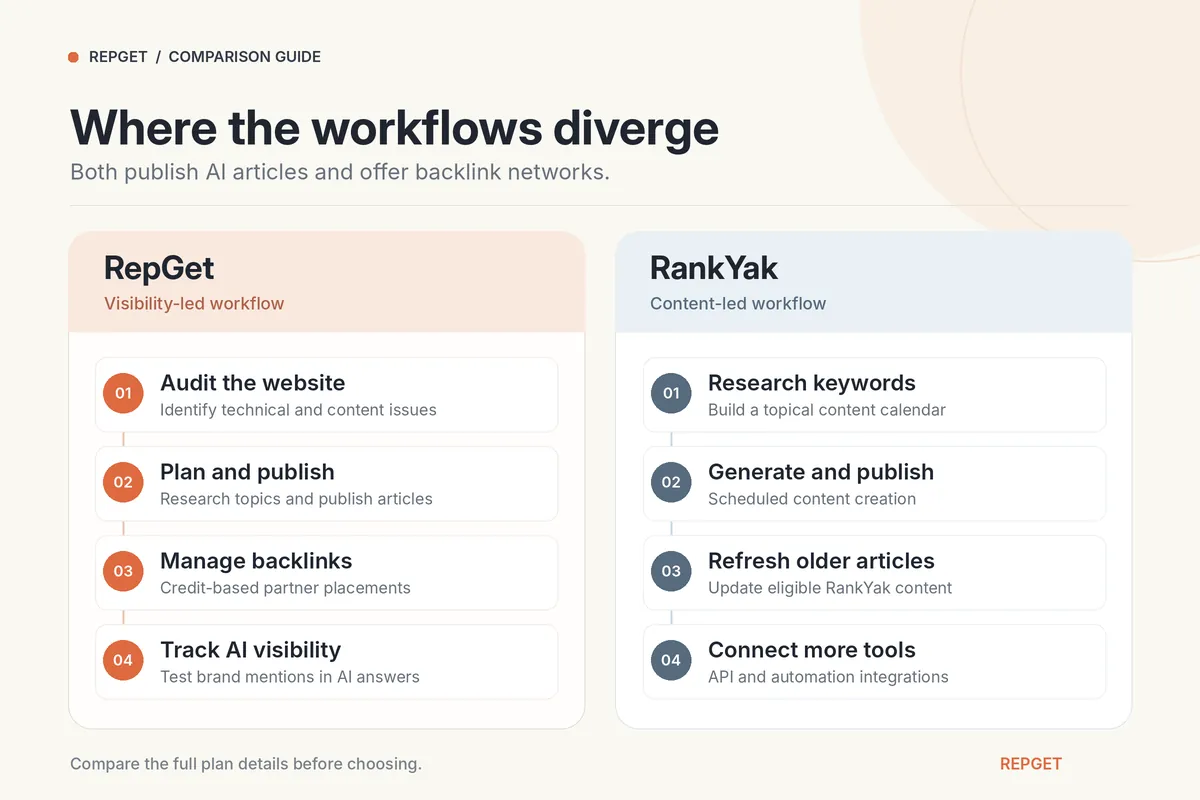
RankYak has developed a sophisticated content workflow with keyword clustering, scheduled publishing, automatic article refreshes and integrations for agencies and technical teams. RepGet brings content automation together with website auditing, backlink placement management and explicit monitoring of how AI assistants mention your business.
There are meaningful differences in pricing, but also in how those features are packaged.
This comparison examines both products using their publicly documented capabilities and pricing as of October 23, 2026. It is published by the RepGet team, so we have a commercial interest in the subject. We have not conducted a controlled, side-by-side ranking performance experiment, and we won't present advertised capabilities as independently verified SEO results.
RepGet vs RankYak: The Main Differences at a Glance
For a business evaluating SEO software, the most useful comparison begins with the tasks each product actually performs.
Feature | RepGet | RankYak |
|---|---|---|
Starting paid plan | Grow: €99/month | Pro: $99/month |
Article capacity | 30/month on Grow; 100/month on Scale | Up to one article per scheduled publishing day |
Keyword strategy | 300 researched and clustered search terms on Grow; 1,500 on Scale | Personalized keyword discovery, competitor research and topical mapping |
Publishing | CMS integrations and webhook; automatic or draft publishing | CMS integrations, API, webhooks, Zapier and Make; automatic or draft publishing |
Existing content | Website audit, Search Console reports and content improvement workflow | Automatic refreshes of its generated articles using Search Console data |
Site-wide optimization | Site audit included in paid plans | Site Guard provides detailed existing-page fixes for an additional $99/month |
AI visibility | Explicit brand-mention tracking across ChatGPT, Claude, Gemini and Perplexity | AI/GEO-oriented content generation; separate comparable cross-assistant tracking is not specified in its core pricing documentation |
Backlinks | Credit-based partner network, with reviewed placements and live-link verification | Opt-in automated exchange involving eligible RankYak-generated articles |
Developer workflow | Direct CMS publishing and webhook support | REST API, MCP server, in-app copilot and broader automation integrations |
Prices use each company's advertised billing currency and should not be interpreted as equivalent amounts after conversion, taxes or payment fees.
Both platforms can help a business publish more consistently. The differences become clearer when we look at the problems behind those features.
Pricing: What Does Each Platform Actually Cost?
At the entry level, the advertised prices look similar.
RepGet's Grow plan costs €99 per month for one website. It includes 30 branded articles per month, research and clustering for 300 search terms, website auditing, AI visibility tracking, CMS publishing and access to its backlink network.
Its Scale plan costs €299 per month, increasing the advertised capacity to 100 articles and 1,500 researched search terms for one website. It also includes priority processing and custom feature requests.
RankYak Pro costs $99 per month per website, with a personalized keyword strategy and up to one article on each scheduled publishing day. It includes content generation, publishing integrations, article refreshes and access to the backlink exchange.
RankYak also offers annual billing with two months free. RepGet advertises the same annual billing structure.
The important difference appears when you examine optimization beyond newly generated articles.
RankYak's Site Guard is a separate subscription
RankYak Pro includes automatic refreshes of articles created by RankYak. According to its documentation, Search Console data helps identify underperforming content, and a scheduled publishing day can be used to refresh an existing article instead of producing a new one.
That's a useful capability, particularly for businesses with an established automated blog.
But RankYak also offers Site Guard, which costs an additional $99 per month per website.
Site Guard addresses broader issues on existing pages, including weak titles, meta descriptions, declining click performance and keyword cannibalization. The basic product can expose audit issue counts, while the add-on provides the detailed findings and suggested fixes.
A site subscribing to both RankYak Pro and Site Guard therefore has a published combined price of $198 per month, before any applicable taxes.
This doesn't make RankYak expensive by default. A business that only wants content planning, publishing and article refreshes may not need the add-on.
It does mean that automatic article refreshes and broader site-wide optimization are not the same product feature, and buyers should distinguish them when comparing quotations.
RepGet's site audit is included
RepGet includes website auditing in both its Grow and Scale plans. The platform also provides Search Console reporting and identifies pages losing clicks, giving businesses information they can use to decide what should be improved.
That is different from promising that RepGet will automatically rewrite and fix every existing page.
RankYak has a more explicitly documented automated article-refresh workflow. RepGet's offering places greater emphasis on auditing, reporting and keeping business owners informed about what needs attention.
For a small company starting with a website that has technical or content problems, having the audit in the base plan may be particularly useful.
For a content-focused company that already knows its site is technically healthy, RankYak's automatic refresh capability may be more attractive.
The right comparison is not simply €99 versus $99. It's the total cost of the features you will actually use.
Content Automation: Which Platform Handles More of the Work?
Both products are designed to remove the repetitive work of finding topics, preparing articles and publishing them.
RankYak begins with keyword discovery and competitor analysis, builds a topical map, and prepares a monthly publishing plan. Its documentation describes live search-results research, source citations, internal links, generated visuals and articles tailored to the website's language and brand voice.
It supports more than 40 languages and publishes according to the schedule configured for each site.
RepGet also researches keywords and groups them into related topics before generating articles. Its content engine produces branded writing with images, internal links, headings and metadata, then sends approved content to a connected website or keeps it as drafts for review.
One difference is the amount of publishing the plans support.
RankYak's standard model is up to one article per scheduled day. RepGet Grow offers a comparable monthly volume of 30 articles, while RepGet Scale advertises 100 articles per month.
That higher capacity can matter for a business operating a larger editorial program, provided it has enough worthwhile subjects to publish.
But publishing volume should never be mistaken for an SEO strategy.
More articles are not automatically better SEO
Imagine a software company has fifteen articles explaining variations of the same product feature.
An automation platform identifies another thirty related keywords and begins writing.
The resulting calendar looks productive. Unfortunately, many of the new pages may answer questions that existing articles already cover.
The sensible decision may be to improve five existing articles, combine two overlapping pages and publish only a handful of genuinely new topics.
RankYak's automatic optimization workflow is relevant here because it can refresh its existing articles rather than continually adding new ones.
RepGet's website audit and search performance reporting can support the same editorial decision, although the subsequent changes may require review or editing.
The better platform is the one that helps your business publish useful information, not the one that creates the highest number of URLs.
When comparing article quality, ask to see actual published examples. Check whether the writing includes credible sources, accurate product information and details that the business could genuinely know.
No AI writing platform can reliably invent your customer experiences, proprietary research, actual pricing or professional judgment.
Those details need to come from the business.
AI Search: Writing for ChatGPT Is Not the Same as Measuring Visibility
This is one of the clearest differences in the two products' public positioning.
RankYak markets its articles for both traditional search and generative search experiences. It produces structured SEO/GEO content and uses search performance data to improve its publishing strategy.
RepGet also prepares content intended to be useful in Google and AI-assisted search, but it explicitly advertises a separate visibility-monitoring workflow.
Businesses can add questions that customers might ask AI assistants and track whether their brand is named in the responses.
RepGet currently describes coverage across ChatGPT, Claude, Gemini and Perplexity, with 20 tracked questions on Grow and 50 on Scale.
That can answer a question ordinary Google ranking reports cannot: when someone asks an AI assistant to recommend a company in your category, does your business appear?
A practical example
Imagine you operate a small accounting firm in Milan.
Your articles may appear in Google for questions about bookkeeping, business taxes and accounting software. Search Console can show impressions and clicks associated with those pages.
But a potential customer might instead ask an AI assistant:
“Which accounting firms help international businesses in Milan?”
That is a different discovery experience.
A tool built primarily around search performance can help you understand how your articles rank and attract clicks. A brand-mention tracker tests whether your business appears in selected AI responses.
These measurements are complementary rather than interchangeable.
RepGet makes the second measurement an explicit part of its product.
RankYak publicly emphasizes creating content suitable for AI search and tracking performance through Search Console. Its core pricing documentation does not specify an equivalent multi-assistant brand-mention tracker, although that should not be interpreted as proof that no related functionality exists elsewhere in its product.
What AI visibility tracking cannot promise
Appearing in an AI answer is not a permanent ranking position.
Responses vary by prompt, model, date and available information. Being mentioned once does not mean the platform will recommend your company consistently.
The useful approach is to monitor a stable group of relevant questions over time and distinguish brand mentions from actual visits or enquiries.
RepGet's guide to getting mentioned in ChatGPT explains that difference in greater detail.
If AI discovery is becoming important to your business, choose a platform that helps you understand what is actually being measured.
Backlinks: Both Platforms Have a Network, but the Rules Differ
This is an area where an outdated comparison could easily mislead readers.
Both RepGet and RankYak offer backlink networks. Neither should be described as a content-only tool without link-building functionality.
The differences concern which pages can participate, how placements are arranged and how users manage the results.
How RepGet handles backlink placements
RepGet operates a credit-based network in which participating businesses can earn and receive links through relevant articles.
According to its published process, users can identify important pages on their websites that should receive links. Placements are arranged within articles on related businesses' websites, reviewed before publication and checked after going live.
The dashboard records the linking page and status of each placement. Credits are used according to the network's rules, and removed links can result in credits being returned.
This gives businesses a way to manage placements associated with specific pages, rather than treating every backlink as an undifferentiated number.
For a local service company, that distinction can be important. Its principal commercial pages may be more valuable to its acquisition strategy than an additional mention of a general blog article.
How RankYak's backlink exchange works
RankYak also uses a network of participating websites, but its documentation describes a different eligibility model.
The exchange is opt-in. Participating sites receive contextual links from other network members, while their own eligible articles also link to related sites.
RankYak says it avoids direct one-for-one swaps and checks placements for relevance.
An important limitation is that the exchange currently involves articles generated by RankYak. Those articles must be published with known live URLs, and the site must continue publishing to remain eligible.
In other words, a business shouldn't assume RankYak's network can immediately build links to every existing service or product page.
RankYak's published rules focus the exchange on articles created through the platform.
The SEO policy question both platforms need to confront
Backlink networks require care regardless of which software operates them.
Google's spam policies identify excessive link exchanges, automated link creation and links arranged primarily to manipulate rankings as potentially problematic practices.
Contextual placement alone doesn't guarantee that a link complies with those policies. Avoiding direct reciprocal swaps doesn't automatically remove the concern either.
Businesses should understand the editorial purpose of a placement, the publisher's control over it, whether a promotional relationship needs to be disclosed and how the links are qualified where appropriate.
Neither platform can guarantee that Google will count a particular backlink as a positive ranking signal.
The more defensible goal is to create relevant references that provide genuine value to readers, with transparent oversight rather than an assumption that every new link improves authority.
For the details of RepGet's approach, see its backlink network documentation. RankYak explains its eligibility and placement rules in its backlink exchange guide.
Integrations and Control: RankYak Has a Strong Developer Workflow
For some businesses, the decision will have less to do with article quality and more to do with how the software connects to an existing publishing system.
Both platforms support popular website platforms and allow automated publishing.
RepGet advertises connections for WordPress, Shopify, Ghost, Webflow, Wix and other setups through webhooks. It also allows articles to remain as drafts when review is preferred.
RankYak supports those mainstream publishing workflows as well, with additional documented options including WordPress.com, Duda, Zapier, Make, RSS and a REST API.
It also provides an in-app copilot and an MCP server for operating parts of the account through compatible AI tools.
Those capabilities may be particularly valuable for agencies, technical founders and teams managing custom workflows.
RepGet's emphasis is more direct: audit the website, connect the publishing platform, generate the articles and follow the resulting search and AI visibility data from one dashboard.
Neither philosophy is inherently better.
A business owner who wants a straightforward interface may have little interest in APIs and external automation tools.
An agency connecting several client sites to an established workflow may consider those capabilities essential.
The right level of automation is the one your team can operate reliably, not necessarily the one offering the largest integration catalogue.
Which Platform Fits Your Business?
Rather than declaring one universal winner, it is more useful to match each platform to a specific operating need.
A local business that wants more enquiries
Consider a small professional-services firm with a WordPress website, several service pages and very little time for SEO.
Its biggest problems may be unclear content, limited search visibility and uncertainty about whether potential customers are finding the business through Google or AI assistants.
RepGet is a sensible option to investigate because its entry plan includes site auditing, content creation, publishing, AI brand-mention monitoring and backlink management.
The firm can begin with a free website check before deciding which recurring services it needs.
That said, an SEO platform will not repair an unclear service offering, weak customer reviews or a poor enquiry process on its own.
A content-driven SaaS or publishing business
Now consider a software company that already has an established blog.
It publishes consistently, has connected Search Console and wants the content system to respond when existing articles begin losing performance.
RankYak is attractive here because article refreshes are a documented part of its core workflow. Its topical map, scheduling features, source-based content generation and developer integrations may also fit the team's operating model.
If it needs detailed audits and suggested fixes for important existing pages, the additional Site Guard subscription becomes relevant.
RepGet remains a possible option, especially when AI brand monitoring is important, but RankYak offers a particularly explicit automation workflow for maintaining articles it previously generated.
A business with a larger publishing plan
Suppose a company has several product categories, a substantial editorial budget and enough original expertise to support a high-volume publishing schedule.
RepGet Scale advertises up to 100 articles per month, compared with RankYak's standard model of one article per scheduled publishing day.
That difference may influence the decision.
However, the company should first confirm that its editorial calendar has enough distinct search intent to justify the volume.
One hundred overlapping articles will not become more valuable simply because software can publish them.
An agency with custom integrations
For an agency operating technical workflows across multiple client sites, RankYak's API, MCP server, copilot and external automation integrations are meaningful advantages.
RankYak charges per website and publishes volume discounts for organizations running multiple sites.
RepGet's subscriptions are also organized around individual websites, but its public positioning focuses more on a connected, accessible SEO workflow for businesses than on extensive programmable account management.
For these buyers, the decision should include the time required to configure, monitor and maintain the automation.
How to Evaluate Either Platform Before Committing
A product comparison can identify capabilities, but it cannot tell you what will happen on your website.
The most useful trial focuses on the quality and relevance of the work, not whether the tool can generate an article quickly.
Start with a real business objective. That might be increasing qualified enquiries for a service, improving visibility for an important product category or understanding whether AI assistants mention your company.
Next, examine the actual output.
Does the keyword plan contain subjects that fit your customers? Are suggested articles meaningfully different from pages you already have? Can the generated content support its factual claims? Do the internal links lead to genuinely relevant pages?
Check the publishing result too. A technically successful CMS connection isn't enough if articles arrive with poor formatting, irrelevant images or incorrect metadata.
Then consider the time your team spends fixing the output.
A platform that saves five hours of drafting but requires four hours of corrections may not provide the efficiency you expected.
Finally, measure search performance and business results over a realistic period. New content can take time to gain visibility, and early rankings are influenced by competition, site quality and other factors the platform doesn't control.
RankYak currently advertises a three-day free trial. RepGet offers a free website audit and a free-article starting option, with its paid plans and refund terms published separately.
The important decision isn't which trial produces the most impressive dashboard. It's which workflow continues to provide useful, accurate work after the initial novelty has worn off.
Final Verdict: RepGet or RankYak?
RepGet and RankYak are closer competitors than their names or marketing pages might initially suggest.
Both automate research, article writing, publishing and access to backlink networks. Both offer ways to reduce the work involved in maintaining an SEO content program.
Their strengths differ in meaningful ways.
RepGet is worth considering when you want content automation combined with an included website audit, explicit tracking of brand mentions in major AI assistants, credit-based backlink management and the option of higher-volume publishing.
RankYak is worth considering when automatic refreshes of previously generated articles, sophisticated content scheduling, technical integrations and programmatic account management are central to your workflow.
For a small business choosing its first SEO automation platform, the most useful next step may be to identify what's actually preventing customers from finding the website.
If the problem is technical, more publishing won't automatically solve it.
If the business already has excellent service pages but very little relevant content, a well-planned publishing workflow may be more useful.
If its audience increasingly discovers companies through AI assistants, understanding brand visibility deserves attention alongside traditional rankings.
Neither product can promise first-page rankings, a particular number of backlinks that Google will count, or automatic growth in sales.
A successful choice should be judged by whether the platform helps your business consistently publish useful content, maintain a healthy website and turn meaningful visibility into qualified customers.
See Where Your Website Stands With RepGet
Before purchasing another SEO subscription, establish what needs attention on your existing website.
RepGet's free website check provides a starting point for reviewing technical SEO and AI accessibility. Its paid plans bring keyword research, branded content, CMS publishing, backlink management and AI visibility tracking into one workflow.
Run your free website check or compare RepGet plans to explore the available options.
Comparison reviewed October 23, 2026. Features, prices and eligibility conditions were checked against publicly available product documentation. This is a vendor-authored comparison, not an independent laboratory test or a prediction of ranking performance.
FAQ
What is the main difference between RepGet and RankYak?
Both automate keyword research, content creation, publishing and backlink building. RepGet emphasizes integrated website auditing, multi-assistant brand-mention tracking and higher-volume publishing options. RankYak emphasizes scheduled content production, automatic article refreshes and developer integrations. The better fit depends on which work your business needs automated.
Is RepGet cheaper than RankYak?
Their advertised starting prices are €99 per month for RepGet Grow and $99 per month for RankYak Pro. Because they use different currencies, the amounts are not directly equivalent. RankYak's broader Site Guard functionality costs an additional $99 per month per site, while RepGet includes its website audit in its paid plans.
Does RankYak include backlinks?
Yes. RankYak has an opt-in backlink exchange for eligible, published articles generated by its platform. It matches related websites and verifies placements. RepGet also operates a partner network, using link credits and reviewed contextual placements. Neither network guarantees ranking improvements.
Does RankYak automatically update old articles?
RankYak's core plan includes automatic refreshes of eligible articles it generated, using Search Console performance information. Broader existing-page optimization, including detailed Site Guard fixes and cannibalization recommendations, requires its additional subscription.
Does RepGet track visibility in ChatGPT?
Yes. RepGet advertises brand-mention tracking across ChatGPT, Claude, Gemini and Perplexity. Its Grow plan supports 20 tracked questions, while Scale supports 50. These checks measure responses to selected prompts, not a permanent or universal ranking in AI assistants.
Can I review AI-generated articles before publishing?
Yes. Both RepGet and RankYak support review workflows that allow content to remain in draft form instead of being published automatically. Businesses should use editorial review for important factual claims, pricing, product information and other content where errors could mislead customers.
Is RankYak better for agencies?
RankYak offers several features that may appeal to agencies, including multi-site management, API access, an MCP server, automation integrations and published volume discounts. RepGet may be better suited to teams prioritizing an integrated website audit, content publishing, backlinks and AI visibility monitoring. Agency requirements should be evaluated against the total cost per website.
Can either platform guarantee Google rankings?
No. Both can automate parts of the SEO process, but rankings depend on search demand, competition, content quality, website accessibility and other factors. Publishing more content or acquiring more backlinks does not guarantee higher rankings or additional customers.