

YouTube Shorts Original Content Algorithm: What Changed
Short answer
On October 1, 2026, YouTube said its Shorts recommendation system now favors original videos over unoriginal reuploads and compilations. Clips reposted with little or no change risk lower reach, while Shorts with real editing, commentary or new footage are more likely to be recommended. YouTube hasn't published exact weighting, so no one can guarantee specific reach outcomes for any channel.
A small business owner reposts a trending clip to their YouTube Shorts channel the same way they always have, adding only a caption.
A week later the views barely reach a tenth of what a similar repost used to get.
Nothing in the account settings looks broken. No strike, no warning, no message from YouTube.
The likely explanation is a change to the YouTube Shorts original content algorithm that YouTube confirmed on October 1, 2026. The company said its Shorts recommendation system now favors original videos over unoriginal reuploads and compilations, which means a repost that used to perform fine can quietly lose reach even though nothing was removed or restricted.
Here's what YouTube actually said changed, what counts as a reupload in its eyes, what's genuinely at risk for creators who lean on reused clips, and what kind of editing is more likely to count as original under the new system.
What YouTube Changed on October 1, 2026
On October 1, 2026, YouTube said its Shorts recommendation system now gives more weight to original videos and less to unoriginal reuploads and compilations. This is a change to how Shorts get recommended, not a new rule that blocks anyone from uploading reused footage in the first place.
What YouTube said changed
YouTube described the update as a shift in how the recommendation system evaluates a Short before deciding whether to show it to more viewers. A video that's a straight repost of someone else's content, or a compilation stitched together from other people's clips, is now less likely to get pushed into the Shorts feed the way an original video would. The upload itself still goes through. What changes is how often the system recommends it afterward.
Why YouTube says original content matters more now
YouTube framed the change around rewarding creators who make original work, rather than channels that repackage someone else's footage with little or no added value. The company has talked before about wanting Shorts to be a place where original creators can build an audience, and this update is a more direct step toward that goal: original content gets more consideration in recommendations, and unoriginal reuploads get less.
What Counts as a Reupload in YouTube's Eyes
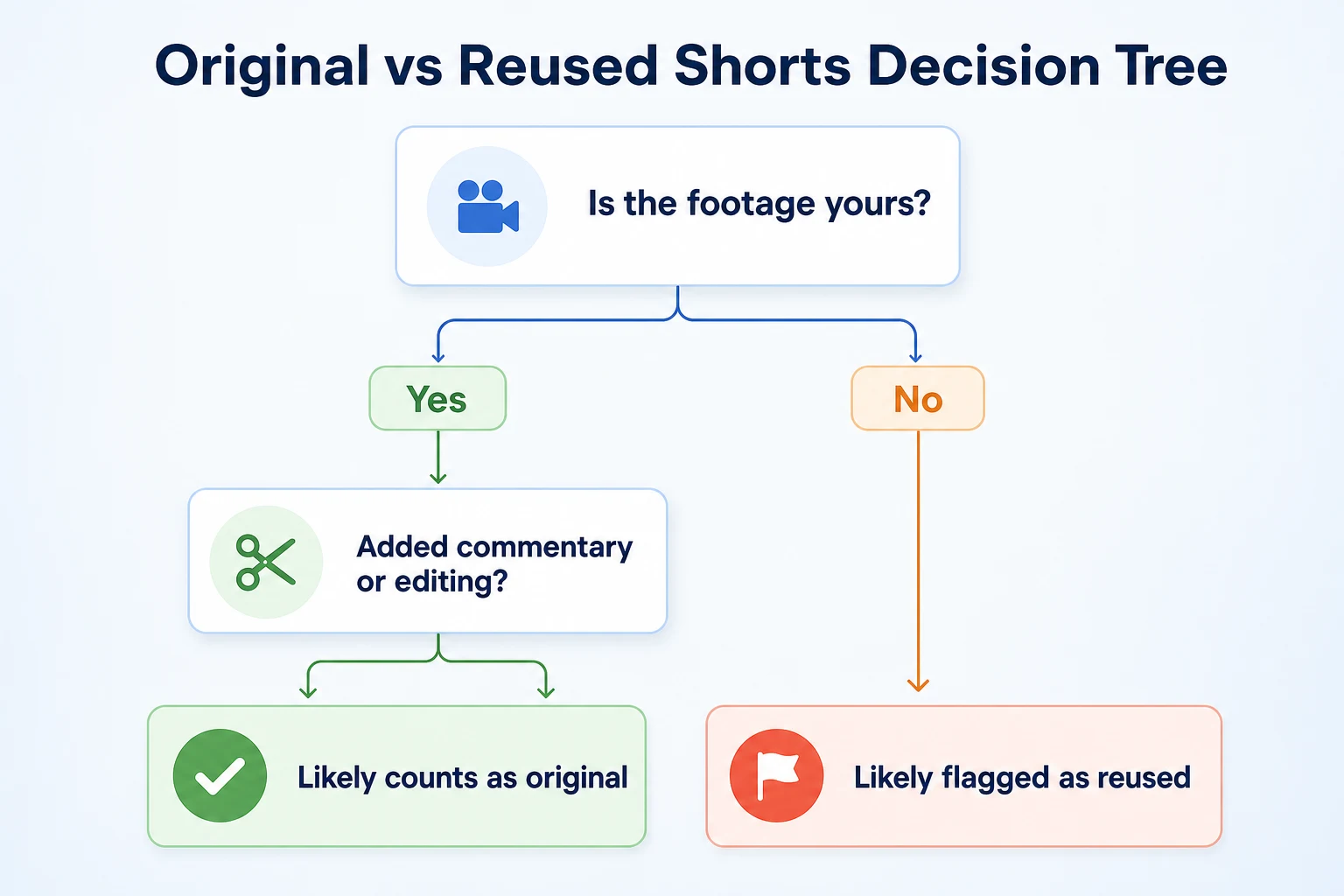
Not every Short that includes someone else's footage counts as a reupload. The distinction YouTube draws is about how much of the video is actually new, and how much is just repackaged.
Straight reposts with no changes
The clearest case is a video uploaded exactly as it appeared somewhere else, with no editing, no commentary, and no added context. Downloading a trending clip and reposting it with only a different caption or a new title falls into this category. This is the kind of Short most likely to be treated as unoriginal under the update.
Compilations and clip round-ups
Stringing together several clips from other creators into one video, even if the editing itself took some effort, doesn't automatically make the result original in YouTube's eyes. A compilation built entirely from other people's footage, with no new commentary or added value tying it together, sits in the same risk category as a straight repost.
Content pulled from other platforms
Reposting a clip that originated on another platform, with a watermark cropped out or a caption swapped in, is treated the same way as reposting something that originated on YouTube itself. The platform a clip came from doesn't change whether it counts as original. What matters is whether meaningful new work went into the video that's actually uploaded.
The Risks for Creators Who Rely on Reused Clips
For a channel built mostly around reposted or compiled content, this update changes the math on whether that strategy keeps working the way it used to.
Lower reach in the Shorts feed
The most direct risk is reduced recommendations. A channel that regularly uploads unoriginal reuploads can expect those Shorts to get less consideration from the recommendation system than they would have before October 1, 2026. YouTube hasn't published an exact formula for how much less, and it hasn't said the drop will be the same size for every channel or every video. What it has said is that the system now favors original content over unoriginal reuploads, which is enough to treat reused clips as a weaker bet going forward, not a safe one.
Open questions around monetization eligibility
YouTube's existing rules already tie monetization eligibility to original and substantially transformed content, and this update sits alongside that policy rather than replacing it. What isn't fully clear yet is how closely the recommendation changes and the monetization review process line up for every edge case, such as a channel that mixes some original Shorts with some reposted ones. Until YouTube clarifies that further, it's safer to assume the two are related rather than treating recommendation reach and monetization eligibility as two separate, unconnected questions.
What Counts as Meaningful Transformation
The practical question for most creators isn't whether to stop using other footage entirely. It's how much needs to change before a Short is more likely to count as original rather than reused.
Added commentary or narration
Talking over a clip, reacting to it on camera, or adding narration that gives the viewer new information is a meaningful addition. The original footage is still there, but the video now carries something the source clip didn't: a perspective, an explanation, or a reaction that wasn't part of the original.
Substantial editing and new context
Editing that changes how a piece of footage is understood, not just how it looks, counts for more than a filter or a trimmed clip. Reframing a clip around a new question, adding on-screen text that explains something the original didn't, or recutting footage to make a different point than the source video made are all closer to the kind of transformation YouTube is describing.
Mixing original footage with existing clips
Combining someone else's clip with footage a creator shot themselves, such as a product demo filmed in response to a trending clip, or a side-by-side comparison using original material, tends to land more clearly on the original side. The more of the final video that's genuinely new, the stronger the case that it isn't just a reupload with extra steps.
Content type | Likely treated as original | Likely flagged as reused |
|---|---|---|
Reaction video with voiceover and added commentary | Yes | No |
Straight repost with a new caption only | No | Yes |
Compilation of clips with no added narration | No | Yes |
Original footage mixed with a short reference clip | Yes | No |
Repost with a watermark cropped out | No | Yes |
These examples are illustrative. YouTube hasn't published a precise checklist for every scenario.
A Worked Example: Turning a Reaction Clip Into Original Content
Imagine a home goods shop that used to repost trending kitchen gadget clips from other accounts, adding nothing but a caption like "we love this one." This example is illustrative.
Under the old approach, a 15-second repost of someone else's gadget demo would go up twice a week, and it performed fine for months. After October 1, 2026, the same kind of repost starts pulling a fraction of its usual views, even though the clip itself hasn't changed and nothing in the account looks restricted.
Instead of dropping Shorts entirely, the shop reworks its approach around the same source material. Rather than reposting the gadget clip as is, someone on staff films themselves actually using the gadget in their own kitchen, reacting to whether it works as well as the original clip claims. They add a short voiceover explaining what surprised them, overlay text comparing the claim to what actually happened, and cut in a few seconds of the original clip only as a reference point, not as the whole video.
The result uses the same trending idea, but the final Short is built mostly from new footage, new commentary, and a new angle on the claim. That's a meaningfully different video from a straight repost, even though it started from the same spark.
A 20-Minute Audit to Check Your Existing Shorts
Before planning new content, it's worth reviewing what's already on a channel. A short audit shows how much of a back catalog might be at risk, without requiring a full rework of everything at once.
Question to ask | What to look for |
|---|---|
Where did the footage in this Short come from? | Whether any of it was filmed by the channel itself, versus pulled entirely from another account or platform |
Was anything added beyond the original clip? | Commentary, narration, on-screen text, or new footage mixed in, rather than just a caption or title change |
Would the video make sense without the reused clip? | If removing the borrowed footage would leave nothing, the Short is likely closer to a straight repost |
Is this Short part of a compilation? | Whether it strings together multiple clips from other creators with no added context tying them together |
Does this Short have original footage sitting unused that could replace or supplement it? | Raw clips, behind-the-scenes footage, or customer interactions already filmed but never posted |
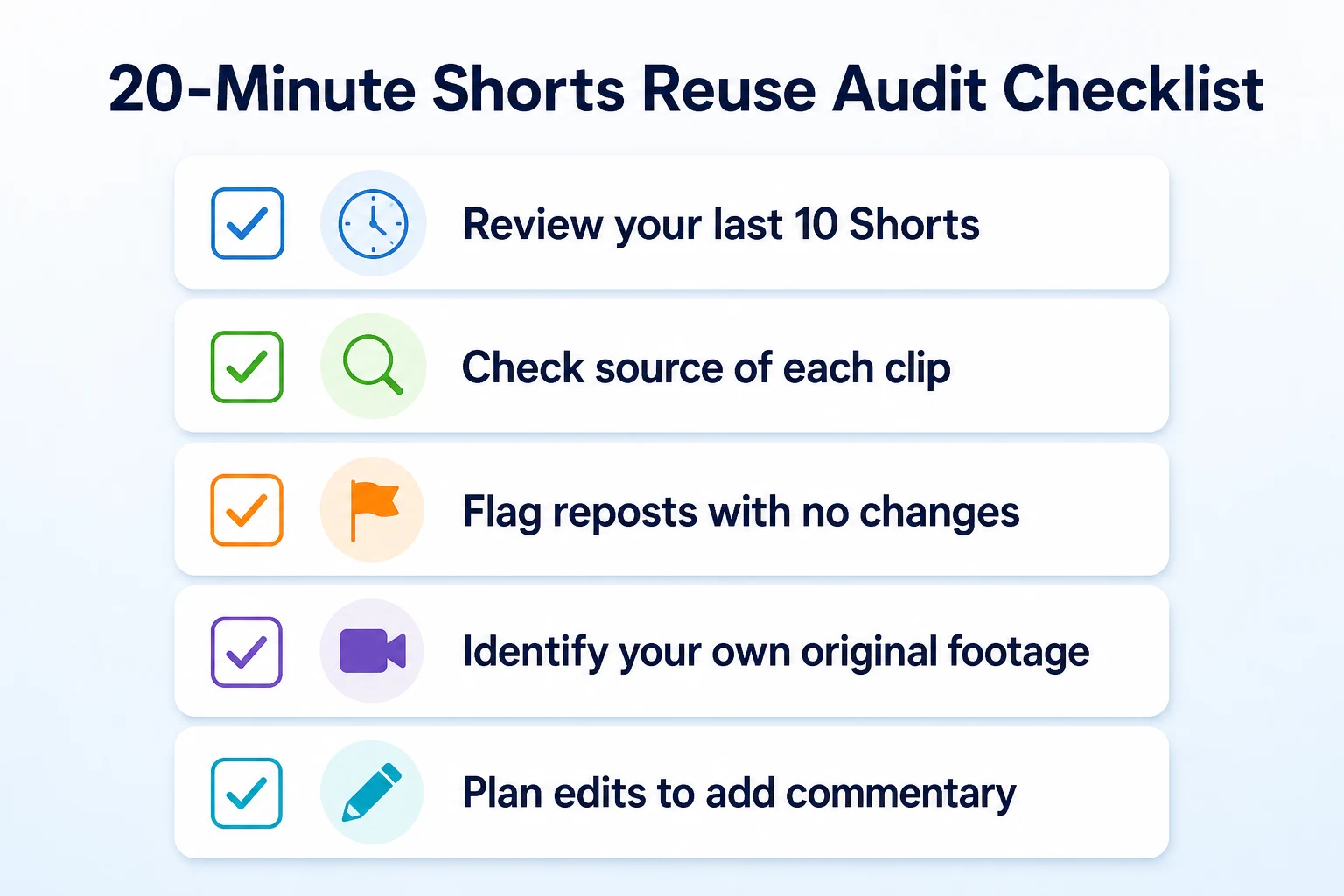
Running through the last ten Shorts on a channel against this table usually takes about 20 minutes. It won't tell a creator exactly how YouTube's system is treating each video, but it's enough to spot a pattern, such as a channel where most recent uploads are straight reposts with no added commentary at all.
A Brand-Friendly Shorts Strategy for Small Businesses
A small business doesn't need to compete with full-time creators to make Shorts work. It needs a format that's genuinely its own, built from things only that business can film.
Original formats that fit a small business
A few formats tend to work without requiring much extra production. A quick answer to a question customers actually ask, filmed on the spot, is original by definition because nobody else has that exact footage. A short walkthrough of a product being made, used, or fixed works the same way. A staff member reacting honestly to a customer review, good or bad, is another format that's hard to classify as a reupload since it's built entirely from the business's own voice and footage.
None of these require expensive equipment or a script. They require someone willing to film something real and say something specific, rather than borrowing someone else's clip and hoping a caption does the work.
Repurposing your own content, not someone else's
A business that already records longer video, such as a webinar, a product demo, or a customer interview, has raw material sitting ready for Shorts without needing to touch anyone else's footage at all. Cutting a few minutes from a longer recording, adding a new title card, or trimming it down to the most useful answer turns existing original content into a short, native piece rather than a repost of something external.
This kind of repurposing fits into the same planning habit covered in our guide to building an SEO content calendar, where content gets mapped out ahead of time instead of scrambled together the day of posting. It's also the same instinct behind platforms testing longer native formats generally, which our look at Instagram's 90-minute video test covers from a different angle: businesses that already have original footage sitting around are better placed to adapt when a platform changes how it treats content, whatever the platform.
Common Mistakes Creators Make After an Algorithm Change Like This
A handful of reactions to this update show up often enough that they're worth naming directly, separate from the strategy above.
Mistake | What it leads to | Fix |
|---|---|---|
Deleting an entire back catalog out of caution | Losing Shorts that were genuinely original, alongside the ones that were actually reposts, without any clear reason to remove the good ones | Run the audit above first and only remove or rework the Shorts that actually look like reuploads |
Assuming a new caption counts as transformation | Continuing to post reworked captions on reposted clips and wondering why reach still hasn't recovered | Add real commentary, editing, or original footage, not just new text around the same borrowed clip |
Ignoring original footage a business already has | Missing an easy source of original content while still relying on other people's clips out of habit | Check existing long-form video, product footage, and customer interactions before filming anything new |
Treating this as a one-time cleanup instead of an ongoing habit | A short burst of original Shorts followed by a slide back into reposting once the update stops feeling new | Build original content into a regular posting routine rather than a one-off reaction to the announcement |
The pattern underneath most of these mistakes is the same one that shows up with almost every platform update: reacting to the headline instead of checking what's actually in the account, and assuming a small cosmetic change does the work that real editing and commentary are meant to do.
What YouTube Hasn't Said Yet
It's worth being just as clear about what YouTube hasn't confirmed as what it has, since the gap between the two is where most of the anxiety around an update like this tends to live.
YouTube hasn't published an exact weighting formula for how much more an original Short gets recommended compared to a reused one. It hasn't said whether the effect is the same size for every channel, every niche, or every type of content, and it hasn't given a timeline for how quickly an existing channel might see the change reflected in its views. A channel that posted mostly reposts before October 1, 2026 might see reach drop within days, within weeks, or more gradually as the system reprocesses older uploads. YouTube hasn't detailed which of those is typical.
It also hasn't published a single, universal checklist that tells a creator exactly how much editing or commentary is enough to count as meaningful transformation in every case. The examples earlier in this article are a reasonable reading of YouTube's general direction, not a quote-for-quote list from YouTube itself. Anyone claiming to know the precise cutoff, in minutes of added footage or words of narration, is going further than YouTube's own statement supports.
None of that means the update isn't real or isn't worth acting on. It means the honest position is to treat original content as the safer long-term bet, without promising a specific amount of reach, a specific recovery timeline, or a guaranteed outcome for any one channel.
Where RepGet fits
RepGet doesn't manage YouTube channels, edit video, or review Shorts for originality. Nothing about this update runs through RepGet, and that isn't going to change.
What RepGet does help with is the website that a YouTube channel usually sits alongside. A small business repurposing original footage into Shorts, the way the strategy section above describes, often needs a written version of the same content too: a blog post explaining a product in more depth, a page answering the same question a Short answers on camera, or a service page that gives a search engine and an AI assistant something to read, not just watch. RepGet's content planning and article writing can help build that kind of page, and articles it writes can stay as drafts for a business to review before anything goes live.
Before adding content aimed at supporting a Shorts strategy, it's worth knowing what the site already needs fixing. RepGet's free website audit crawls a site and gives it a 0 to 100 SEO score, flagging technical and content issues worth addressing regardless of what brings a visitor there. No account or credit card required. Its free SEO tools cover things like page titles and meta descriptions, which matter just as much whether a visitor arrives from a Short, a search result, or somewhere else entirely.
RepGet doesn't guarantee reach on YouTube Shorts or anywhere else, and it has no way to predict how quickly a specific channel will see this update reflected in its views. What it can do is make sure the website behind a Shorts strategy is actually ready for whoever clicks through from it.
The bottom line
YouTube confirmed a real, dated change on October 1, 2026: its Shorts recommendation system now favors original videos over unoriginal reuploads and compilations. A straight repost, a clip-based compilation, or footage pulled from another platform with little added is now a weaker bet for reach than it used to be, even if nothing about the upload process itself has changed.
What hasn't been confirmed is just as important. YouTube hasn't published an exact weighting formula, hasn't given a timeline for how quickly existing channels feel the effect, and hasn't offered a precise checklist for what counts as enough transformation in every case. The sensible response isn't to panic and strip a channel bare, and it isn't to assume a new caption on an old repost will fix anything either. It's to audit what's already posted, lean on footage a business already owns, and build commentary and editing into content that used to be just a reposted clip.
Find out what your website needs first
Run a free website audit with RepGet to see what your own site needs before building content around a Shorts strategy. No account or credit card required.
FAQ
Does YouTube penalize reposted Shorts?
YouTube hasn't described this as a penalty. It said its recommendation system now favors original videos over unoriginal reuploads, so a repost is less likely to get recommended widely rather than being removed or restricted.
What counts as original content on YouTube Shorts?
YouTube hasn't published an exact checklist, but footage a creator filmed themselves, or existing clips combined with real commentary, narration or new editing, is more likely to count as original than a straight repost.
Will reused clips lose views on YouTube Shorts?
YouTube said unoriginal reuploads and compilations now get less consideration in recommendations, which can mean lower reach, though it hasn't published how large that drop is for any given channel.
How much do I need to change a video to make it original?
YouTube hasn't set a precise threshold. Adding genuine commentary, narration, or your own footage alongside existing clips is a stronger approach than a new caption or title on an unchanged repost.
Does this YouTube Shorts update affect monetization?
YouTube's existing monetization rules already require original or substantially transformed content, and this update sits alongside that policy, though YouTube hasn't detailed exactly how the two interact for every channel.
When did YouTube change its Shorts recommendation algorithm?
YouTube confirmed the change on October 1, 2026, saying its Shorts recommendation system now favors original videos over unoriginal reuploads and compilations.
Can I still repost clips with permission on YouTube Shorts?
Having permission addresses copyright, not originality. YouTube's update is about how much the recommendation system favors content that's genuinely transformed, regardless of whether the source clip was used with permission.
How do I know if my Shorts count as reused content?
Check whether the footage is yours, whether you added commentary or substantial editing, and whether the video would still make sense without the borrowed clip. If not, it likely reads as reused.