

Google Connected Apps Platform: What It Means for Your Business
Short answer
On October 28, 2026, Google previewed a Connected Apps Platform letting third-party apps connect with Gemini and Google Search. Google hasn't published a launch date, full partner list, or performance figures. The practical move is to track developer access and check your own app's readiness rather than assume it's already live.
A software vendor opens Google's developer blog on a quiet Wednesday morning.
There's a new post sitting at the top: a Connected Apps Platform, meant to put third-party app data inside Gemini and Google Search.
It reads like an invitation. It isn't clear yet whether it actually is one.
Should a business apply for access now, or wait until the platform is something closer to finished?
That's the real question behind the Google Connected Apps Platform, previewed on October 28, 2026. Here's what Google actually said, what's still preview-only, and what a small business or developer can reasonably do about it this week.
What Google Announced on October 28, 2026
On October 28, 2026, Google previewed a Connected Apps Platform built to let third-party apps connect their own data to Gemini and to Google Search. Google described the announcement as a preview, not a general release, and framed it as an early look at a direction the company plans to develop further rather than a feature every developer or business can use today.
What the Connected Apps Platform does
At its core, the platform is meant to let an app, such as a booking system, a loyalty program, or a local service marketplace, share specific pieces of its own data with Gemini and Search so that information can show up when it's relevant to a person's question. Instead of a user needing to open a separate app to check something like appointment availability or a loyalty balance, the idea is that a connected app's data could be pulled into an answer inside Gemini, or into a result inside Search, without the user leaving either product.
Why Google calls it a preview, not a launch
Google was specific about the word it used: preview. That matters, because a preview typically means a feature is being tested with a limited group before any broader rollout, and the shape of the final product can still change based on what Google learns during that period. Google didn't describe October 28, 2026 as a public launch date, and it didn't say every developer or business would see the Connected Apps Platform appear in their own account starting that day. The practical effect is that most of what's confirmed so far describes intent and early mechanics, not a finished, universally available system.
How Third-Party Apps Connect to Gemini and Search
The mechanics Google described are worth separating from the ambition behind them, since the two aren't the same thing yet.
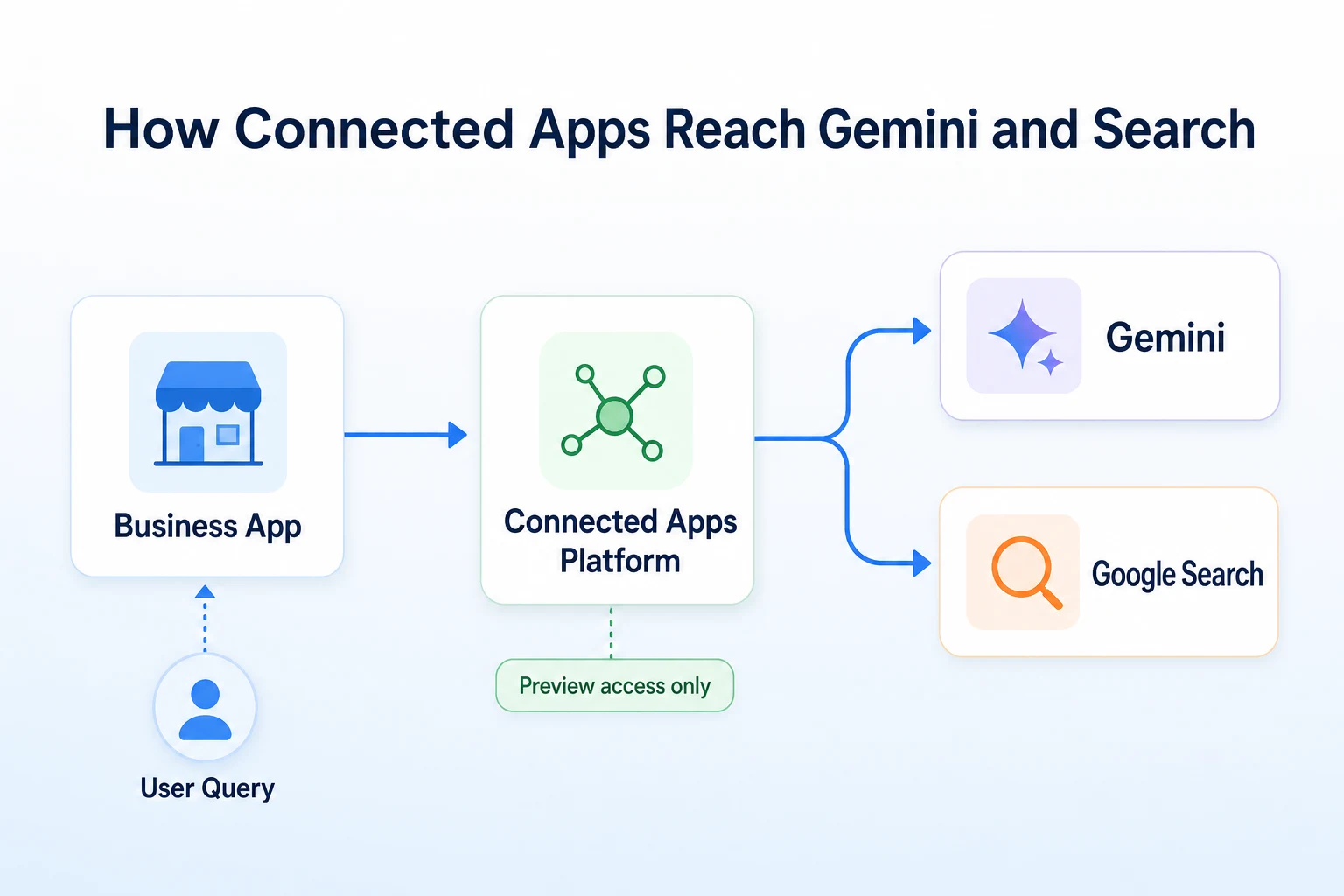
The connection layer Google described
Google described a connection layer that sits between a third-party app and Google's own systems, through which an app can register and grant access to specific types of its data. Rather than Google crawling or guessing at an app's content the way a search engine might crawl a public webpage, the connection is meant to work more directly, with an app owner choosing what gets shared and under what conditions. That's a meaningfully different setup from how Google typically finds and indexes a public website, since it depends on an app actively opting in and configuring the connection rather than on Google discovering content on its own.
Where connected app data can appear
Google said connected app data is intended to surface in two places: inside a Gemini conversation, where it could inform part of a generated answer, and inside Google Search, where it could appear alongside or within a search result. Google hasn't published a detailed breakdown of exactly which surfaces within Search or Gemini will show this data first, or whether every connected app's data appears the same way once it's linked. What's described is the general direction, not a fixed, documented format for how a given piece of connected data will look to a user.
Supported Partners and Categories in the Preview
A preview, by definition, doesn't include everyone. Google named a handful of categories as part of this early group, rather than opening the platform broadly.
Confirmed launch partners
Google described the preview as working with a limited set of partners across a few categories, rather than naming an open list that any developer could join immediately. The categories Google pointed to include reservation and booking apps, loyalty and rewards programs, and local service marketplaces, the kinds of apps where a user's question (is there a table free tonight, how many points do I have left, who's available nearby) maps fairly directly onto data an app already holds.
Categories most likely to benefit
Based on what Google described, categories where an app holds real-time, specific data tied to a common question seem the most natural early fit. A booking app that knows today's appointment slots, or a loyalty app that knows a specific account's balance, has a clearer, narrower kind of data to share than, say, a general content or media app with no single factual answer to surface.
Partner category | Kind of app | What's connected in the preview |
|---|---|---|
Reservations and bookings | Restaurant, salon or appointment scheduling apps | Availability data for a specific time or service |
Loyalty and rewards | Points or membership programs | Account-level balance or tier information |
Local service marketplaces | Apps connecting users with nearby service providers | Provider availability and basic listing details |
Review and reputation platforms | Apps that collect and display customer reviews | Aggregated review signals tied to a specific business |
Developer Access: Who Can Apply and How
For a developer or business outside the initial group Google worked with directly, the practical question is whether, and how, to request access.
What Google has said about applying
Google described a process for interested developers to express interest in the Connected Apps Platform, consistent with how the company has handled other preview-stage developer programs in the past. That typically means a request goes into a queue rather than access being granted immediately, and being accepted into a preview isn't the same as the platform going live for the general public. Google hasn't published a fixed timeline for how quickly a request moves from submitted to approved, so it's reasonable to expect that to vary.
What's still unclear about criteria
Google hasn't published a detailed, public list of criteria it uses to decide which developers or apps get access to the preview first. It isn't clear whether company size, existing integration with other Google developer products, or the category an app falls into plays the biggest role in that decision. Until Google says more, the safest assumption is that access during this stage is limited and somewhat selective, rather than a simple first-come, first-served queue open to any app that applies.
Preview Features vs Public Availability: What's the Difference
It's easy to read one announcement and assume a feature is either fully off or fully on. With a preview, it's neither.
What's live in the preview today
Right now, what's confirmed is limited to a small group of partners across the categories Google named: reservations, loyalty programs, local service marketplaces and review platforms. Within that group, an app can register with Google, configure which pieces of its data it's willing to share, and see that data appear inside Gemini or Search for at least some users. Google hasn't said this reaches every user of Gemini or Search, or that it works the same way across every connected app in the preview.
What Google says comes with public availability
Google described a broader rollout as the goal, with more partner categories, a more open developer application process, and presumably more consistent documentation once the platform moves past its early testing stage. It hasn't attached a date to that broader rollout, and it hasn't said which specific limitations from the preview, such as the narrow list of supported categories, will be lifted first. The table below separates what's documented at each stage, based on Google's own description of the announcement.
Aspect | Preview stage (confirmed) | Public availability (stated intent, no date) |
|---|---|---|
Who can connect an app | A limited set of named partner categories | A broader, more open developer base |
Where data appears | Some surfaces inside Gemini and Search | Described as expanding, format not detailed |
Application process | Expression of interest, selective | Expected to be more standardized |
Documentation | General description, limited technical detail | Expected to be fuller, not yet published |
The gap between these two columns is the whole story right now. A business reading the announcement should treat the right-hand column as Google's stated direction, not as something it can plan a launch around.
What This Could Mean for AI Discovery
The obvious question for a small business is whether connecting an app changes how often it gets surfaced in an AI-generated answer. Google hasn't answered that directly, but the shape of the announcement gives some honest boundaries to work with.
What's documented so far
Google has confirmed that connected app data is meant to appear inside Gemini conversations and Google Search results when it's relevant to a user's question. That's a real, if narrow, form of discovery: a business's live data showing up in response to a specific query, rather than a business's webpage simply being indexed and ranked the usual way. It's a different mechanism from the crawling and ranking process behind traditional search results, and different again from how an AI assistant might decide to mention a business in a generated answer without a direct data connection at all, a topic covered in our piece on how AI assistants decide which businesses to recommend.
What's still a prediction, not a fact
Whether connecting an app actually increases how often a business shows up in Gemini or Search, compared with not connecting at all, isn't something Google has published data on. It's reasonable to think that a direct data connection could make a business easier to surface for a narrow, relevant question, but reasonable isn't confirmed. The same caution applies here as in our guide to how to get mentioned in ChatGPT: no platform has published a formula for AI mentions, and nobody, including RepGet, can promise a specific outcome tied to this announcement.
A Worked Example: How a Local Business App Might Use This
This example is illustrative. It's meant to show how the pieces described above might fit together for a business that already has an app, not a guarantee of what any real business will see.
Imagine a regional chain of hair salons that runs its own booking app, used by a few thousand regular customers to check appointment slots and stylist availability. The app sits in the reservations category Google named as part of the preview. If the company applied and was accepted, it might configure the connection to share only its open appointment slots, nothing about individual customer records, and watch for that availability to appear when someone asks Gemini or searches for a haircut nearby with same-day openings.
What the example shows
Even in this illustrative case, the salon chain would still need to do the groundwork that has nothing to do with the Connected Apps Platform at all. Its own website would still need to load properly, its business listings would still need to be accurate, and its booking data would still need to be correct and current, since a connected feed showing wrong or outdated availability would be worse than no connection at all. The platform, if it worked as described, would add one more place that accurate data could surface. It wouldn't fix inaccurate data, and it wouldn't replace the basic technical and content work a business needs to get right regardless of whether it ever applies for access.
A 30-Day Plan to Evaluate the Connected Apps Platform for Your Business
A month is enough time to move from reading an announcement to making an informed decision about it, without rushing into an application before knowing whether it fits.
Week | Action | What to check before moving on |
|---|---|---|
Week 1: Research | Read Google's own announcement and note which partner categories and mechanics are actually confirmed | Whether your business or app realistically fits one of the named categories |
Week 2: Check readiness | Review your website and any app data for accuracy, using RepGet's free website audit and AI Crawler Checker to see what's already findable | Whether basic technical and content issues exist that would undercut a connection even if you got access |
Week 3: Apply or wait | Submit an expression of interest if your category fits, or set a reminder to check back once Google publishes more detail | Whether applying now adds anything beyond what fixing your existing site would already achieve |
Week 4: Review decision | Reassess based on any response from Google or any newer announcement | Whether to keep the application pending, resubmit, or focus effort elsewhere for now |
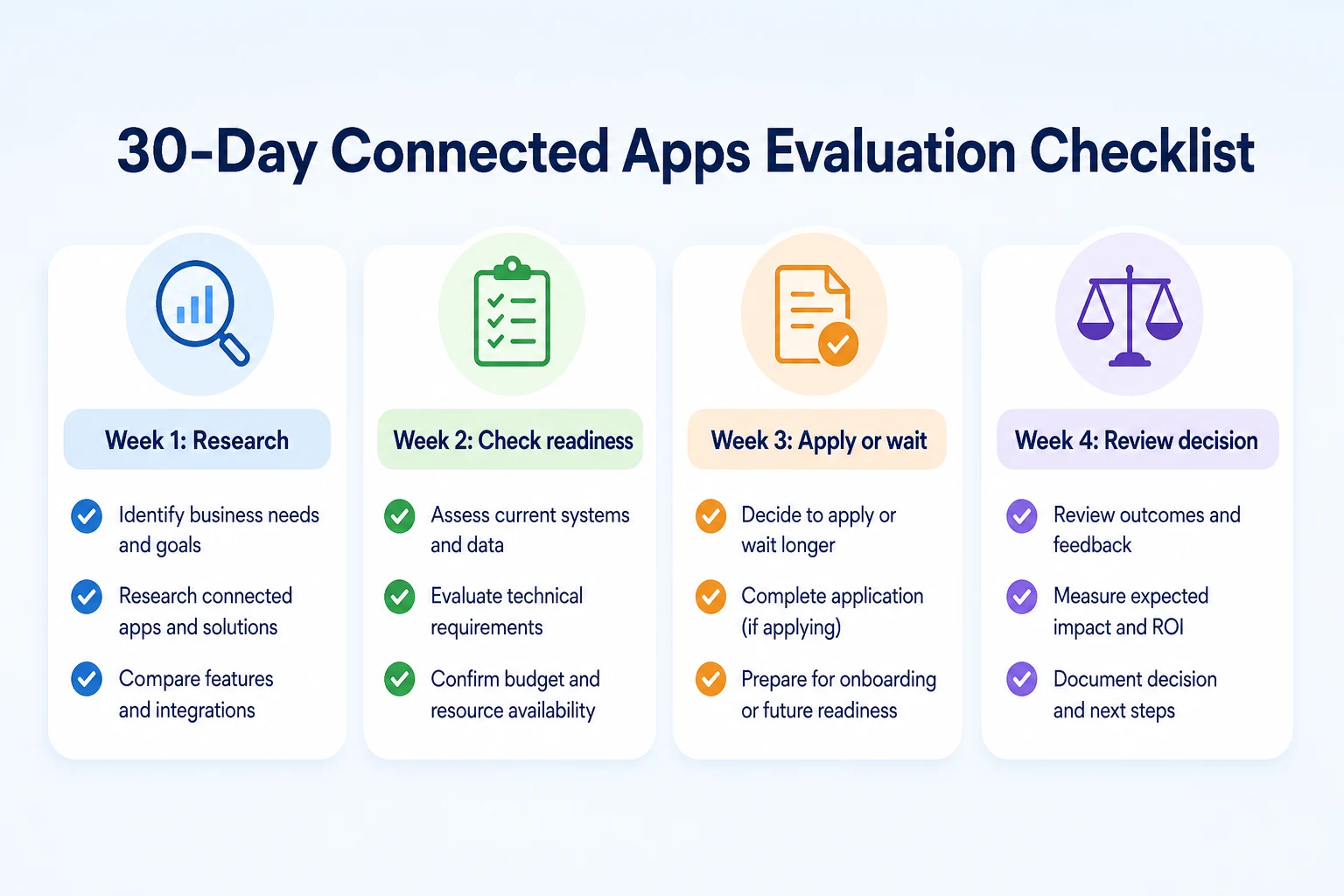
None of these four weeks depend on access being granted. A business can complete every step and come out the other end simply better informed, with a tidier website, whether or not Google ever responds to the application.
Common Mistakes to Avoid With a Preview-Stage Platform
A preview announcement tends to produce the same handful of overreactions, on Google's platforms and elsewhere. Most of them cost more than the announcement itself ever promised to fix.
Mistake | Why it backfires | Better move |
|---|---|---|
Assuming access is already open to everyone | Leads to wasted time configuring a connection for a program your app hasn't actually been accepted into | Confirm acceptance before building anything beyond the expression of interest |
Rebuilding an app's data structure around an unconfirmed format | Google hasn't published a fixed technical format, so early guesses may need to be redone later | Wait for published documentation before investing in a specific data structure |
Treating the preview as a ranking or visibility guarantee | Google hasn't published any data tying a connection to more frequent mentions or clicks | Treat a connection as one more channel to test, not a replacement for existing SEO work |
Ignoring basic site and listing accuracy while waiting for access | A connected feed built on inaccurate underlying data would be worse than no connection | Fix website and listing accuracy now, regardless of when or whether access arrives |
The pattern underneath most of these mistakes is the same one that shows up after almost any platform preview: reacting to what a company says it intends to build, rather than to what it has actually shipped and documented.
What Google Hasn't Said Yet
It's worth listing plainly what remains unconfirmed, since most of the confusion around a preview like this comes from filling in the gaps with assumptions rather than reading what's actually there.
Google hasn't published a date for when the Connected Apps Platform moves from preview to public availability. It hasn't said how many partners are currently connected, and it hasn't published a full, public list of every partner category under consideration beyond the ones named in the announcement. Anyone describing this as already open to any developer who wants in is going further than Google's own announcement supports.
Google also hasn't published pricing for using the platform, if any applies, and it hasn't said whether a connected app's data receives any kind of preferential treatment inside Gemini or Search compared with a business that isn't connected at all. It hasn't detailed the technical format a connection uses in enough depth for a developer to build against it without direct guidance from Google, and it hasn't said how quickly an expression of interest typically turns into actual access.
None of that means the announcement isn't real or isn't worth watching. It means the honest position is to treat October 28, 2026 as the date Google confirmed a direction, not the date it confirmed a finished, broadly available product.
Where RepGet fits
RepGet has no role in Google's Connected Apps Platform. It can't request developer access on a business's behalf, it can't configure a data connection to Gemini or Search, and nothing about this announcement runs through RepGet or any similar tool.
What RepGet can help with is the groundwork that matters regardless of whether a business ever applies for access, or whether the platform even reaches public availability on the timeline a business might hope for. A connected app, if and when it arrives, is still only as useful as the website and content sitting behind it. RepGet's free website audit crawls a site and gives it a 0 to 100 SEO score, flagging technical and content issues worth fixing before worrying about a feature that's still in preview. No account or credit card required.
For the narrower question of how visible a site already is to AI systems, RepGet's free AI Crawler Checker checks whether bots like Gemini's and Google's can actually reach a site's pages, and its free LLM HTML Visibility Checker checks how much of that page's text is readable once a crawler gets there. Neither tool has anything to do with the Connected Apps Platform specifically, but both answer a more basic question that applies whether or not that platform ever reaches a given business: can an AI system find and read what's already on the site today.
RepGet doesn't guarantee a business will be accepted into Google's preview, doesn't guarantee a mention inside Gemini or Search, and doesn't control any part of how Google chooses partners. What it can do is make sure the basics are in order while that decision plays out somewhere else entirely.
The bottom line
Google confirmed a real, dated announcement on October 28, 2026: a Connected Apps Platform preview that lets a limited set of partners connect app data to Gemini and Google Search. The categories named so far, reservations, loyalty programs, local service marketplaces and review platforms, suggest the kind of app most likely to benefit early is one with specific, current data tied to a common question.
What hasn't been confirmed matters just as much. Google hasn't published a public launch date, a full partner list, pricing, or any data showing that a connection changes how often a business gets surfaced. A preview is a limited, early-stage test, not a finished product, and treating it as one risks spending time on an application or a rebuild before there's enough published detail to act on with confidence. The steadier move is to research the category fit, check a site's existing readiness, apply if it genuinely applies, and keep the rest of the business's SEO work moving regardless of the outcome.
Find out what your website needs first
Run a free website audit with RepGet to see what your own site needs before deciding whether a preview-stage platform like this one is worth pursuing. No account or credit card required.
FAQ
What is Google's Connected Apps Platform?
It's a preview Google announced on October 28, 2026 that lets third-party apps, like booking or loyalty apps, connect specific data so it can appear inside Gemini conversations and Google Search results.
When did Google announce the Connected Apps Platform?
Google previewed the platform on October 28, 2026, describing it as an early-stage test with a limited set of partners rather than a finished, publicly available product.
Is the Connected Apps Platform available to all businesses?
No. Google named a small set of partner categories, including reservations, loyalty programs and local service marketplaces, and hasn't opened the preview to every developer or business yet.
How do I apply for developer access to Google's Connected Apps Platform?
Google described a process for submitting an expression of interest, similar to past developer previews, but hasn't published fixed criteria or a timeline for how requests get approved.
Does the Connected Apps Platform affect how my business shows up in Gemini?
It could, since connected data is meant to surface inside Gemini answers when relevant, but Google hasn't published any figures showing that a connection increases visibility compared with not connecting at all.
What's the difference between Google's preview and a public launch?
The preview includes a limited group of named partners with basic, early mechanics. Google says a broader, more open rollout is the goal but hasn't attached a date or confirmed what changes first.
Which apps can already connect through the preview?
Google named reservation and booking apps, loyalty and rewards programs, local service marketplaces and review platforms as the categories currently involved in the preview.
Will connecting my app to Google guarantee more visibility in AI search?
No. Google hasn't published data tying a connection to more frequent mentions or clicks, so any expectation of guaranteed visibility goes beyond what Google has actually confirmed.